-- From Pakse to Pakse, Bolaven Plateau
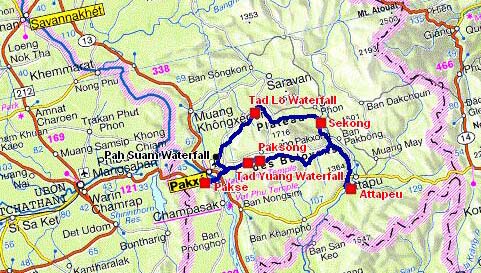
The road tracklog
From Pakse to Pakse
From 20/12 to25/12/2008
The 20/12 I left Pakse to do an excursion on the Bolaven Plateau which consisted to explore various waterfalls. It was a loop from Pakse to Pakse.
Bolaven Plateau
The Bolaven plateau bears its name from the ethnic group of Lavens of which it is the home. Of volcanic origin it has a very fertile ground moreover its situation in altitude gets a mild climate and well watered. At the beginning of the 20th century the French colonists tested the culture of the coffee-tree which, after many mistakes, was a success around 1930. During the second war of Indo-China it was a strategic stake between Vietminh and American army. The American bombardments destroyed cultures and made flee the last French colonists remaining after the seizure of power by Pathet Lao. The culture of the coffee-tree started again slowly around the Nineties.
At 33 kilometres away the Housay Champy River going down from eight meters high precipitates in a great din. The falls fit in a quadrilateral shape whose walls, probably basaltic, point out the “Giant’s causeway” in Northern Ireland. The site is agreeably arranged with a reconstitution of an ethnic village and a small museum in the communal house exhibiting some artefacts. Each house presents a handicraft activity. I lunched at the Uttayan Beachieng Resort from an excellent fish from the river.
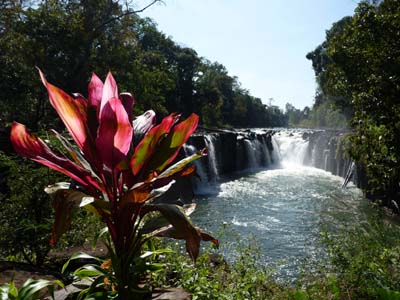
Pah Suam Waterfall
Houay Champy River
20/12/2008
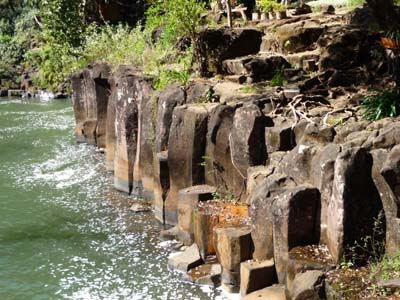
Basaltic wall!
Pah Suam Waterfall
20/12/2008
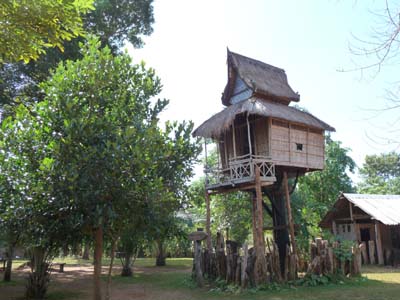
Ethnic village
Pah Suam Waterfall
20/12/2008
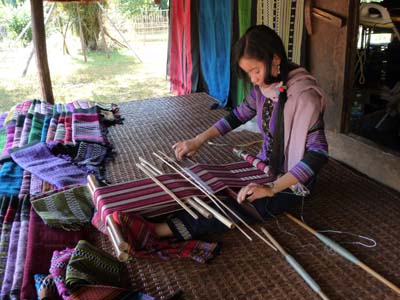
Ethnic village
Pah Suam Waterfall
20/12/2008
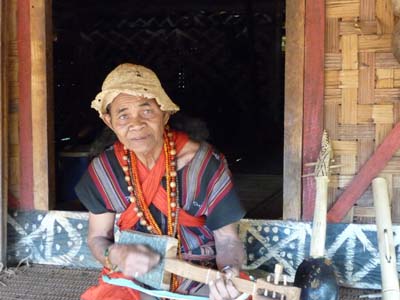
Ethnic village
Pah Suam Waterfall
20/12/2008
50 kilometres further in Ban Khoua Set several waterfalls are worth a detour in particular Tat Lo where I established my bivouac.
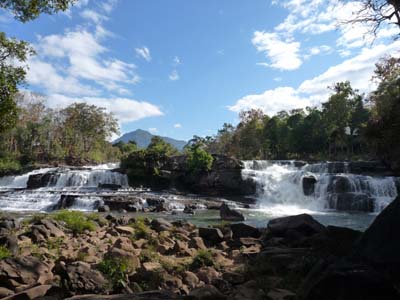
Tat Lo Waterfall
Ban Khoua Set
20/12/2008
The day of the 21 started with about thirty kilometres of a bumpy laterite track. Then the sealed road came back in Tha Taeng. After two controls of police in vernacular language, at the second a baksheesh was asked me which I refused to give while leaving, I arrived to have lunch in Sekong at the Pha Thip restaurant where I met François French owner of an art gallery in Vientiane. There is nothing to look at in Sekong. I establish my bivouac close to the market.
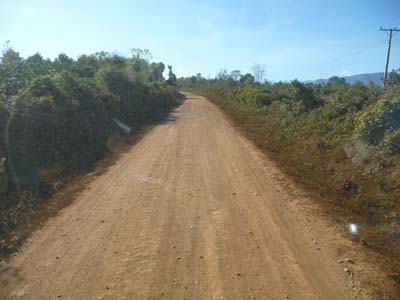
En route
to Tha Taeng
21/12/2008
The 22/12 I headed on road 16 towards the south in the Se Kong valley with cliffs of the Bolaven Plateau in the west. Landscapes are much contrasted, rice paddies along the river, waste equatorial lands at the foot of the plateau. The morning was resplendent of beauty, pure sky, haze on the plateau and low angle sun on the rice paddies. I arrived in Attapeu in the late morning in right time to pay a visit to Tourism Office which had neither booklet nor plan or map of the province. I went my way to visit this city which was a trading route as of the Chenla Empire. Alas consequence of the second war of Indo-China and the proximity of the Ho Chi Minh Trail, the city is recent, nothing to look at. I have there lunched then I looked for a bivouac at the edge of water, the river was inaccessible. I stopped on a ground besides the building of the International Red Cross.
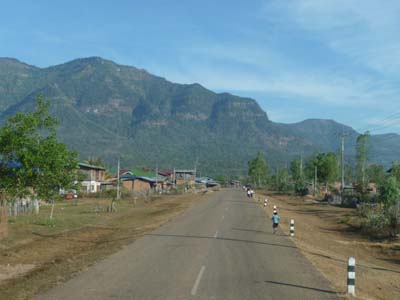
En route
Bolaven Plateau
22/12/2008
The 23/12 was a glorious day; starting from Ban Bengkhua Kham on road 16 I forked to take a laterite track climbing the Bolaven Plateau.
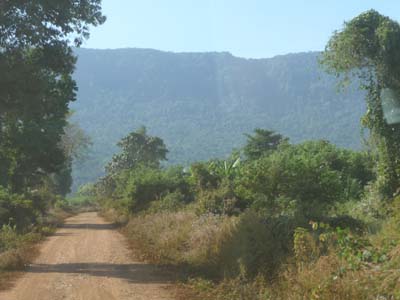
En route
to Paksong
23/12/2008
On the move I stopped at kilometre 16 to take a picture of a no-name fall; then two kilometres further on new stop to admire the splendid fall of Nam Tok Katamtok.
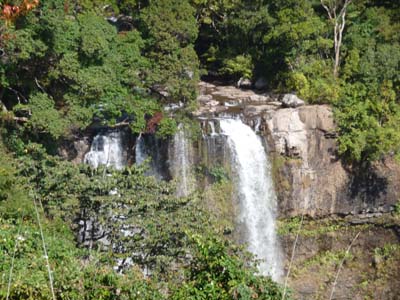
No-name fall
au Km 16 tos Paksong
23/12/2008
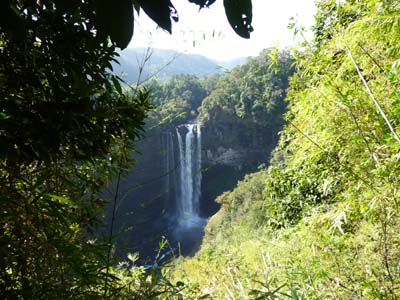
Nam Tok Katamtok
au km 18 tos Paksong
23/12/2008
The narrow track, fortunately I did not meet any vehicle, climbed up to 1300 meters of altitude where I looked at the first coffee-trees.
I arrived at Paksong, km 72, to have lunch. Then I visited the market abounding in products from bordering countries. The city true altitude station encouraged me to establish my bivouac there.
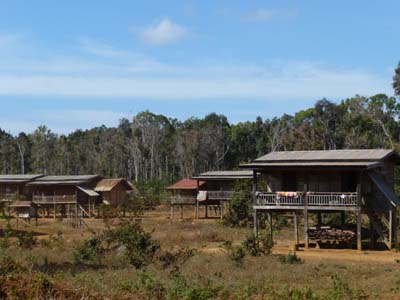
Lavens'
Home
to Paksong
23/12/2008
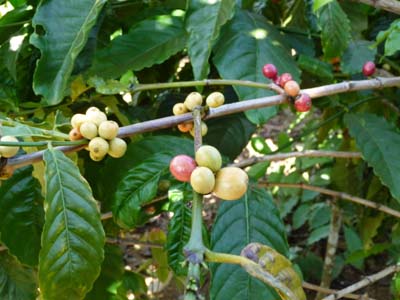
Coffee-tree
to Paksong
23/12/2008
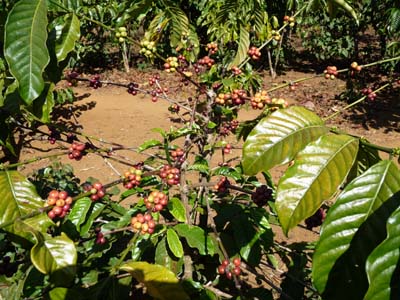
Coffee-tree
to Paksong
23/12/2008
The 24/12 I visited at kilometre40 the Tad Yuang Waterfall with 42 meters high. At kilometre38 the Tad Fane Waterfall is 120 meters high. At the end of the morning I drove back to Tad Yuang Waterfall to set up my bivouac.
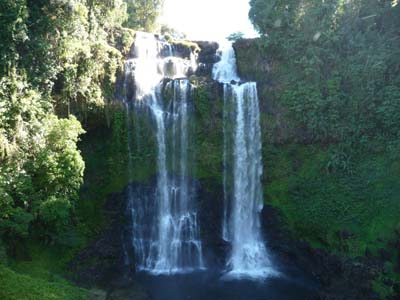
Tad Yuang Waterfall
route 23 Km 40
24/12/2008
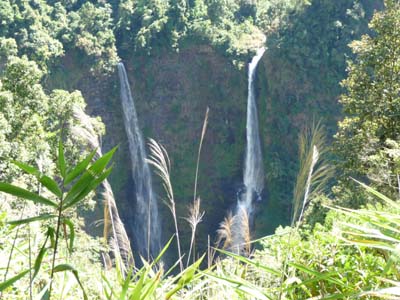
Tad Fane Waterfall
route 23 Km 38
24/12/2008
December 25 I was back in Pakse after a trip of 270 kilometres around and on
the Bolaven Plateau.
I began again its visit by visiting the Champasak Historical Heritage Museum to
look at mainly three Old Dong Bronze Drums back to the 7th century. Then I
made a detour to look for the Old French Houses. Finally I walked again to Wat
Luang to take a picture of the Monk’s School.
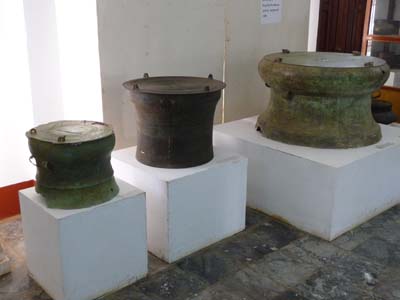
Champasak Historical Heritage Museum
Pakse
25/12/2008
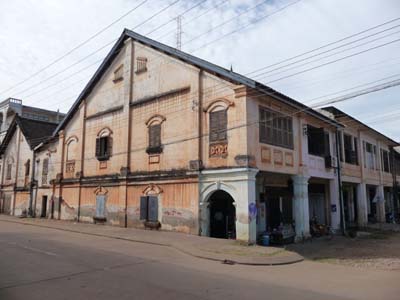
Old French Quater
Pakse
25/12/2008
