|
|
|
China |
 |
|
For the West,
China is this remote land closed a long time that the Romans called
"Sinae" by reference to silk.
The history of China is not the purpose of these pages. It is outlined
briefly.
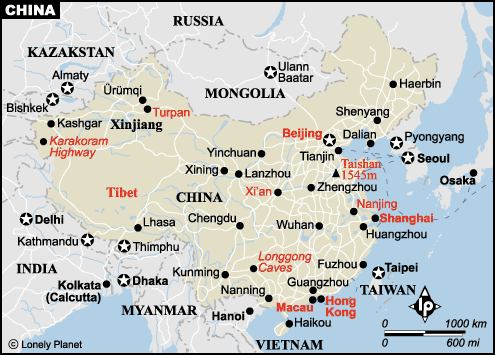
The geography is presented in large maps to locate the journeys.
China is known under the name of "Empire of the Middle".
The Chinese call it "Zhongguo" in pinyin transcription, the Land of the Middle.
Moreover, the Chinese recognize themselves as Han, as descendants of the Han dynasty
(206 BC, 220 AD) in opposition to Mongols, Manchus, Tibetans and other minorities. |
|
|
|
|
|
History |
|
Geography |
|
|
|
|
The history of the
Chinese space occupation is attested before the Neolithic era. The
first dynasties, Xia, Shang, Zhou reigned before
the first emperor Qin Shihuangdi (221-210 BC). Since, six great
dynasties have given emperors to China.
From 206 BC to 220 AD, the Han completed the installation of the
administrative system with the introduction of examinations. After
the Han fall, three Kingdoms shared the power, Wei, Shu,
Wu.
From 618 to 907, the Tang succeeded to the Sui (581-618) and reorganized
the administration. It was an era of economic and cultural prosperity. The arts showed it.
After the Tang fall, sixteen dynasties shared the territory.
From 960 to 1276, the Song inaugurated a period of technical and cultural revival.
But threats appeared on the borders with "barbaric" people.
From 1277 to 1368, the Yuan, a Mongolian dynasty, developed international relations,
Marco Polo's travels, embassies of the King of France and of the Pope.
From 1368 to 1644, the Ming, a Chinese dynasty, were despots and developed arts,
"blue and white" porcelains. They were corrupted by the Eunuch caste.
From 1644 to 1911, the Qing, a Manchu dynasty, underwent the Chinese nationalism
opposition in spite of undeniable economic success. They did not expect the arrival of
the Western powers, British, French, Japanese, Russians.
From 1911, October 10, 1910 the army revolted and the Republic was
proclaimed on the 01/01/1912. This movement brought a time of change
which developed with the Long March and led after World War II to the
foundation of the People's Republic of China in 1949. |
|
China has a complex shape that can be put in an almost perfect square of 5,500Km
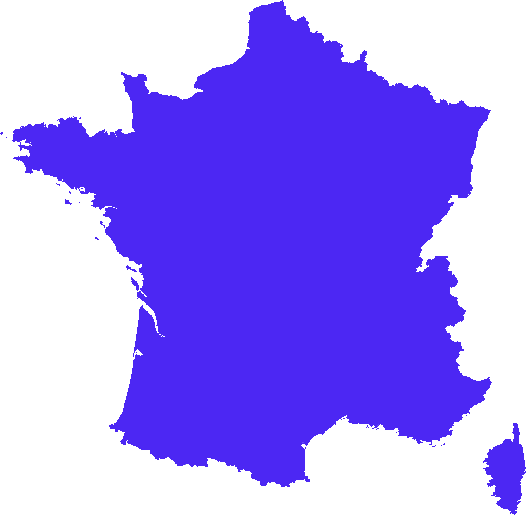
from west to east and 5,000Km from north to south. The area is 17 times as large as France.
It is divided into five large areas:
The Northern part is made up of steppes and plains which
are prolonged by Mongolia, territories of sheep and
horse stockbreeders living in yurts. The North-East is the flat rich
Manchuria plain which extends to Peking and the
Yellow River basin. It is mostly cereal crops and recently paddy
fields.
The Western part is the China desert and steppe area with in
the north Chinese Turkistan, Tianshan, and in the south the Kunlun
mountains and the Tibetan plateau.
The Southern part made up of three subsets. The karstic tables
of Yunnan, Guizhou and Guangxi offer dramatic sceneries around Guilin
and Lijiang river. It is a great tourist attraction. The meridional coasts
whose land end is the Hainan peninsula, are cut out and scattered with small
islands. The coastal plain with the Fujian and Ningbo is the tea plantation area.
The part from West to East is the Changjiang river middle basin and delta.
The plains of the middle basin with its two large lakes are called China's "two bowls
of rice". The delta, a rich marshy plain, ends by the great metropolis of Shanghai,
China's first harbour.
The part of the centre is Sichuan, a basin irrigated by
"four rivers" and the city of Chengdu.
China knows all type of weathers:
In the North, the climate is continental, in the Centre it is
continental with influences of the monsoon, in the South the climate is
tropical under influence of the monsoon. |
|
|
|
|
The Chinese landscape is as varied as its geography and its climatic
system. Irrigation, control of rivers are part of
the cultural inheritance of Chinese peasants, all the fertile soil is used
for cereals, rice and vegetables. The absence of cattle herd is balanced
by pig and the young wild boar large herds. Finally pisciculture is developed
considerably for the recycling of animal various waste. Chinese
peasants are artful.
|
|
|
|
|
Economic facts |
|
Civilization |
|
|
|
|
China is a major economic
power with which the Western must learn how to work.
Agriculture, China must feed 20% of the world
population on 7% of the planet's cultivable surface by employing 30% of
farmers on 15% of the Chinese territory. Productivity remains relatively
low and peasants must seek incomes from other productions.
>Mines, in this vast territory, mining
resources are enormous in of non-ferrous metals.
Energy, coal and oil are abundant though layers are very
dispersed.
Industry has been the subject of all the government's
attentions since the years 1950's. China has become a major actor in new technologies, too.
Services develop with transport and tourism which takes an
increasingly significant part.
The Chinese currency is the Yuan. |
|
The official name is
People's Republic of China whose capital is Beijing (Peking).
The population was 1,250 billion in the year 2000. The official
language of China is Putonghua (Mandarin dialect of Peking).
The population is made up of 93% of Chinese Han and 55
ethnic minorities.
In Asia the concept of poverty line is unsuited,
the GNP is of $3,600 per capita.
China has had a communist regime since the foundation
of the People's Republic of China on October 01, 1949.
Specialized books present Chinese art according to three axes:
- architecture, sculpture regarded as craft industry,
- ceramics, craft industry of the pottery and metals,
- art of the brush related to the writing, literature.
The Chinese are Confucians, Buddhists, Taoists and Moslems. |
|
|
|
|
China attracts tourists either for cultural activities by visiting
the archaeological centres or the monuments or for sports activities in
the west. At the time of a first contact the tourist is impressed by
the dimension of any thing, is disorientated by the difficulty to speak
with Chinese people, is subjugated by the value and artistic refinement.
|
|
|
|
|
Information of the traveller |
|
Sights |
|
|
|
|
A visa is necessary to
enter China. The individual journeys are not encouraged. They are made
difficult by the language, few Chinese speak English.
The vastness of the country, the diversity of the climates,
the selected season are as many parameters to be taken to define holiday conditions.
On the health plan it is recommended to consult specialized websites,
in France the website of the Foreign Office. For trekkers in the Himalayas
no particular precaution is advised.
The traveller's budget depends on his intentions, China offers
few opportunities for small budgets.
|
|
China it is also a
real ethnic, linguistic, cultural and religious mosaic.
Each area has its personality, and its centres of interests.
Several journeys will be necessary to appreciate this cultural diversity.
Sports activities are possible in all Chinese areas, trekking,
bicycle touring, caving, riding, skiing and ice-skating.
Two journeys were made: In 1982, the Silk Road and in 1988,
the South Road. A journey was made in Tibet in 1990, on Alexandra David-Neel's tracks. |
|
|
|
| Neuilly, le 2003/09/14 |
|
|
|
|
|
|