|
|
|
Ethiopia
|
 |
|
It is usual to say that
Ethiopia belongs to the horn of Africa. It is less known that it
is the only country in the area that was never colonized, even if a country tried
to settle there, at the end of 19th without
success, after many military vexations. Attempt reiterated in
1936 with the passive complicity of the Société des Nations proved quite as
vain in 1940. Thus its history is worth to be
told, even briefly and its geography presented and connecting with the origin
of humanity. The appearance of the
Hominides in this area does not seem fortuitous to the
palaeontologists. The skeleton of "Lucy" discovered
in Hadar
belongs to the family of the australopithecus afarensis which
goes back to 3,100,000 years. None of the species of this group can be
regarded as truly human. |
|
|
|
|
|
History |
|
Geography |
|
|
|
|
The name of Ethiopia
is one of oldest in the world, the country of the burnt faces in Semitic
"Habesha" which gave Abyssinia. The name covered a
different space in the course of time. In the antiquity it indicated
the lands south of Egypt. Then starting from the 4th
century BC it refers to the current geographical surface, the country
of Punt.
Its origins, between the 3rd and the 1millenium BC
must be found in the megalithism of
the south as well as in the kingdom of Axoum in the north. The site of Yeha,
5th century BC, is representative of the pre-axoumite
civilization appeared on the plateau of Tigray.
The empire of Axoum is said to have been founded in the 8th
century BC by following the meeting of the Queen of Sheba, Makeda,
and of Solomon, king de Juda. However Axoum is attested only starting
from the 3rd century BC. Mélénik I was the first sovereign
of Axoum by founding the salomonide dynasty which reigned
to 10th
century after being converted with Christianity in 4th AD.
This dynasty was replaced by the Zagwé which reigned until 1270 and
were replaced by an alleged descendant of the salomonides.
The 14th and 15th centuries are marked by
ceaseless fights with Moslem emirs, it is at that time that
the legend of the Priest Jean to help the Christian kingdom of Axoum.
In the second half of the 16th and the midddle of the 19th
century the court is settled in Gondar, on the abyssian plateau, a city
founded by king Fasilidas.
In 1889, Ménélik II proclaimed himself Negus Negast and founded the future
Addis Ababa capital. Ethiopia entered modern times. In 1926 Hailé
Sélassié "Negus" reigned until his tragic disappearance in
August 1975.
Troubled period settled in the country with colonel Mengistu
self-proclaimed Head of State then exiled in 1991 in Zimbabwe.
In 1994 democratic elections elected the representatives of the constituent
assembly which created the federal State in 1995. |
|
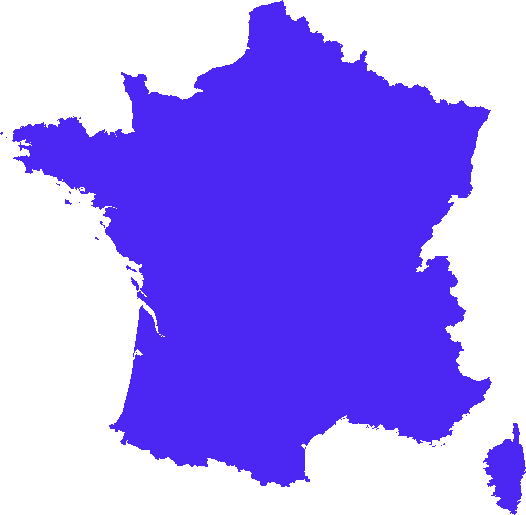
Ethiopia is a vast plateau twice as large as France. Equidistant of the
Equator and tropic of Cancer, it is crossed by many rivers and its
summits exceed 4000 meters. It is cut in deep canyons of 1,000 to 2,000 meters of
variation. A tectonic rift, Great Valley Rift,
directed north-eastern south-west, divides it into two.
The north-eastern end, in the shape of a funnel, constitutes the
depression of Afar. It is the assemblage point of the three
rifts, the East-African rift coming from Kenya, the rift of the Red Sea
and the rift of the gulf of Aden. The desert of Danakil is to
-120 meters below sea-level.
The centre of the rift is occupied by an alignment of lakes between
the linear structures of the edges of the two parts of the plateau.
The part north of the Valley Rift is occupied in the septentrional part
by the massif of Abyssinia, in the centre by the plateau of
Choa, in the south by the plateau of south-west. This unit presents
summits above 4,000 meters with mountainous landscapes, like the American west.
The part south of the Valley Rift it is made up of the plateau
of Harargué and the lowlands of south-east of Ogaden
towards Somalia.
Located at the south of the tropic of Cancer, the altitude and the
monsoon of the Indian Ocean characterize the climate of the area, in
lowlands the temperature is on average of 30°C and in highlands it is
of 5°C.
The vegetation is the resultant of the climatic conditions and from the
altitude of the area concerned, it is very varied.
The great richness of the fauna constitutes a true arch of Noah.
Instead of the first
hominids the palaeontologists prefer to speak of conservation of bones and
materials. In fact the climatic conditions
allowed this conservation like nowhere elsewhere.
As for "Lucy", the skeleton has only 52 bones, measures
approximately 1m30 and its sex is undefined!!!. |
|
|
|
|
Ethiopia is not the
cradle of humanity and "Lucy" is not our genetic Eve. On the other hand
the area was the migratory crossing point towards north by the isthmus
of Suez for the settlement of Eurasia. Thus the soil preserved
traces which the archaeologists collect and which the imagination of
the public transforms into myth via the media.
|
|
|
|
|
Economic facts |
|
Facts of civilization |
|
|
|
|
The economy of Ethiopia
is characterized by three components.
The principal resource, agricultural production, comes from the ground,
water and hydroelectric energy. The surface of the territory
consists of arable land 65% crossed by 14 rivers.
The livestock made up of bovines and caprines is the most important of
Africa. It is a matter of fact it was the origin of the constitution of the
richness of Negus Negast for ages.
The soil contains gold, natural gas, iron,
tin, lignite and potassium.
The gross national
product has a total value of +48% depending on agriculture, 10% of
industry and 4% of the craft industry. The remainder is represented by
services for 37%.
50%
of the exports come from coffee, the remainder is also of agricultural with
the ores.
The imports consist primarily in oil and the investments goods.
The deficit is financed mainly by private transfers and the
international assistance.
The Ethiopian currency
is the birr together with two official exchange rates compared
to the American dollar.
The rate of unemployment
in the cities is estimated by the international organizations at +40%.
|
|
The official name is
Republic of Ethiopia whose capital is Addis Ababa. The population is
+55 million inhabitants, for a GNP of $400 per capita. The
official language of Ethiopia is amharique. The rate of
literacy is 66%.
Ethiopia is a mosaic of
people gathering 80 ethnic groups speaking more than 290 languages.
They belong to the family of the Afro-Asian languages of which three of
the sub-groups are represented.
The couchitic languages among which afar and
oromo are spoken mainly in the rift and the afar depression.
The omotic languages among which karo and dassanetch
are spoken in the omo basin.
The Semitic languages whose amharique, guèze
and somali are spoken for the two first on the high plateau
in the north of the rift and the somali in Ogaden border with Somalia.
The Christian religion
was established in 4th century by the conversion of king Ezana.
The tradition reports that it is due to two Syrian missionaries,
Frumentios and Aidesios. Frumentios was named bishop by the
patriarch of Alexandria which considered Ethiopia as a diocese until
1959 when the first bishop of Ethiopian nationality was
named by Hailé Sélassié. Guèze is the liturgical language of
the Ethiopian church which follows the syriac rite
The majority of
Ethiopians is of Islamic religion. |
|
|
|
|
The majority of
Falachas lived in the province of Gondar. The
Moïse operation transferred them to Israel starting from the refugee
camps in Sudan at the end of 1984. The origin of the name comes from a
guèze root meaning "emigrant". Falachas called themselves Bétä
Esraél, i.e. the house of Israel. Their Ethiopian origin is attested,
they belong to the agäw ethnic group. On the other hand the origin of
their Judaism is controversial and no explanation is to date
satisfactory. |
|
|
|
|
Facts for the traveler |
|
Sights |
|
|
|
|
It is necessary to have
a visa on a passport to enter Ethiopia, valid passport three months after
the return in the country of origin.
On the health plan the
usual recommendations are sufficient for this type of country because
of the average altitude of the plates.
Ethiopia follows the
Julien calendar which began 7 years and 113 days after the beginning
of the Christian era. The year is divided into 12 lunar months and
one month of a five days (six days leap years).
The time lag with
France is two hours summer and winter. The hours
of the day is particular in Ethiopia. The day is divided into two times
twelve hours and zero hour corresponds to 6/18 hours of the watch.
Summer garments are
recommended as well as warm clothing for cold evenings.
You can buy objects of the local arts and crafts
|
|
The main holidays
are related to the syriaque Christian liturgy. In 2002 the festivals of
Timkat were celebrated on January 19. The processions are very
coloured, the officiants wear brocart and the congregation are in white.
The most interesting visits relate to the Christian churches, without
any restriction. They are remarkable in Lalibela, Axoum, Gondar, Bahar
Dar.
The national park of
Simien, which means north in amharic, is
located on the plateau at the north of the valley of the rift. Its
average altitude is 3,300 meters, the summit is
Dejen with 4,620 meters.
The park belongs to the world heritage of UNESCO and covers
a surface of 179 km2. It was created for the safeguard of three endemic
mammals of Ethiopia, the ibex walia, the jackal of Simien and the
baboon gelada.
Treks are possible in the park of Simien starting from the town of
Debrak. Nevertheless hikers will have to ensure their logistics
from Addis Ababa, the area being very poor.
The journey describes a part of the historical road of north at the time of the
festivals of Timkat in January 2002. |
|
|
|
| Neuilly, le 2003/05/23 |
|
|
|
|
|
|