|
The settlement of the area is attested as of the Neolithic era.
In the 6th millennium BC The mountains of Kurdistan are
among the oldest areas of humanity, a passage from hunting and
gathering to sedentary agriculture.
In the 5th millennium BC: The area saw the blossoming
of the El-Ubaid civilization whose painted ceramics spread in
all the Middle East as far as Egypt.
The history of Iraq is presented in large stages:
Ancient Mesopotamia:
In the 4th millennium BC: Cities-States appeared
in Ourouk, Kish and Lagash. They often made war as the
"Epic of Gilgamesh" and the "Stele of the Vultures"
testify. At that time appeared monumental architecture, the cylinder seal, the
wheel, the potter's wheel.
In the 3th millennium BC: Sargon founded the kingdom
of Sumer and Akkad. Then, nomads of Zagros broke on the kingdom and
Sumer was struck off History.
In the 2nd millennium BC: the Babylonian kingdom took
its rise with Hammurabi leaving to posterity the "Code of Laws".
The palaces got sumptuous: Nimrod, Khorsabad, Nineveh. The
decline came with the attacks from Hittites. The Assyrian kingdom
emerged with Salmanasar who reunified the area.
In the 1st Millennium BC: the Assyrian empire maintained
its power with violence but succumbed to the repeated blows of Medes and
gave up the rule to Persia's Cyrus II in 539 BC. In 331 BC, Alexander
the Great restored the country to order.
Seleucids, Parthians, Sassanians and Romans followed until
the Arab conquests in 632 AD.
Arab Iraq: The Abbasid empire (750-1258) set up its
capital in Baghdad relegating Syria to the level of a common province. The
Mongols threatened the area by causing the decline of the Empire which
they devastated in 1258.
Ottoman Iraq: Turcoman founded the Ottoman empire and
annexed Iraq in 1516. Allied to the Germans, the Ottomans were driven out
in 1918 by the English and the troops of the Emir Fayçal.
Iraq under the British Mandate (1920-1932): the
conference of San Remo confirmed the Sykes-Picot agreements by giving a
mandate to England to manage the area. Fayçal was thanked by receiving
the Kingdom of Iraq.
Independent Iraq: the coups d'etat followed one another
in 1958 and 1963 and finally ended with the arrival of Saddam Hussein to
power in 1968. The war with Iran, 1980-1988, Gulf War I, 1990-1991,
Gulf War II, 2003, destabilized the country.
The present history remains to be written: ? |
|
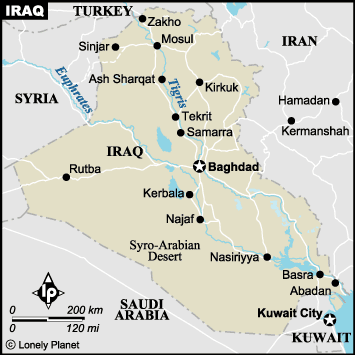
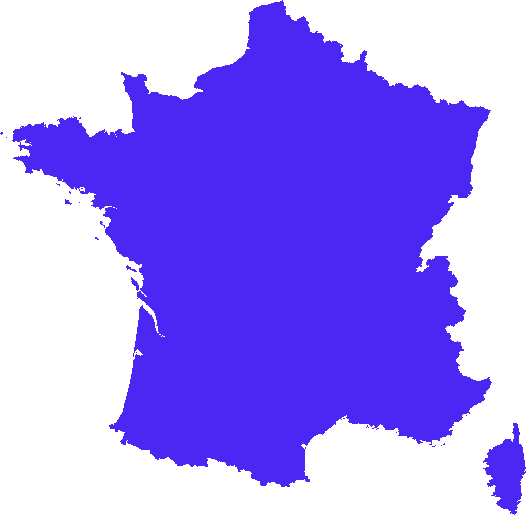
Iraq has a complex shape, its surface is equal to +79% that of France.
The borders of Iraq were fixed at the end of World War I in the north, Turkey,
in the west, Iran, in the South, Kuwait, in the south-west, Saudi Arabia and Jordan,
in the north-west, Syria.
A country was forgotten in this division: Kurdistan.
Iraq is presented in three large areas:
In the North-West: The Arabian peninsula is inserted under Zagros
creating a tectonic foreland, Iraqi Kurdistan. It is composed of a
mountainous part bordering to Iran with deep valleys and summits over +2,000 m
high culminating at 3,607 m high. The valleys are either suitable for farming
or grazing grounds of difficult access. The other part, the
plains of Mosul and Kirkuk are well watered.
In the centre: Mesopotamia, the Interval between two rivers, is a vast
alluvial plain, a corridor between the Tiger and Euphrates of an average
altitude of 65m. It is the prolongation of the "fertile crescent" to
the gulf of Shatt Al-Arab.
In the south and the west: The Arabian and Syrian desert is
made of the Hamad desert in the south and the Djezireh desert in the west.
Consequently on the climatic level, Iraq has a climate of the
Mediterranean type accentuated by its continental situation:
Zagros Piedmonts: The winter is cold and wet, rainfalls increase with
altitude to reach +1,000mm a year. The summer can be hot. It is 18% of the territory
Mesopotamia: The summer is long, dry and hot, +35°C.
Rainfalls are 100 to 200 mm a year. It is 22% of the area.
Steppe and desert: the rest of the country in the
south and south-west, 60% of the country, has rainfalls lower
than 100 mm a year and temperatures +40°C. |
|
Iraq's economy is developed enough. Iraq under the impulse of the Ba'ath
socialist party has developed heavy industry and armament. An oligarchy was
set up to control the economy.
Agriculture: The installations of the Tiger and Euphrates irrigation
canals have allowed the increase in agricultural production. However the
demographic pressure increases the dependence on foreign suppliers. Iraq
imports +70% of its food needs.
Mineral resources are appreciable. It has 11% of the world's hydrocarbon
reserves. The extraction cost is lower than that of Saudi Arabia!
Industry is well developed. The financial resources provided by oil have
made it possible to build refineries and chemical industries.
Trade is very difficult. Iraq has a very narrow maritime outlet. The harbour
installations are concentrated in Fao the only maritime frontage.
The currency unit is the Iraqi dinar. |
|
The official name is Republic of Iraq whose capital is Baghdad. The name of Iraq is
the Arabic pronunciation of the word Iran. The Iranian plateau was called Iraq Adjemi.
The population is +24 million inhabitants. It is very young, 47% are less than 15 years old.
The official language of Iraq is Arabic as well as Kurd and Armenian. The population
is 80% Arab (Semite), the rest is Kurdish (Indo-European).
Iraq is a popular republic with a single Baath party, socialist Arab party.
Iraqis are 55% Shiite Moslems, 40% Sunni Moslems, and 5% Christians. Islam has the
same origin as Judaism and Christianity. The adepts of these
three religions belong to the "people of the Book".
It is trite to say that hospitality is the corner stone of the Arab
culture. This tradition is the consequence of the hardness of the life
in the desert and the habits of the Bedouin tribes of accommodating
strangers by offering them water, food and the lodging.
The GNP is US$2,500 per capita. |
|
All tourists need visas to enter Iraq, available at the consulates
or in some cases at the arrival.
On the health plan it is recommended to consult specialized websites, in
France the website of the Ministry of Foreign Affairs. No particular precaution is
required, it is necessary to be up to date with one's usual vaccinations.
The budget of the traveller depends on his choices,
Iraq offers few opportunities for small budgets. |
|
The geographical
situation of Iraq, the climatic variety offer travellers multiple
possibilities of activity in the archaeological sites
as well as in the Zagros mountains.
They offer all opportunities to sportsmen. Sports activities are possible in
all the areas of Iraq, excursions, bicycling.
A package tour was made in Iraq in spring 1990. |