|
|
|
Ireland |
 |
|
Ireland is part of the mythical areas that every man should
visit. No visitor will ever forget Irish landscapes nor the people
whose ancestral combat for the conquest of national freedom is still
the topic of the day. Climatic conditions should not stop people from
visiting the Shamrock Island.
A land of refuge of the European elite during the dark days of
Saxon invasions in the Middle Ages, Irish monasteries were art
centres for scholars of the continent. The rich history of Ireland
is not the topic of these pages. It is outlined briefly to try to
understand its particularisms.
Ireland's insularity was a guarantee against invasions, except for the Vikings.
But it never could be a protection against the English with whom it maintains
troubled relationships. The geography of Ireland is presented in broad maps
to locate the journey.
|
|
|
|
|
|
History |
|
Geography |
|
|
|
|
The history of Ireland is presented in great phases.
Ancient Ireland: At dawn of prehistoric times, it was
populated by immigrants coming from the British Isles. The Celts
arrived from the Indo-European plain bringing the mastery of metal work.
Rome never invaded Ireland.
Christian Ireland: In 432, St Patrick evangelized the pagan Gaelic people.
In 800: The first Viking raiders, Norwegians, came
to plunder the monasteries located near the coasts.
In 914: The Vikings, Danes, settled on the coasts to
make trade. Some of them founded lines.
In 1014: At the battle of Clontarf, the Gaelic overcame and
drove out the Vikings definitively. King Brian Boru was killed during this battle.
English Ireland: In 1541: Henri VIII proclaimed himself king of Ireland.
The first English colonists settled in Ireland. Laws against the Catholics were promulgated.
From 1595 to 1601: The Nine-Year War, launched by O'Neill, to try to drive the English
out of Ireland devastated the country. It ended with the battle of Kinsale.
In 1649: Cromwell landed in Ireland, the oppression of the Irish
started with the dispossession of the land by the landowners, the Landlords.
In 1792: The Irish Parliament was inaugurated and was independent from
the British Parliament. It abrogated laws against Catholics.
In 1823: O'Connell founded the Catholic Association.
Independent Ireland: In 1829: The Act of Emancipation was voted
thanks to the obstinacy of O'Connell.
In 1914: The "Home Rule", the autonomy, was voted. It came into effect
only after the end of the First World War.
In 1921: The treaty of December 6 recognized the existence of a "Free
State of Ireland".
In 1949: April 14, the Irish Republic was proclaimed. The whole of
the Irish territory was not acquired. Six counties, Ulster, remain
joined to the Crown of England. |
|
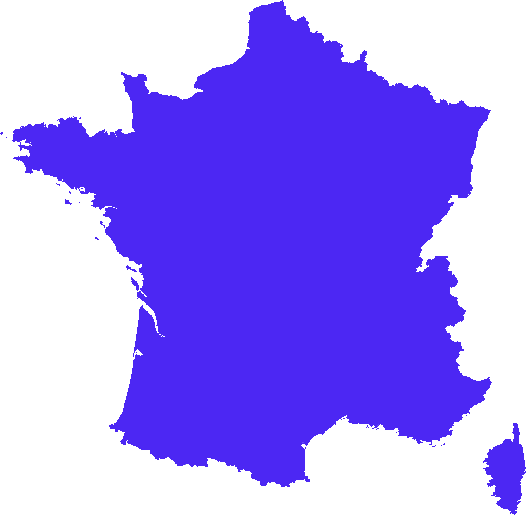
Ireland is an island whose surface is equal to 16% that of
France. It stretches 486Km from north to south and 375Km from west to east
with 3,172Km of coastline. It does not border any other country, except Ulster.
The relief can be presented in three areas:
In the centre, the plain has an average altitude lower than 150m
and it is partially bordered with mountains. It is crossed by rivers forming
many lakes in the lowlands. Some valleys dug by the glaciers end
in fjords, e.g. the bay of Killary Harbour in Mayo.
In the north, low altitude slows down the water run-off making
peat bogs which cover the mountains and make a typical landscape of moors.
In the south, the mountains border the Atlantic coast in
parallel folding. They rise gradually towards the west to reach the
top summit of Ireland at the Carrantuohill mount 1,041m high.
Consequently on the climatic level, Ireland has a particular climate
due to its maritime localization:
The winds coming from the Atlantic Ocean bring heavy precipitations
partly stopped by the mountains. The West coast is rainy
in any season, primarily drizzles. Whereas the East coast
has a climate relatively drier. The centre receives less precipitations.
The summer months, July and August, are pleasant with a temperature
varying from 14 to 16°C up to 20°C.
The winter months, from December to February, are particularly mild
with temperatures ranging between 4 to 7°C seldom going down to 0°C.
Precipitations are minimal in December and maximal in August. |
|
|
|
|
Little of native vegetation is left in Ireland. Heathers, moss and ferns
grow in peat bogs. Alpine flora, gentian, grow on the hills of Clare.
Mediterranean vegetation can be found in the south-west.
Mammals are represented by stag, marten, fox, badger,
squirrel and hare. Marine birds make many colonies
along the coasts, more particularly on the west coast. |
|
|
|
|
Economic facts |
|
Civilisation |
|
|
|
|
Ireland did not know industrial revolution unlike England
in the 18th century due to the lack of coal and iron.
Only the Belfast area developed textile industry and shipbuilding.
Ireland's economy (the Republic of Ireland) was described as "a Celtic Tiger" due
to the success of its policy of scientific education and
its infrastructure of communication with European funds.
Agriculture is 11,8% of the working population.
It remains a traditional sector of the island activity.
Mineral resources are non-existent.
Industry is developed 21% of the GDP employing 23% of the working population.
The education policy of the State was decisive. The sectors of
chemistry, pharmacy and new technologies are among the most powerful in
Europe. It became the first world producer of software. It is a centre
of téléservices in Europe.
Trade is important. Tourism is expanding.
The Irish currency is the Euro (€) |
|
The official name is Republic of Ireland whose capital is Dublin.
The population is +4 million inhabitants. The official language of Ireland
is English as well as Irish and Gaelic. The
population is 99% Irish, the rest is English!
The 26 Irish counties, Eire, constitute a democratic republic.
The 6 counties of Northern Ireland, Ulster, are part of UK.
Irishmen are 95% Catholics, 5% Protestants.
North Irishmen are 60% Protestants and 40% Catholics.
Folklore and legends have always been an essential part of the Irish culture
with historical narration and oral tradition. In Gaelic Ireland,
the poet was the guardian of knowledge and as such enjoyed a high statute in the society.
Irish literature has been recognized for its quality everywhere in the
world by Joyces's and O'Casey's works.
Medieval music was transmitted orally from generation to
generation. The harp (cláirseach) and the small harp
(cruit) are the main musical instruments.
The GNP is US$26.500 per capita. |
|
|
|
|
Historically, the Irish society has been shaped by religious
conflicts between Catholics and Protestants. The latter settled
in the North-East as of the 17th century. In 1921, the
British government divided the country into two parts.
The constitution of Ireland written in 1937 granted a particular
statute to the Catholic Church which was repealed in 1972.
Most Irishmen are Catholic and other religions grow irremediably
to the detriment of Protestantism.
|
|
|
|
|
Traveller's information |
|
Sights |
|
|
|
|
Nationals of the European Union and Western countries do not need visas
to enter Ireland.
On the health plan it is recommended to consult specialized websites,
in France the website of the Ministry of Foreign Affairs. No particular precaution
is needed, it is necessary to be up to date with one's usual vaccinations.
The traveller's budget depends on his choices, Ireland offers opportunities
for small budgets. |
|
The geographical situation of Ireland, its climatic variety offer
travellers multiple possibilities of activities in archaeological
sites as well as in the mountains or on the ragged western coasts.
Sports activities are possible in all areas, excursions, cycling,
surfing, fishing in river and diving on coasts.
In summer 1992, I made a tour in Ireland and in
Wales driving across
England. |
|
|
|
| Neuilly, le 2004/01/25 |
|
|
|
|
|
|