|
|
|
Jordan |
 |
|
Jordan, biblical ground, lost cities, epic of Lawrence of
Arabia, is the object of all phantasms and desires of
the powerful neighbours contained by the same religion.
Resulting from the Franco-British political game and a Hashemite prince ambition,
the recent creation of Jordan was fortuitous. The history
of Jordan is not the topic of these pages. It is outlined briefly.
A communication trail from the Nile valley to the Oronte valley, Jordan was
arabized when the Nabatean went out of their desert in the 6th century BC.
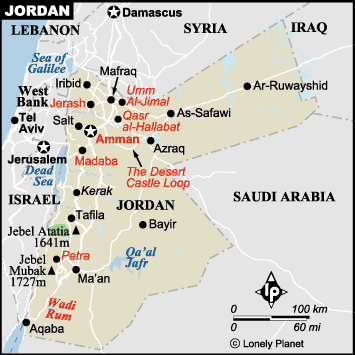
The geography of Jordan is presented in broad maps to
locate the journey.
|
|
|
|
|
|
History |
|
Geography |
|
|
|
|
The history of Jordan is
presented in large periods.
Ancient Jordan does not exist. Until the beginning of the 20th
century, it was part of Palestine including one large part that is
currently Israel. This area is one of the oldest civilizations of the world.
Archaeological excavations attest the origins of the settlement as of
9000 BC.
From 3000 to 1800 BC, the area was inhabited by Canaanites
and Amorites, then by the armies of Sargon, king of Akkad.
From 1800, Abraham led groups of nomads coming from Mesopotamia,
the city of Ur. They settled in the mountains of Canaan.
In 1023, the Jews founded a kingdom led by Saul then David. They
seized Jerusalem and made their capital of it.
In 63 BC, Rome seized Israel and placed it under the control of
Consuls, among whom Herod the Great and Pontius Pilate. It was at that
time that Jesus lived and preached.
In 331 AD, emperor Constantine converted himself to the
Christian religion. Since this time, Palestine has been covered by buildings to
mark the holy places.
In 638 AD, Jerusalem fell into the hands of Caliph Omar and
was declared Holy City of Islam due to the arrival of prophet
Mohamed on the mountain of the Temple.
From 1099 to 1291, the Christians mobilized themselves against
the profanation of the holy places. It was the time of the Crusades.
They occupied Jerusalem and established fortified towns on the coastal
strip from Antiochus. The Mameluks evicted the Crusaders from
Palestine.
From 1291 to 1520, Palestine had the calmest period of its
history.
From 1520 to the end of the First World War, the Ottoman empire
ruled the area. The desert became the field of the Bedouins.
Since 1918, Transjordan is under military control of the
United Kingdom which entrusted the administration to prince Abdullah.
In 1928, Transjordan was given a constitution by the British.
Since 1946, Transjordan has been an independent monarchy. Then it became
the Hashemite kingdom of Jordan in 1949 at the time of the proclamation
of king Abdallah. |
|
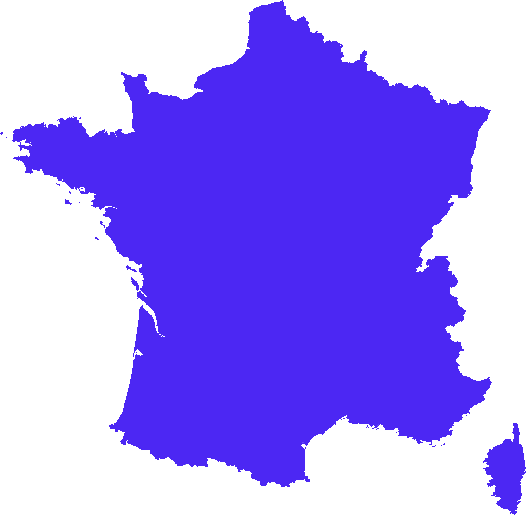
Jordan has the shape of a butterfly. The surface is equal to 17% that of
France and half of Syria.
It has borders with Syria in the north, with Iraq in the North-East,
with Saudi Arabia in the east and with Israel in the west.
It can be presented in four long strips of area, from west to east:
The Ghor, called "Araba", is a depression of negative altitude,
-394 meters deep constituting a long and narrow fertile plain.
Jebel, east of the Jordan, are a narrow mountainous
range culminating 1,586 meter high and cut off by spectacular gorges. They have
the only forests of Jordan.
The high plateau is in the east of the Jebel and limited by
the railway line on the western bank of the desert. This narrow band is the
area where cities set up.
The desert is located at the extreme east of Jordan beyond the
railway. They are the butterfly wings, the place of Bedouin wandering
tribes and of desert castles.
Consequently, on the climatic level, Jordan is characterized by four large
types of climates:
The Ghor has a temperature exceeding 38°C from spring until late October.
In winter, it does not go down below 8°C. The cultures are tropical.
Jebel have a climate of the Mediterranean type, summers
are hot and winters can bring snow.
The high plateau has very little rain. It looks like
a steppe with hot summers and mild winters.
The desert is characterized by precipitations lower than 100 mm
a year and temperatures +46°C. |
|
|
|
|
Jordan, the land of the Jordan river, is structured in three North-South
bands along the Ghor rift where the Jordan river flows. The
east border, beyond the railroad of Hedjaz, is purely artificial.
The first band confining to the Jordan river is cultivated and the flora is
Mediterranean. The second band is cut by gorges and covered by forests in
the north. The third band is the part where cities were established.
Without Palestinian refugees, Jordan is little populated. |
|
|
|
|
Economic facts |
|
Civilisation |
|
|
|
|
Jordan's economy is little developed. Jordan has an ambiguous economy, due to the
presence on its ground of a majority of Palestinian refugees. It remains
a transportation route of goods starting from the Aqaba harbour, either
by road or by railway.
Agriculture occupies the majority of the working population.
Mineral resources are appreciable. Phosphate as well as
hydrocarbons are produced.
Industry is developed little. It is especially present in the refining of
hydrocarbons.
Trade is very weak. It is primarily a south-north transit from the Aqaba
harbour and from east to west from Iraq and Saudi Arabia.
The Jordanian currency is the Jordanian dinar. |
|
The official name is Hashemite kingdom of Jordan whose capital is Amman. The
population is +5 million inhabitants. The official language of Jordan
is Arabic as well as English. The population is +90% Arab
(+60% Palestinian refugees), the remainder is Armenian and Circassians.
Jordan is a constitutional monarchy.
Jordanians are 96% Sunni Muslims, 4% Christians. Islam has the same origin as
Judaism and Christianity. The faithful of these three religions belong
to the "people of the Book".
It is trite to say that hospitality is the corner stone of Arab
culture. This tradition is the consequence of the hardness of the life
in the desert and the habits of the Bedouin tribes of accommodating
strangers by offering them water, food and lodging.
The GNP is U$3,500 per capita. |
|
|
|
|
Jordan is a Muslim land with all that comprises the cultural
plan, traditional music, arts and letters. It is necessary
however to mention the strong presence of the Bedouins who have preserved
their traditions of the desert.
Hospitality is the corner stone of "Arab Way
of Life", the Jordanian do not fail in this ancestral
tradition. On the contrary, they develop it in trouble time.
|
|
|
|
|
Traveller's information |
|
Sights |
|
|
|
|
All tourists need visas, available at the consulates or at the border. Valid two weeks, it
can be extended for a further three months.
On the health plan it is recommended to consult specialized websites, in
France the website of the Foreign Office. No particular precaution for
Jordan, it is necessary to be up to date with one's usual vaccinations.
The traveller's budget depends on his choices, Jordan offers opportunities for
small budgets. |
|
The geographical situation of Jordan, its climatic variety
offer travellers multiple possibilities of activity
particularly in the Petra and Wadi Rum archaeological sites.
They offer all opportunities to sportsmen. Sports activities are
possible in all areas of Jordan, excursions, diving in the Gulf
of Aqaba.
In spring 1989, a package tour was made in Jordan in connection with
Syria. |
|
|
|
| Neuilly, le 2003/11/16 |
|
|
|
|
|
|