|
|
|
Oman |
 |
|
Oman had always had friendly relations with its neighbours
It is a people of tradesmen who sometimes has integrated various ethnic groups
of immigration sometimes from remote lands. Visiting this country is a real pleasure
as one feels very safe.
The sultanate has had a remarkable stability since the
17th century even if incidents, troubles or socio-economic regressions
have sullied its history. The history of Oman is not the topic of these
pages. It is outlined briefly to put it in perspective with its neighbours.
The south-eastern horn of the Arabian peninsula is
shared peacefully between the United Arab Emirates and Oman.
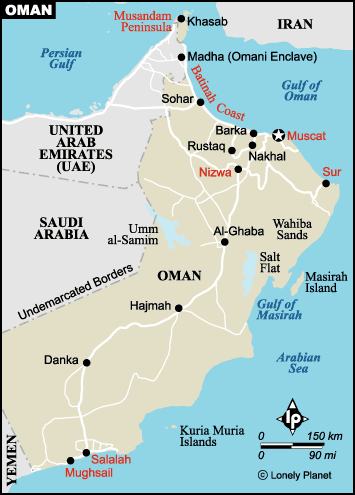
The geography of Oman is presented in broad maps to locate the journey. |
|
|
|
|
|
History |
|
Geography |
|
|
|
|
The origin of the name "Oman" is unknown. The history
of Oman is presented in large periods.
As of the 4th Millennium BC: The excavations of the site of
Ras al-Hamra in the North-West of Muscat gave evidence of a
human settlement by the artefacts found there, but no pottery was discovered.
In the 3rd Millennium BC: several sites were inventoried:
Bat, Ras al-Hadd and Samad al-Shan showing tombs of circular
shape built in stone blocks. The artefacts made it possible to date
these settlements towards 1800 BC.
In the 2nd Millennium BC: the archaeological sites of Mikhailif
and al-Waset on the Batinah coast excavated significant artefacts.
The site of Sohar shows the power of the Hormuz princes who built
fortifications to ensure the trade with India and China. It was
the time of the Magan empire on the Batinah coast.
In the 1st Millennium BC: the excavations of the Dhofar area
highlighted its importance in the trade of the frankincense westwards by
the "Frankincense route" as well as eastwards to reach the
country of Sumer. In 563 BC, the northern part of the territory was
incorporated into the Achaemenid empire.
In the first centuries of our era: the collapse of the Sheba kingdom
involved migrations of population, in particular, eastwards by the Hadhramawt
and Dhofar coast. Moreover the decline of the trade of frankincense helped
the extension of Islam in the 7th century AD.
In 1506, the Portuguese, very active in the South Seas, occupied
Oman for more than one century.
In 1650, Sultan bin Saif Imam expelled the Portuguese. This
victory was the beginning of a large economic and territorial expansion.
In 1744, the coming to power of Sultan Ahmad bin Said founded the dynasty
of Al Bu Said. At the end of the 18th century the Omanis controlled
a vast empire. At the beginning of the 19th century, the empire controlled Mombassa and
Zanzibar. Trading posts were set up on the southern coast of
Africa.
In 1913, when Sultan Faisal bin Turki died, some tribes did
not recognize the future Sultan and the country was divided.
In 1938, the new sultan, Said bin Taimur, acceded to power and reunified the country.
He turned Oman into a medieval anachronism.
In 1970, his son, Sultan Qaboos bin Said, took power
after a bloodless palace coup. The country entered modern
times. |
|
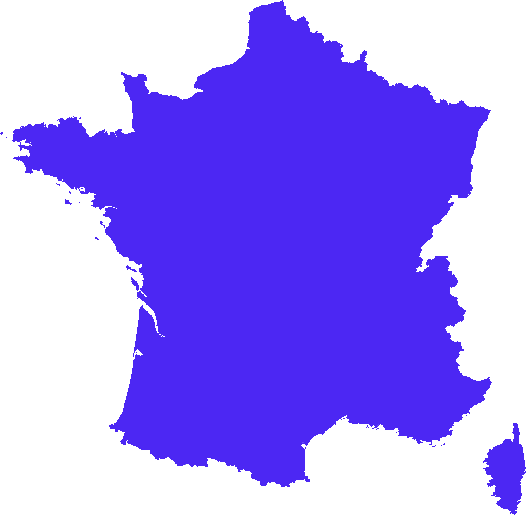
Oman is of complex shape, almost a quadrilateral. Its surface is
equal to 57% that of France.
It is bordered in the west by Saudi Arabia, in the north-west, by the
United Arab Emirates, in the north-east by the Gulf of Oman, in the
east by the Sea of Oman, in the south-west by Yemen. The border of desert
al-Rub' al-Khali with Saudi Arabia is vague, as for Yemen. The discovery
of oil could lead the two countries to fix it.
Two thirds of Oman are uninhabited.
Sutuated in the south-eastern horn from the Arabian peninsula to the strait
of Hormuz, the geography of Oman is presented in three large sets of areas:
In the north-east, the coast, Batinah coast,
is discontinuous to the strait of Hormuz, a part belongs to UAE and a
Madha enclave is located halfway of the respective borders.
This sandy plain is separated from the back land by the Hajar chain. The
highest summit is Jebel Akhdar ('green mountain') 2,980m high. The Musandam
peninsula in the extreme south-east of the Arabian horn is only 50Km far away
from Iran, strait of Hormuz.
In the south-east, the southernmost coast extends to the border with
Yemen on +900 km and gives on to the Sea of Oman. The landscape of the coast
is varied, ragged or flat with a sometimes rocky back land.
In the centre, the al-Rub' al-khali desert extends beyond the
coastal plains, it is inclined towards the east and Saudi Arabia. Two
areas include salt lakes, Umm al-Samim and Salt Flat.
This geographical diversity implies that Oman has a
large variety of climates.
Muscat the capital has a very hot and humid
climate from March to October, and mild from October at March. The
southernmost
Salalah gets the monsoon from June to September
and has a temperature approaching 30°C in December. |
|
|
|
|
The frankincense of Dhofar was transported either by sea from the harbour
of Salalah to Mukala, or by caravan road as far as Shabaw to be controlled
before being dispatched to Gaza.
Oman has one of the most rigorous governments for environmental policy.
The Sultan personally supervises the safeguard of the flora. The National
Protected Areas has establishments on the coast as well as in the interior
of the country. The protection of fauna is as strict. Reserves were
created to preserve some endanger species, the rare Arabian Oryx, giant sea
turtles, Arabian wolf and leopard and many others in the process of extinction.
Oman is really an idyllic country.
|
|
|
|
|
Economic facts |
|
Civilisation |
|
|
|
|
Oman's economy is
developed enough. Since the accession to the throne of Sultan Qabus,
the economy has been strongly modernized. Pakistani Immigration
is important.
Agriculture is 31% of the GDP with 33% of the
working population. Unlike many other Arab countries, Oman, since the land
reform of 1970, is no longer in a state of food dependence.
Mineral resources are appreciable. Hydrocarbons,
oil and gas, have allowed the modernization of the infrastructures of communication.
Industry is developed in petrochemistry and natural gas.
Trade is with Japan and South Korea. Tourism increases regularly.
The Omani currency is the riyal |
|
The official name is
Sultanate of Oman whose capital is Muscat. The population is
+2,5 million inhabitants. The official language of Oman is Arab
as well as English, Baluch, Farsi and Urdu. The population is
90% Arab, the rest is Asian and Baluch.
Oman is a kingdom. The visitors must remember that
it is prohibited to drink, eat and smoke in public.
Omanis are 75% Ibadite Moslems, Sunnite Muslims,
Shiite Muslims and Hindu. Omanis are very respectful of their religion.
Visitors, men and women, must wear correct clothing covering legs and
shoulders.
It is a common to say that hospitality is the corner
stone of Arab culture. This tradition is the consequence of the hardness
of life of the desert and the habits of the Bedouin tribes who offer
strangers water, food and lodging.
The GNP is U$7,900 per capita. |
|
|
|
|
Oman is of remarkably clean due to the government policy, which is as
rigorous for public behaviour. Having not visited the other countries
of the Gulf, I do not hesitate to say Oman is Switzerland of the Arabian horn.
The billboards praising the Muscat capital show it.
I noticed, once more, that Muslim countries do not have the culture
of sea sports. The beautiful sand beaches of the southernmost coast are
unfortunately or fortunately deserted. |
|
|
|
|
Traveller's information |
|
Sights |
|
|
|
|
All tourists need
visas to enter Oman, available at the consulates through agencies.
On the health plan it is recommended to consult
specialized websites, in France the website of the Foreign Office.
No particular precaution is needed, it is necessary to be up to date
with one's usual vaccinations.
The budget of the traveller depends on his choices,
Oman offers little opportunities for small budgets. |
|
The geographical situation
of Oman, its climatic variety offer travellers multiple possibilities of
activity on the coast as well as in the back land.
Sports activities are possible in all the areas of Oman,
excursions, desert motoring, bicycling and diving on the Oman sea coast.
I made a package tour in Oman in spring 1995. |
|
|
|
| Neuilly, le 2003/12/14 |
|
|
|
|
|
|