|
|
|
Réunion |
 |
|
Réunion Island is the largest of the Mascareignes islands. This
piece of France is more simply called "La Réunion". However,
its name followed the vicissitudes of national as well as international policy.
The history of
Réunion is not the purpose of these pages. It is outlined rapidly by its renaming.
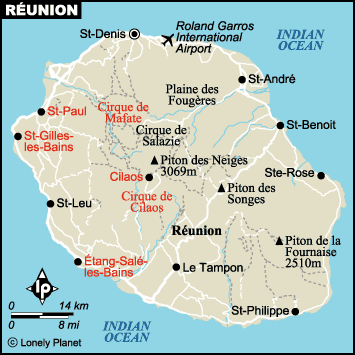
The geography is presented in broad maps to locate the journey.
Sometimes, tour
operators also call it "the Treasure Island", an
island in the Indian Ocean shaped by volcanic activity and compared with
the garden of Eden by the richness of the vegetation and the beauty
of the landscapes.
|
|
|
|
|
|
History |
|
Geography |
|
|
|
|
Until 1512, it is
attested that the island was never occupied.
In 1512, Pedro Mascarenhas, a Portuguese navigator, discovered the
archipelago of the islands which became Maurice, Réunion and Rodrigues.
From 1642 to 1649, the French Company of India established
a trading post. It took the name of Mascarin Island.
From 1649 to 1792, the settlement really started. Attached
directly to the crown of France, it took the name of Bourbon
Island.
From 1793 to 1806, the Revolutionists gave it the name of
Réunion Island, with strong symbolic value.
In 1806, the Empire being installed, it was necessary to change
the name, it became ... Bonaparte Island.
From 1810 to 1815, the British, victorious of the Empire wars, called it ...
Bourbon Island.
From 1815 to 1848, a return in the bosom of France, it kept the
name of Bourbon Island.
From 1848, the island was given again its name
of Réunion Island which it has kept.
The human, sociological, political and economic history is more
complex than the changes of its name.
The 20th century is marked by ups and dawns of the economy due
to the monoculture of sugar cane established by the British.
In 1946, the statute of French department made it profit from the
economic developments of la Métropole (mainland France, that is). |
|
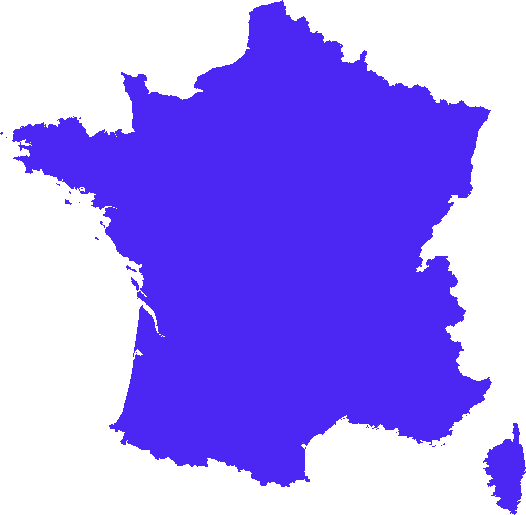
Réunion has the shape of a tortoise! The surface is 0,5%
that of France. The circumference of the ellipse is 207 km. It
stretches on 72 km from north to south and on 51 km from east to west.
In the Indian ocean in the southern hemisphere, it is about 800 km east
of Madagascar and roughly 220 km south-west of Mauritius.
It is divided into two volcanic massifs separated by high plains.
The North-West is occupied up to two thirds by a volcanic
massif. The highest peak is Piton des Neiges, 3,069m high. Three
enormous cirques surround it like the petals of a clover, Salazie,
Mafate, Cilaos. There are abrupt slopes from 800 to 1,200m
strongly tilted and shredded by gullies leaving between them "islets".
The erosion of the volcanic grounds is the consequence of the tropical
climate.
The South-east called by the navigators "Brûslé land",
consists in several extinct craters and the active volcano, Piton de la Fournaise,
2,613m high. Its eruptions, approximately every six years, are very spectacular.
The High plains and the valley plains separate the two mountainous massifs.
They are composed of the Plain of the Palmistes in the east and the Plain
of Cafres in the west.
Réunion is characterized by a tropical climate presenting a large variety due to
the mountains and the uneven relief. |
|
|
|
|
Located south of the equator in full tropical zone, Réunion
offers visitors a very contrasted landscape between the two
volcanic solid massifs as well as between the East coast, windward,
and the West coast, leeward.
|
|
|
|
|
Economic facts |
|
Civilisation |
|
|
|
|
Réunion's economy
has been completely unbalanced since the 2e Republic developed
the sugar cane culture in 1815 after the loss
of Mauritius, Seychelles and Rodrigues.
Agriculture is practically a sugar cane monoculture with +2 million
treated tons. There is also vanilla culture and
flower oil, geranium, vetiver, ylang-ylang. Breeding
provides 55% of the local milk consumption and 13,000 tons of meat.
Fishing is the fourth export product.
Mineral resources are non-existent, to date.
Industry is developed little, some handicraft.
Trade and services develop with tourism, 400,000 visitors a year.
The réunionnaise currency is the Euro, €. |
|
The official name is
Department of Réunion whose capital is St Denis.
The population is +72.000 inhabitants. The official Réunion language is
French but also Creole.
The population is made
up of Madagascans or Cafres and Europeans, Indians or
Indochinese and Europeans. The birth rate is 20‰.
Many poets were born in
Réunion, for example, Leconte de Lisle.
The GNP is USS8.000 per
capita. The rate of unemployment is very high, +35%.
The Island of
Réunion is a French department integrated into the French Republic.
Réunionnais are 70%
Catholics, then Hindus, Buddhists and Moslems. |
|
|
|
|
Réunion is especially known for its beaches of the West coast,
leeward, for its trekking inland with Piton des Neiges and Piton de la Fournaise.
No archaeological site exists. The settlement of the island is
posterior to its discovery in 1512.
|
|
|
|
|
Information of the traveller |
|
<Sights |
|
|
|
|
Visa requirements are
the same as for France.
Travellers should
not forget that this country is located in the southern hemisphere,
consequently the seasons are reversed. The dry season is from May to
September.
On the health plan it is
recommended to consult specialized Internet sites, in France the website
of the Foreign Ministry.
The budget of the
traveller depends on his choices, Réunion offers little
opportunity for small budgets. |
|
Réunion's geographical
situation, the climatic variety makes it possible to
offer travellers multiple possibilities of activity.
Natural parks are
many and offer all opportunities to travellers.
Sports activities
are possible in all the areas of Réunion, trekking, rafting, canyoning, swimming.>
A trek was made in the Réunion cirques, in 2000,
the trek of the Treasure Island. |
|
|
|
| Neuilly, le 2003/09/27 |
|
|
|
|
|
|