Report of the trip into Cambodia
The history of the three countries of
Indochina, Cambodia, Laos and Vietnam is inseparable from the history of
their colonization by France from 1847 to October 1953 then from the history
of the anticommunist struggle of USA until November 17, 1973. Afterwards each
country has its own history under the influence of outside contributors. The
Russian perestroika and the going- to-market China were not without asking
some problems to Marxists leaders of these countries; however the death of the
“old guard” incited to go towards the “market”. The next major step will be
the setting up of democracy by the emergence of a middle class.
I present this history by great periods omitting some facts which were
certainly decisive. I refer net surfers to specialized books. Some parts are
taken again by the conclusions of the three quoted countries.
Origins:
Habitation of the area is attested:
-- Far back as 50000 BC limestone dwell-caves were discovered,
-- As of 10000 BC Hoabinhian civilization is discovered in north of Vietnam
and on the plateau of Korat in central Thailand,
-- By 4200 BC the civilization of Ban Chiang and Ban Prasat in the North-East
of Thailand was the oldest to cultivate rice, well before Chinese, and to
produce bronze, better quality than Mesopotamia, thanks to the presence of
tin,
-- By 2000 BC the civilization of Dong Son appeared around what will be Hanoi,
-- From 3rd to 2nd century BC at the time of Asoka the area accepted Indianan
missionaries coming with merchants who diffused Buddhism of the school of
Theravada – Hinayana, lesser vehicle. It was the beginning of the
indianisation of the South-East Asia along the coasts towards South China.
This acculturation is attested by Buddhist sculptures of Gupta influence.
-- From 1st to 6th century AD the kingdom of Funan, Chinese name, extended
from Angkor Borei – current Takeo in Kampuchea to Oc-Eo in the Mekong delta
–current Long Xuyen in Vietnam-. These City-States adopted the Sanskrit as
liturgical language and developed a sophisticated system of channels both for
culture of rice and transport of goods.
-- From 6th to 15th century AD kingdoms called Chenla by Chinese succeeded
Funan and reigned in the north of the area having adopted the system of caste
of India. Chinese chronicles referred to “Water Chenlan” along the coasts and
“Land Chenlan” on banks of Mekong.
-- From 2nd to 15th century AD kingdom of Champa appeared on the coasts of
central Vietnam stretching from Danang to Dalat. Of Indian culture it adopted
Sanskrit and Indian art of Gupta influence. It was a warlike kingdom in
perpetual conflict with its neighbours, Vietnam in the north and Khmer in the
Mekong delta involving its disappearance.
As well as in Kampuchea and in Laos as in Vietnam powerful kingdoms succeeded
these Indianan City-States affirming their individualities.
-- As of 802 AD an inscription at Phnom Kulen mentions that Jayavarman II
proclaimed “King Universel” according to the Indian concept of “God King” –
Devaraja-. For historians he was the first king of Kampuchea and the beginning
of the flourishing period of the Empire of Angkor.
-- Until 1219 many kings followed one another with more or less of happiness
until Jayavarman VII who adopted Buddhism of the school of Mahayana.
-- From 1219 to the 15th century it was the period of decline of the Empire of
Angkor and its sack by the Thais in 1431 who annexed it with the area of
Battambang.
The decline of the Empire of Angkor proceeds, according to historians, from
two factors:
---- Overexploitation of the peasants for the construction of temples
involving the impoverishment of agriculture and the draining of the channels
by deforestation.
---- Rise to power of the states close to the west, Thais and to the east
Viets.
The site of Angkor was “rediscovered” in 1860 by Henri Mouhot although it was
never given up by monks and pilgrims.
-- From 1600 to 1863: The Thais controlled the area of Battambang and of Siem
Reap, and the Viets obtained the Mekong delta in compensation of their help
against the Thais!
-- In 1864: The French gunboat diplomacy involved the signature of a treaty of
protectorate by the King Norodom I consolidating his power with respect to his
neighbours.
-- In 1907 the same diplomacy with Siam allowed the return of Siem Reap and
Battambang to Cambodia and the provinces at the east of Mekong to Laos. France
had cherished the hope of the return of the plateau of Korat to Laos however
the First World War put an end to this project.
-- 1864 to the 9/11/1953 Cambodia was a French colony. But never France was
interested in the development both Cambodia and Laos regarding these two
countries as the hinterland of Vietnam.
During the Second World War and the occupation of the South-East Asia by
Japanese, France of Vichy by its policy of collaboration with the ‘Reich’ kept
the administration of Indo-China thus avoiding Japanese carnage.
-- on November 9, 1953 King Norodom Sihanouk proclaimed independence
recognized by the Conference of Geneva on May 1954.
-- From 1953 to 1970 Kingdom of Cambodia. The history of Cambodia was marked
until 2004 by the personality of Norodom Sihanouk who is presented as well
like a prototype of the politician survivor as a worthy successor of the “God
Kings” of Angkor.
-- From 1970 to 1975 Khmer Republic (Long Nol). The General Long Nol seized
the power in March 1970 by depositing Norodom Sihanouk. The régime is marked
by corruption, monopolization of the American funds and by the failure to
overcome the Khmer Rouges.
-- From 1975 to 1979 Democratic Kampuchea (Khmer Rouge). April 17, 1975 Phnom
Penh fell into the hands of the Khmer Rouges who instituted the bloodiest
régime of the history of humanity by the genocide of his own people.
-- From 1979 to 1989 The People's Republic of Kampuchea (under Vietnamese
administration). December 25, 1978 Vietnam launched the invasion of Cambodia
and installed a new government. It left Cambodia in September 1989 due to the
international pressure.
-- From 1989 to 1993 The State of Cambodia. The UNTAC, UN Transitional
Autority of Cambodia, managed Cambodia until the elections in 1993.
-- From 1993 at our days The Kingdom of Cambodia. May 25, 1993 was the first
free elections and in September 24 Norodom Sihanouk took again the title of
King, under the American pressure, “comeback kid”. October 7, 2004 King
Sihanouk abdicated for the profit of his Sihamoni’s son. King Sihanouk lives
in Beijing for health reasons, he was 86 years old in 2008.
Facts:
The History of the People of Southeast Asia is cruel, for them. Their
liberation intervened in the middle of the 20th century:
-- Singapore with its charismatic leader and Malaysia with the period known as
“Emergency” struggled the Marxism effectively. Thailand, in spite of fatal
student's insurrections, could wipe out Communism by the alternation of civil
and military power. Indo-China could not avoid this political adventure in
spite of two bloody wars.
-- Singapore whose only natural resource is its hard labour, Malaysia with its
natural resources and its religious “submission”, and Thailand educated in
Oxford and Buddhist became major economic powers. Indo-China still thwarted by
Marxist leading elite has difficulties to take off, in particular Laos.
-- Singapore, in Malaysia and in Thailand democracy is a tangible reality,
certainly with nuances. In Indo-China democracy remains a far-off future; let
us leave time to time, let us avoid an external intervention of “cow-boys”
directed by a “born again”.
Ideas of “intellectuals” are sometimes a calamity for people when they are
recovered with fine policies. They have a historical responsibility, moreover
Althusser in drew the conclusions.
Compared history of the countries of the South-East Asia would owe attracted
historians of any obedience: The Malaysian peninsula of British ex-colony,
Thailand never colonized and Indo-China French ex-colony.
Cambodia with a shape of an almost perfect quadrilateral, 580 km east-west and
450 km north-south, is a surface of the third of France for a population about
14 million inhabitants which is composed:
-- 90% Buddhist Khmer of the Theravada school
-- 10% Cham, Vietnamese, Chinese and minorities
---- About 400000 Moslem Cham
---- About 100000 Buddhist Vietnamese
---- Maybe 500000 Chinese practicing the Chinese trilogy
---- About 70000 minorities living in the mountains in the east, Ratanakiri,
Modulkiri,
--Originally the economy was directed towards the production and export,
rubber, timber and tin. Textile industry develops in Phnom Penh. Cambodia
receives about a million tourists a year.
But also:
-- Corruption remains a recurring problem.
-- Hygiene and access to the medicine are a real problem in rural areas.
-- Life expectancy is about 57 years.
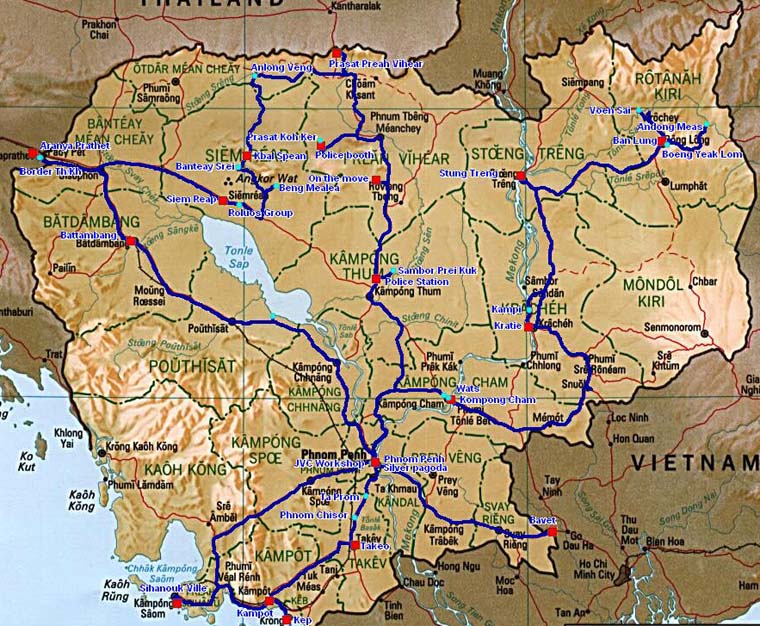
GPS tracklog of the trip in
Cambodia
I Team:
No change, MAN truck and its Guy driver.
II Journey:
The trip envisaged was done in two periods. The first one drove from the
Border of Thailand to Phnom Penh and back due to incident of the body. The
second period returned to Phnom Penh to continue towards the east and the
south of Cambodia.
2.1 the tour:
The first stay aimed to visit the historic sites of the Khmer culture with
strong point in Siem Reap then the district of Preah Vihear. It finished in
Phnom Penh close to the Royal Palace where I awaited a German technician to
carry out consolidation works on the body in order to return to Europe.
The second stay, nine months later, proceeded initially in the east of the
country by streaming up the Mekong River to visit Ratanakiri and Mondulkiri
and to discover the Minorities in these areas. Then I had rest on the coast of
the Gulf of Thailand in Sihanoukville.
2.2 The road network:
It was the best and the worst, the worst being the everyday life. Asphalted
roads and in good condition were rare: The NH5 from Sisophon to Phnom Penh,
NH4 from Phom Penh to Sihanoukville and others recently in the east of the
country.
2.3 Cambodian drivers:
On the roads traffic was not very busy; it was primarily made up with bus and
motor cycles, as in all the Southeast Asia. I did not meet erratic behaviours
as in India which is reference on the matter.
2.4 The insurance of the vehicle:
I did not have an insurance of the truck.
2.5 Various facts:
On nearly 5,000 kilometres I attended no road accident.
III bivouacs:
As everywhere else bivouacs were easy to find in open country or on coasts.
However downtown it was often a stroke of luck, as in Battambang and Phnom
Penh. I did not encounter any problem of safety; in the night I slept with the
open windows and the door to ventilate the cell. The temperature seldom went
down under 27°C.
The table of menu Campsite-position
gives waypoints of all my bivouacs as well as mileage between each stage.
IV Supplies of food:
As in the other countries I lunched on the move at “local truck-driver stalls”
or in the cities at “food stalls”. The “Day-markets” and the “Night-markets”
offered all essential foodstuffs; fruits were abundant.
In Phnom Penh there are supermarkets attended by the Westerners such as “Lucky
Supermarket” well supplied in products of French origin.
V Fluids:
Diesel is present in all service stations; of course the price moved up with
the rise of the rate of the barrel. Water is normally available in service
stations.
VI Money:
All banks have ATM accepting a Visa card, very often Master Card but seldom
AMEX. HSBC bank was not present at Cambodia.
VII Guides:
I never took of guide to visit sites. I had Lonely Planet.
VIII Passport, visa, border crossing:
One of the characteristics of the countries of the South-East Asia, except
Vietnam, is obtaining a VOA, visa one arrival. In Cambodia it is 90 days
duration with fee.
I had filled the Carnet de Passage en Douane at each trip.
The border crossing is described by the
Informations page
IX My appreciation:
9.1 I liked:
The discovery of the site of Angkor by bicycle was a great moment as
well as the old French Quarters in Battambang, Phnom Penh, Kampong Cham and
others. I must also mention the trip on my own to Voen Sai and Andong
Meas in Ratanakiri looking for Totems.
By all out large cities Cambodians were accessible and obliging, like the
director of Tourist Office in Takeo.
9.2 I hated:
Of course the state of the laterite tracks which
made the voyage painful and the abandon of the visit to Sen Monorom.
The use of the US Dollar which increases the prices for foreigners; the unit
of account was the note of one dollar.
X Relevance of this trip by camper:
To drive with a camper van in Cambodia requires a robust vehicle and still. I
made of them the expenses at my cost. I already mentioned that the road
network is mainly dirt roads. Admittedly investments by friendly countries,
China, gradually improve the state of the roads. It is necessary to be
patient.
XI Return trip to Thailand:
The return trip was the consequence of the breaking of the central fixation of
the cell of my truck. I embarked it in Singapore for going to the
manufacturer.
