-- From Puri to Hyderabad
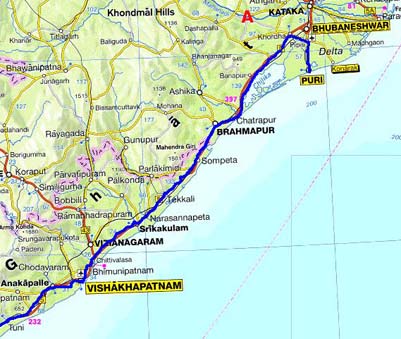
The road tracklog
from Puri to Tuni
the 03/01/2007
The 02/01 I decided to remain one day more in Puri to benefit from the beach, the sea and the restaurants to taste the fishthalis.
The 03/01 I left as of 07:00 to reach the entry of Visakhapatnam where I wished to withdraw money at the ATM of my HSBC bank, because the withdrawal is without commissions. I bivouacked on a service area at approximately 80 kilometres from the city.
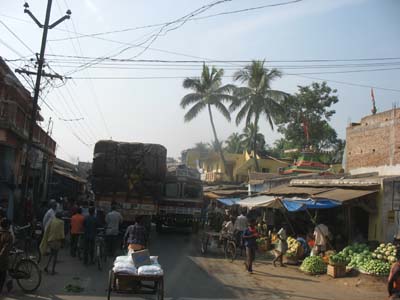
Crossing a village
towards Vishakhapatnam
the 03/01/2007
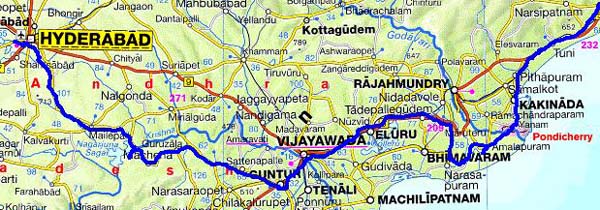
The road tracklog
from Tuni to Hyderabad
from 04/01/2007 to 08/01/2007
The 04/01 I arrived
around 08:20 in Visakhapatnam, modern city with broad avenues, where I
stationed close to a rickshaw which led me to HSBC ATM. I left the city about
09:00 and I stopped to have lunch in Tuni at a “A1” rstaurant . I
informed myself by the director to the road to go to Yanam, the old French
town of Yanaon, where I arrived around 16:30 to establish my bivouac at the
edge of the river where the vessels of the Indian Company anchored.
While walking at the edge of the river, I have the pleasant surprise to
meet a French speaking Indian with whom I discussed the history of the French
old towns. He regretted the absence of France in Yanam which does not preserve
any trace of our presence.
The monument, below, represents an emerging lingam out of a yoni.
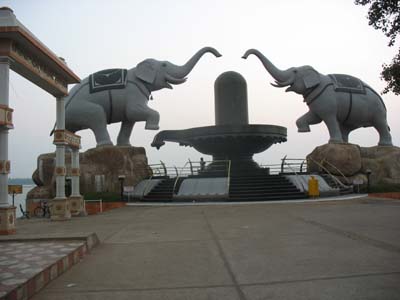
Sculpture
Yanam
the 04/01/2007
The 05/01 was a road day to go to Guntur by the NH5 before taking the road towards Macherla. To join the NH5 starting from Yanam, I should take secondary roads and to inform me by locals. The road tracklog shows mistakes. I stationed for the night at 21 kilometres from Guntur on a service area.
The 06/01
at the entry Guntur, I have the chance to inform me by a tourist bus driver
who drew me the plan to circumvent the city and to reach the road to Macherla.
During these days I practiced the secondary roads twice. I could observe
villages and population of the back country. Traffic required much attention
to cross trucks and buses close to various teams, on feet, by bicycles,
by oxcart, etc, as well as animals in transit, buffaloes, goats and others. More
surprising was to see children and teenagers to go to school, sometimes
distant, naked feet. I observed this situation on several occasions, it is
thus not single.
I arrived at the archaeological site of Anupu about 14:00. It is the
rebuilding of a site excavated in 1926 and flooded in 1960 by an artificial
lake, Nadarjuna Sagar, of a hydroelectric factory.
I found a bivouac on the plateau dominating the lake opposite of a cemetery, nothing
more resting. In any manner I was not importuned by locals. Consequently I
decided to spend Sunday there to prepare this page of my site.
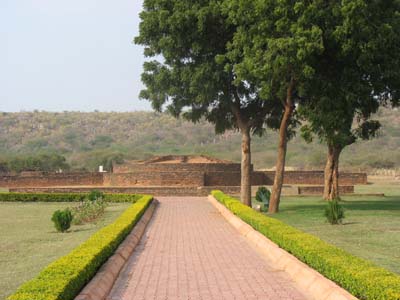
Archaeological site
Anupu
the 06/01/2007
The 07/01, I left my campsite vis-a-vis
the cemetery as of 07:00 to enter Hyderabad around 12:00. The afternoon was
dedicated to visit the Golconda Fort and the Necropolis of the Sultans Qutb
Shah.
Golconde occupied a privileged place in the imaginary of French and English
adventurers in 16th and 17th centuries. Indeed the most beautiful diamonds in
the world were extracted in the mines of Golconde, the Regent which decorated
the crown of Louis XV then the handle of the sword of Napoleon Ist and
the Koh-i-Noor which always forms part of the treasure of the crown of England.
The mausoleums of the sultans are imitations of mosque with bulbous domes.
Only the mausoleum of Ibrahim Qutb Shah preserved part of its enamelled
earthenware.
The bivouac was established at the foot of the wall of Golconda Fort and
Baradari.
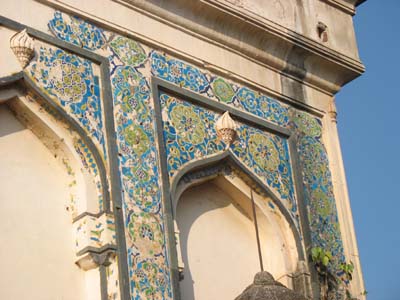
Faïence Ibrahim's mausoleum
Necropolis's Qutb Sahi
le 07/01/2007
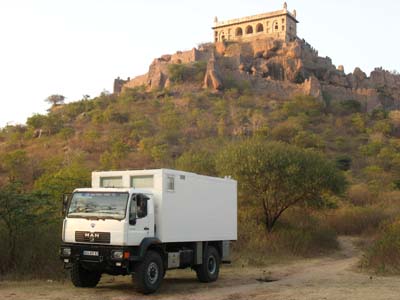
Campsite
Golconda Fort, the Baradari
the 07/01/2007
The objective of the following week was to cross the 600 kilometres towards Bangalore.