-- Ernakulam, Poomkudy FORCE garage
From the 05 to the 20/03, I remained in “Cochin Suburban Club” at less than one kilometre
from the Poomkudy FORCE garage where my truck was under repair. I spent the
majority of my time there to supervise the progress of the work. The critical
path was the supplying of some spare parts coming from the MAN-FORCE factory
in Pune located at approximately 1300 kilometres. They are manufactured in
India under MAN specifications. The most delicate repair was the replacement
of the compressor and the hoses of the air conditioning and the loading of the
R134a refrigerant. At the first test the hoses exploded. They were not in
conformity with the AC specifications.
Finally repairs were completed the
17/03. Alas I should wait the water radiator hoses until the 20/03.
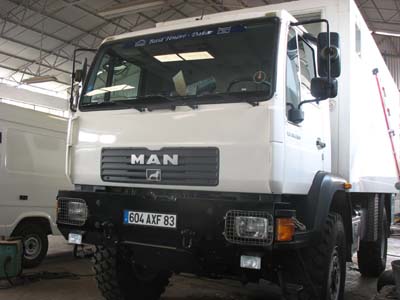
FORCE garage
Ernakulam
le 17/03/2007
The 21/03 I was again on the road to go towards the territory of Goa.
The sound landscape of India is worth to be presented. It takes part in the culture and the civilization of this country. Moreover it plunges its roots into the Vedas.
As well in cities as in countryside the first sound heard in India is the horn of buses.
It is strident with several tonalities. It is a pressing order to line up
a free lane. The horn of trucks has another tonality and is quite as imperative.
All the commercial vehicles painted at the rear: “Sound Horn”. Of course
private cars are not in remainder. Motorbikes are not the least quiet. Their
driver permanently uses the horn of two short blows.
The excessive use of the horn arises from the non observance of traffic rules in
spite of many panels of recall: “Obey Traffic Rules”. Indeed no vehicle
uses the turn lights and drivers never consult the rear view mirrors when they
exist.
The vehicles of intervention, police, firemen, ambulances, etc emit sounds quite
different from those in France. Moreover in Europe the sounds of these
vehicles are specific of each country. The European Union did not try to
standardize them.
In Bangalore staying at the CWC I was to a hundred meters from the KR Puram
Railway Station. Trains at the approach of the station and during all the
crossing ring a sound with a deep tonality. Indeed the railways are not
protected. Indian people cross them at any hour of the day and the night.
Traffic in cities very quickly becomes martyrdom. Sound pollution is the most unbearable
aggression.
One of the major aspects of India is the integration of arts. An artist is all at the
same time poet, painter, sculptor, musician and dancer. There is no musical
notation leaving the creativity of the artist free to express his emotions.
There are three types of music, the sacred music, Vedic, the classical music,
Raga, and the popular music, Carnatic.
It is not rare, at the turning of a temple to hear a sung artist being accompanied
himself with
an harmonium. Sometimes temples use an over boost sound system emitting a
shooting music for a Western ear.