-- From Bandung to Yogyakarta
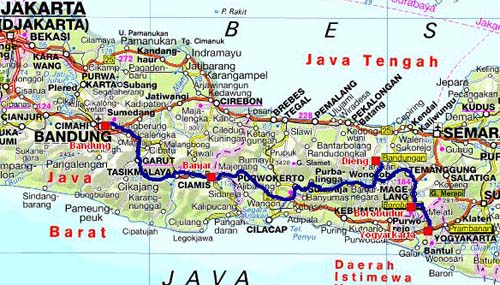
The road tracklog
from Bandung to Yogyakarta
from 06/07 to 10/07/2009
En route
I left Jalan Lengkong Kecil 38 as of early dawn expected that it would be long and difficult to leave Bandung, city of more than two million inhabitants. Of course the migratory direction was towards the city. The intensity of the traffic was a synthesis of India for the number of cars and of Vietnam for the number of motorbikes, it was little to say. Police was present at all crossroads without intervening in this jumble. With experiment, sometimes painful, patience and blow horn I successful to leave there without damage.
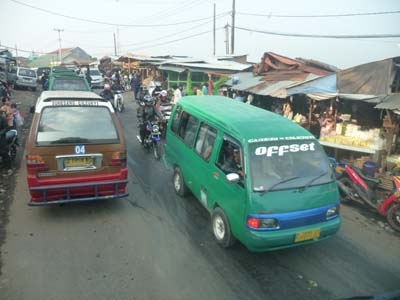
En route
Bandung
06/07/2009
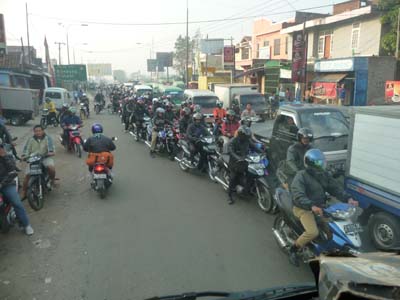
En route
Bandung
06/07/2009
The suburbs extend on tens of kilometres then the road curves in the mountains at an altitude of approximately 900 meters. By very where it is possible the pieces are irrigated in rice paddies.
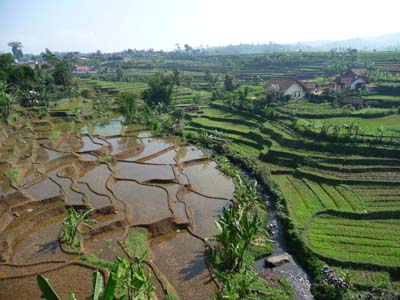
En route
towards Banjar
06/07/2009
Left early I stopped to have lunch in a well customer restaurant, vehicles stationed on the carpark. Before leaving my truck I went around it and I noted a flow of water under the cell. I expected a leakage at a water tank pump. I had lunched quickly then I was looking for a carpark which I found at a petrol station at the entry Banjar 177 kilometres away from Bandung. I inspected the room of the pumps under the false floor and I discovered that the filter of the pump n°1 was loosened; water ran out abundantly, the tank was at the three quarter empty. I tightened it then I sponged water. Water damage it was domestic damage as at home. I hoped that this incident is not recurring. I decided to bivouac on the spot.
Dieng Plateau
The 07/07 after seven driven hours for more than 240 kilometres I reached the “Plateau of Dieng” where the oldest ruins of Hindu temples in Indonesia are located dating back from 8th century AD. Dieng is the corruption of Sanskrit “Di-Hyang” meaning the residence of Gods. The site is in an dramatic landscape, a plain at 2085 meters of altitude GPS is surrounded by mountains of volcanic origin. It was discovered in 1856 by the archaeologist Van Kinsbergen. It is a local tourist resort very attended by young Indonesian people.
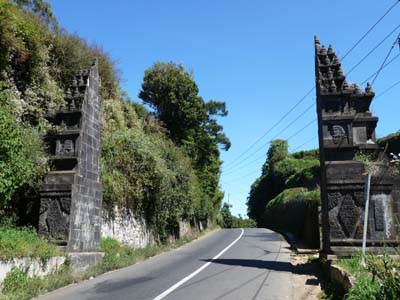
Dieng's gate
Dieng
08/07/2009
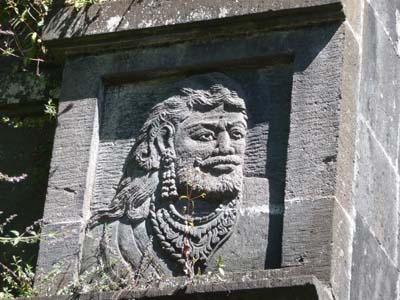
Effigy
Dieng
08/07/2009
The architecture of temples is stark, squat and boxlike. The Arjuna complex has five temples, Arjuna, Semar, Puntadewa, Srikandi and Sembadra; for each one I took pictures what seemed to me most characteristic.
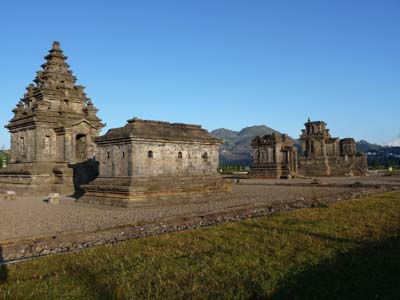
Arjuna complex
Dieng
07/07/2009
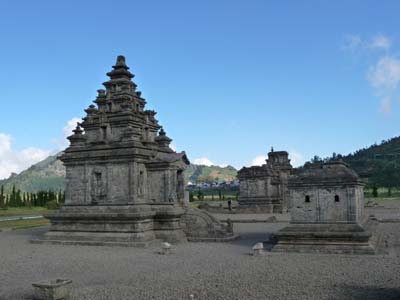
Candi Arjuna
Dieng
07/07/2009
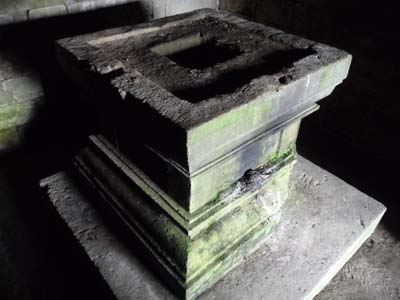
Candi Arjuna
Dieng
07/07/2009
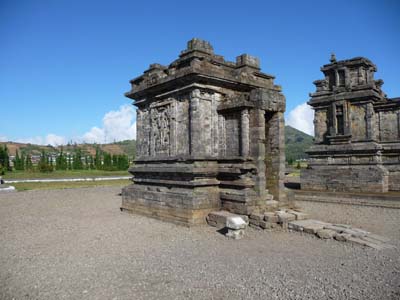
Candi Puntadewa
Dieng
07/07/2009
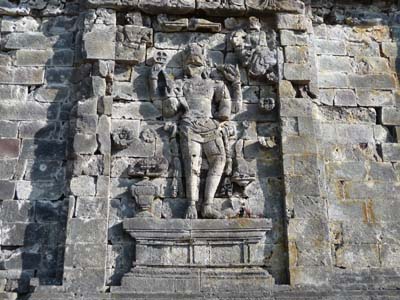
Candi Puntadewa
Dieng
07/07/2009
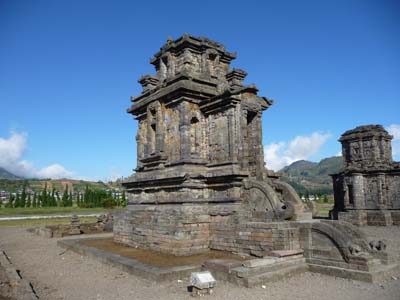
Candi Srikandi
Dieng
07/07/2009
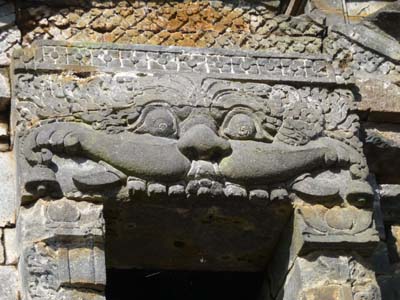
Candi Srikandi
Dieng
07/07/2009
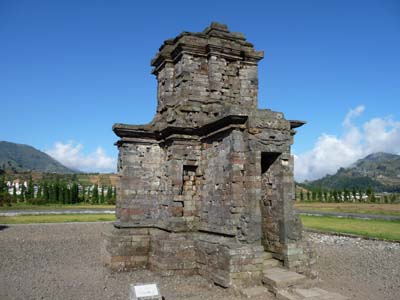
Candi Sembadra
Dieng
07/07/2009
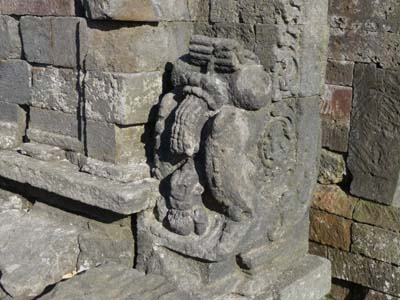
Candi Sembadra
Dieng
07/07/2009
At some distance by a paved trail the temple of Gatutkaca close to the museum.
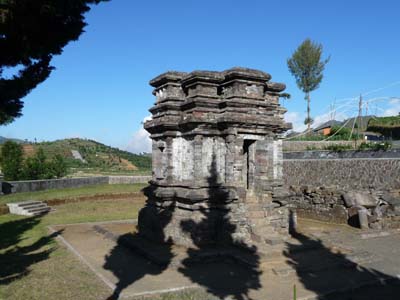
Candi Gatutkaca
Dieng
07/07/2009
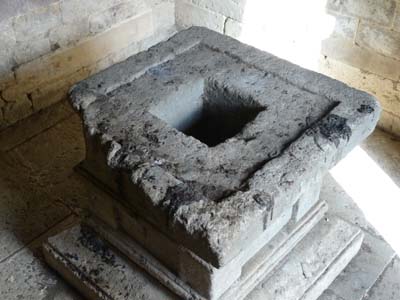
Candi Gatutkaca
Dieng
07/07/2009
At approximately one kilometre by an asphalt road the Bima temple of which the higher part is carved, Kudu.
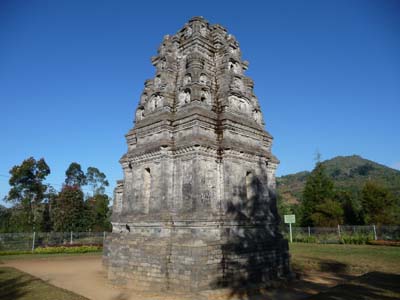
Candi Bima
Dieng
07/07/2009
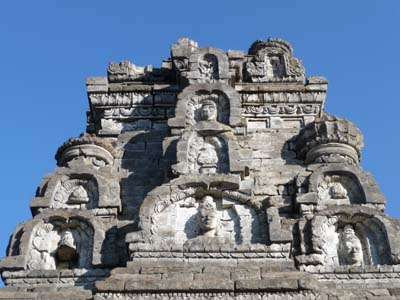
Candi Bima, Kudu
Dieng
07/07/2009
The museum exhibts objects coming from temples, statues, fries, lintels and of course the symbol of Shiva, Lingam in its Yoni. Splendid boards expose the architectural concepts. Alas all labels and comments are in Malay language.
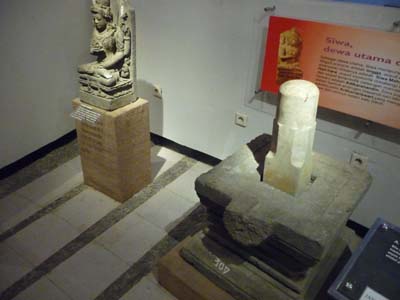
Museum
Dieng
07/07/2009
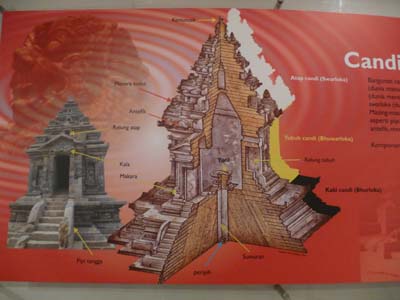
Museum
Dieng
07/07/2009
The second day in Dieng
The following day after the service of my truck I left in excursion for a walk suggested by Lp. It was initially the temple of Dwarwati in hillside. It is surrounded by potato fields.
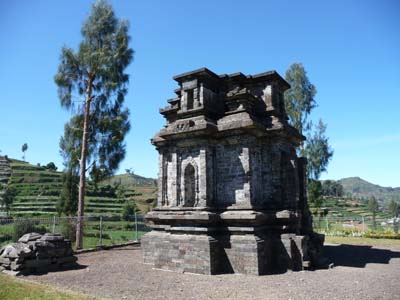
Candi Dwarwati
Dieng
08/07/2009
At the entry of Dieng close to the gate the basin of ablutions is which would have been a holy place.
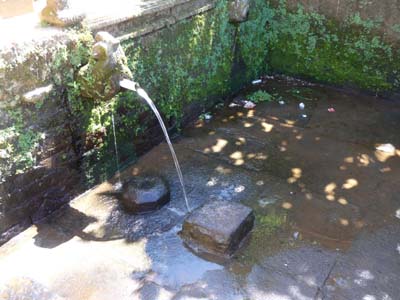
Bimo Lukar
Dieng
08/07/2009
Then I went to visit some natural sights. Telaga Warna is a lake with turquoise water whose accesses are covered with sulphur releasing odour suis generis. Further on the cave Gua Semar was closed. By following a paved track in the mountain I arrived at “Dieng Plateau Theatre” which projects an exceptional film on the site.
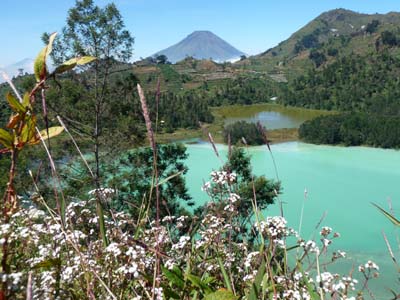
Telaga Warna
Dieng
08/07/2009
Finally I went in Kawah Sikidang, crater of sulphurous mud.
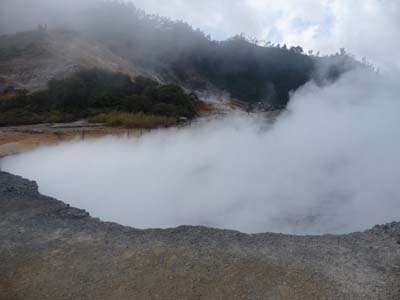
Kawah Sikidang
Dieng
08/07/2009
This pedestrian trip made me farmers met in their fields which greeted me by a large smile accompanied by “Hello Mister”. The plain is surrounded by medium mountains whose sides are cultivated out of potatoes and other market gardeners. On the ways I discovered many bags of manure coming either from the hen houses or from the wallows of pigs.
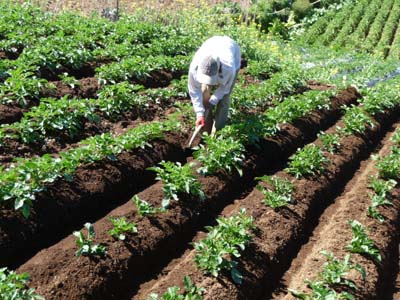
Hoeing of potatoes
Dieng
08/07/2009
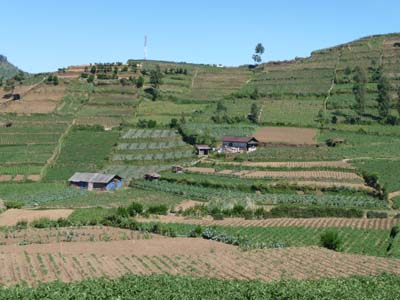
Farming landscape
Dieng
08/07/2009
The site is remarkable by its serenity and its quietude; alas it is regularly disturbed by the thundering calls to the prayer of three or four surrounding mosques. It was improper in this historical place of old Hindu culture. Islam is not tolerant, it is conqueror; it is not democratic, it is totalitarian. Moreover Sultanates and Islamic Republics support an orthodox Islam and apply the charia to consolidate their hegemony. Despite everything I did not see a peasant abandoned his hoe to do his prayer or young people by motorbike stopped to do it. Evolution towards a laicization is moving on, leave time to time.
Borobudur
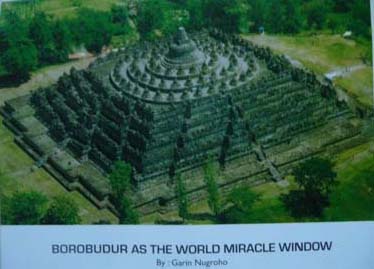
Borobudur was built by the Buddhist dynasty Syailendra from 750 to 850 AD. The name is made of two words; Boro coming from the Sanskrit Byara means temple and Budur coming from the Balinese Beduhur means above the mountain. It was abandoned shortly after its completion without the reasons of its origin being known. It was rediscovered under the government of Samford Raffles. It undergoes two restorations, the first from 1907 to 1911 by the Dutch then from 1973 to 1983 by UNESCO. It was registered with the world inheritance in 1991.
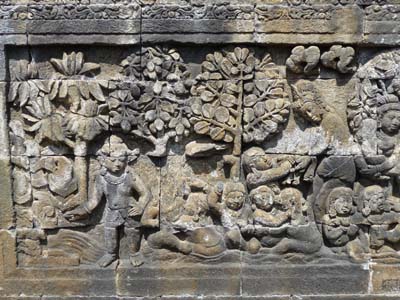
Its shape corresponds to the mandala, representation of cosmos according to the vision of the Vajrayana sect, Vehicle of Diamond, or Tantric Buddhism of Tibet. It is a quadrilateral of 118x118 meters with six terraces with carved panels of the Buddhist canon.
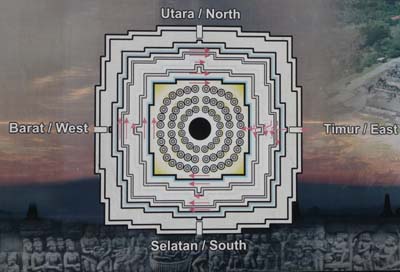
Mandala
Borobudur
09/07/2009
Mandala
Borobudur
09/07/2009
Borobudur
09/07/2009
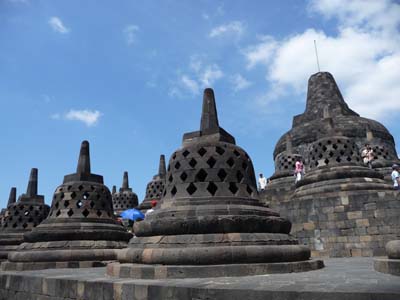
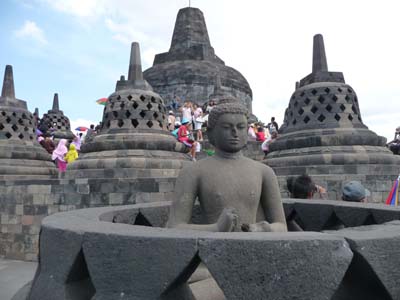
Then three circular terraces respectively support 32, 24 and 16 openwork stupas containing an image of the Buddha. At the top the central Stupa dominates the area. The unit is majestic in spite of the hugeness estimated at two million stone blocks. The visit in July during the vacation of Indonesians is a challenge if not a great moment of user-friendliness.
Borobudur
09/07/2009
Borobudur
09/07/2009
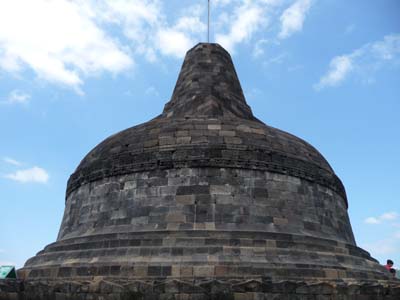
Central Stupa
Borobudur
09/07/2009
Mendut Temple has not the magnificence of Borobudur, but it has very fine carved panels and a sited Buddha of beautiful work.
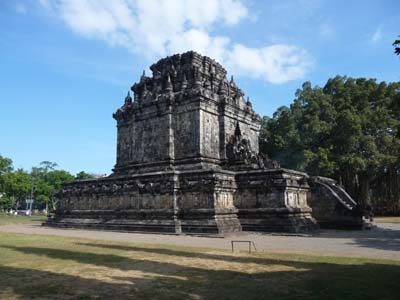
Mendut Temple
09/07/2009
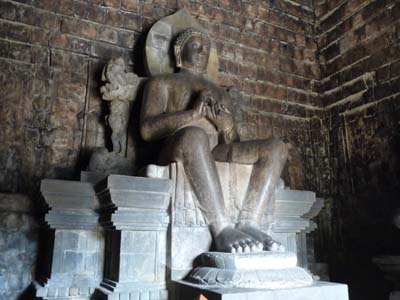
Mendut Temple
09/07/2009
Candi Pawon has the same architecture as Mendut Temple with beautiful carved panels.
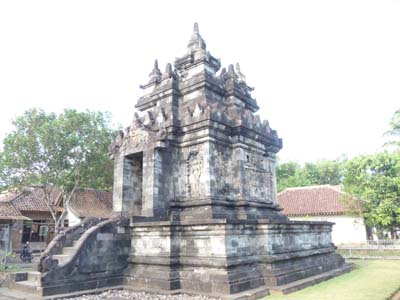
Candi Pawon
09/07/2009
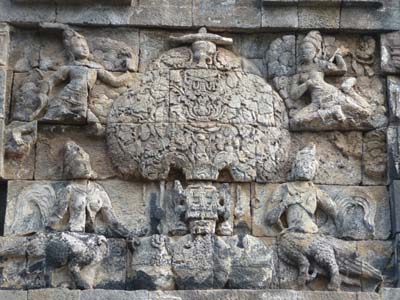
Candi Pawon
09/07/2009
By arriving in the morning around 09:30 I presented myself at the entry of the site carpark and I explained that I would like to bivouac. One of the guards led me to the main office where I was accommodated cordially. Three photocopies of my passport were carried out. Then by scooter we went to the police to present myself and to give the second photocopy then to Tourist Police which accepted the third photocopy. I was agreeing.
Yogyakarta
On the last four kilometres before Yogyakarta there were a policeman each cent metres for channelling motorbikes into the left lane. By arriving I found a carpark at the crossroad between Jln KH Ahmad Dahlan and Jln Wahid Hasym. I took my bike and I strolled to discover the city which is the arts centre and the heart of Java. It was the capital of the Hindou kingdom Mataram from 8th tot the 10th century. In 1755 prince Mangkubumi built there his Palace, Kraton, It became the capital of the Indonesian Republic from 1946 until independence in 1949. Kraton is a vast set of buildings whose centre is the Golden Pavilion. The complex gathered dwelling houses of approximately 25000 people with its markets, its stores and its factories.
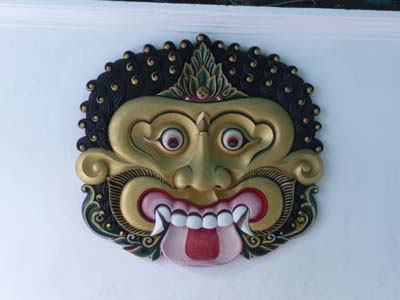
Dragon
Yogyakarta
10/07/2009
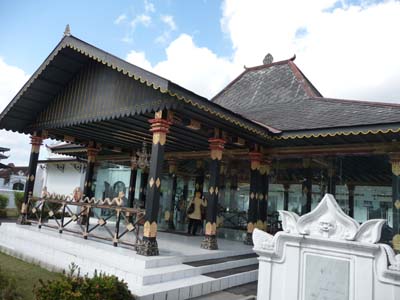
Kraton
Yogyakarta
10/07/2009
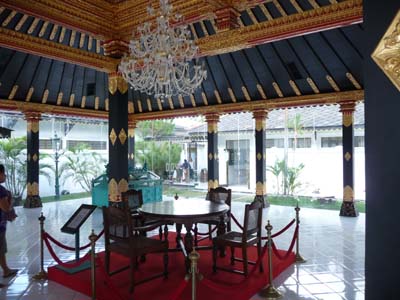
Golden Pavilion
Yogyakarta
10/07/2009
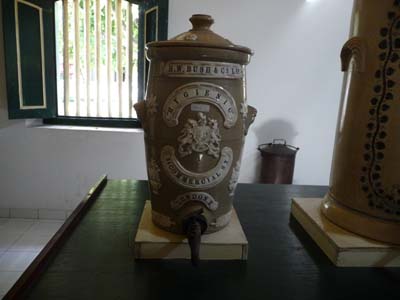
Water filter
Yogyakarta
10/07/2009
Benteng Vredeburg is an Old Dutch fort which shelters now dioramas telling the history of the independence of Indonesia.
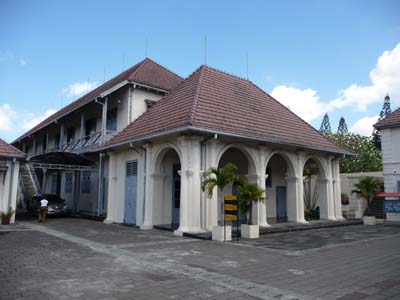
Benteng Vredeburg
Yogyakarta
10/07/2009
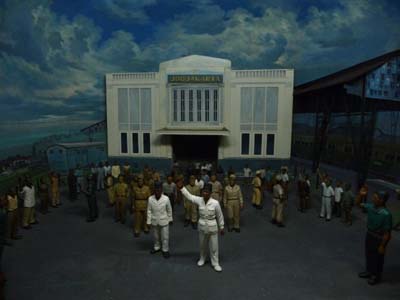
Diorama
Yogyakarta
10/07/2009
Taman Sari was conceived by a Dutch architect from Batavia carried out at the end of work not to reveal it. It was a park made up of palaces, basins for amusements of the sultan.
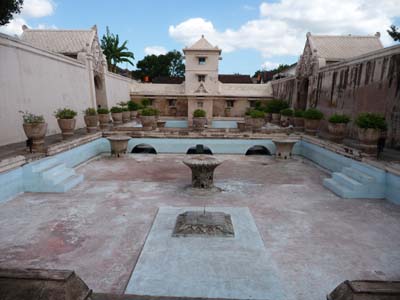
Taman Sari
Yogyakarta
10/07/2009
Yogyakarta is the centre of the Batik art by application of wax to draw on cloth. The technique is known since the 12th century. Java is the world centre of Batik.
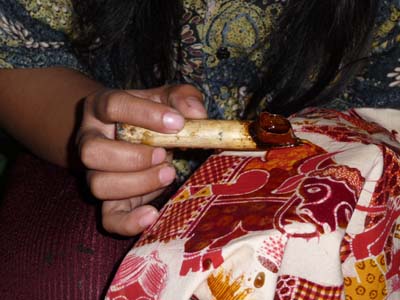
Batik
Yogyakarta
10/07/2009
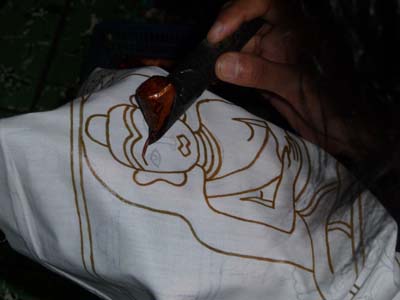
Batik
Yogyakarta
10/07/2009
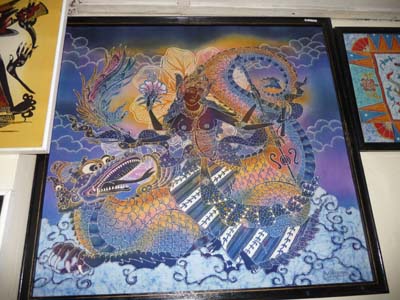
Batik
Yogyakarta
10/07/2009
The Javanese puppets are cut in the leather of buffalo, Wayang Kulit.
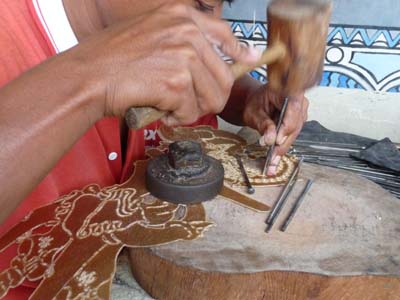
Puppet
Yogyakarta
10/07/2009
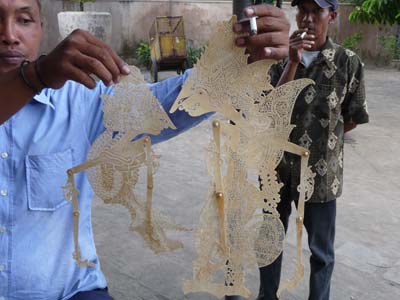
Puppets
Yogyakarta
10/07/2009
