-- Bali, from Gilimanuk to Padangbai
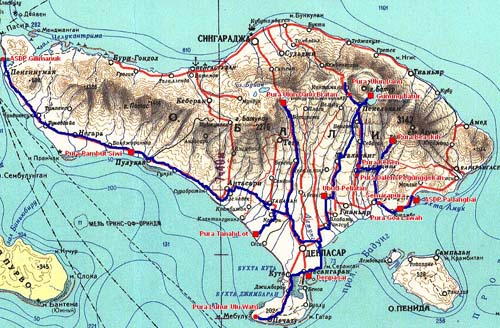
The road tracklog
From Gilimanuk to Padangbai
from 22/07 to 31/07/2009
Bali
History:
-- 3000 BC the settlement of Bali is attested by stone tools and earthenware
vessels,
-- At the 9th century a stone inscription attests presence of Indian
tradesmen,
-- 11th century Bali was absorbed by the Hindu kingdom Mataram, central Java,
--
12th & 13th centuries Bali recovered its independence,
-- 14th century the
Hindu kingdom Mejapahit conquered Bali for a short period before its decline
for a quarrel of succession involving the escape of elites and arts. Bali
became durably of Hindu culture,
-- 1597 Dutch seafarers unloaded,
-- 1710 Dutch settled durably in Indonesia,
-- From 1894 to 1906 Dutch engaged a series of battles to control the whole
Bali. Kings of Bali committed suicide in vain battles - Puputan-
to avoid the dishonour of the captivity,
-- August
17, 1945 proclamation of the Independence of Indonesia by Soekarno.
Population:
The Island is populated with 95% of Balinese organized in castes
according to the India model however without Untouchables. Aside the caste
of Brahmans, the clergy, they are at 90% Sudra. The community, -family, clan,
caste and village-, is the social organization which ensures the perennially of
traditional values and customs.
Religion:
The Balinese Hinduism resembles that
of India by the trilogy, Brahma, Siva & Visnu but differs by a supreme god,
Sanghyyang Widi, by the non representation of the divinities in temples and by
the incorporation of animist deities, the “spirits” which influence the
everyday life.
Arts:
The Balinese language does not have a word for art and
artists; tourism developed commercial art especially around Ubud.
The 22/07 around 12:40, local time, I unloaded in Gilimanuk, Bali. Landscape had changed, the climate seemed more tropical and it was raining. Habitat also had changed, houses for more were preceded by small temples dedicated to the deities of the guardian spirits, Nats, already met in other countries of the Southeast Asia; civilization is a stacking of social receipts for several millennia. I stopped to visit the temple Pura Rambut Siwi dominating a black sand beach. I bivouacked on the deserted carpark preparing the next publication of my site.
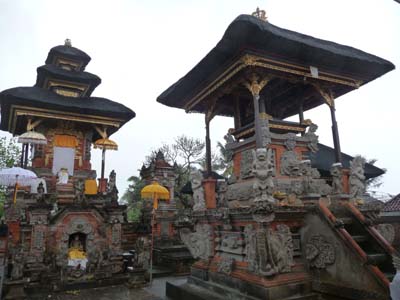
Pura Rambut Siwi
en route
22/07/2009
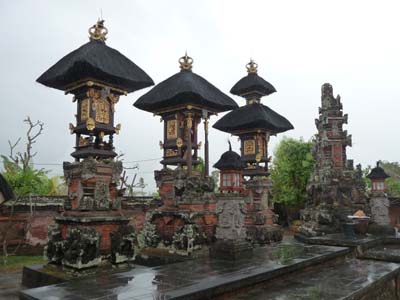
Pura Rambut Siwi
en route
22/07/2009
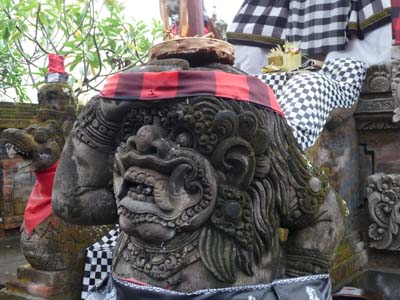
Pura Rambut Siwi
en route
22/07/2009
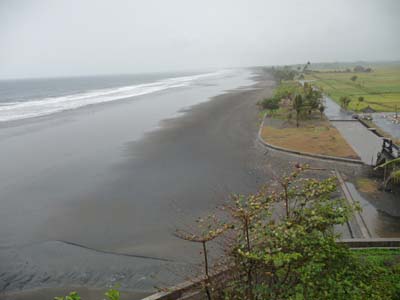
The seashore
Pura Rambut Siwi
22/07/2009
Pura Tanah Lot
On the move towards the Temple of Tanah Lot I stopped the 23/07 in Tabanan looking for a cybercafé to publish the last page of the trip in Java.
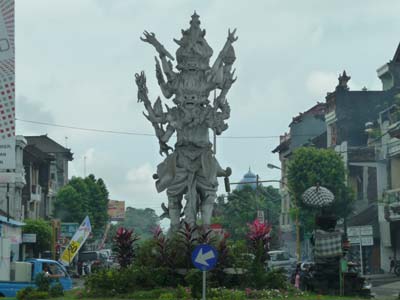
Animist God
en route
23/07/2009
Then I continued my way to reach the temple around 14:00 under a Britain drizzle, a grey sky and moisture of 8O %. The temple is perched on a small hill surrounded by the sea. Admittedly the site is admirable however to see it was necessary as a preliminary to cross the shops of the merchants of the temple.
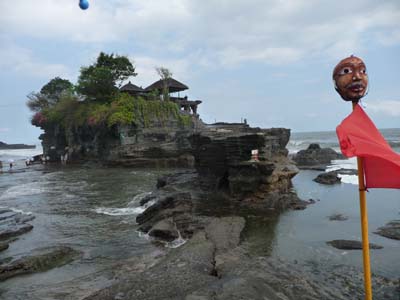
Pura Rambut Siwi
Pura Tanah Lot
23/07/2009
Of course Brahmans officiated at the entry of the artificial cave.
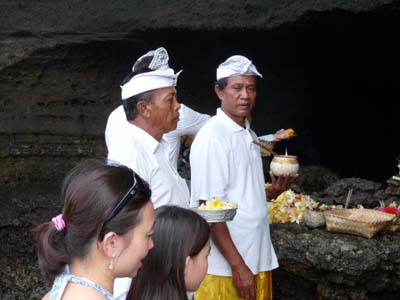
Brahmans
Pura Tanah Lot
23/07/2009
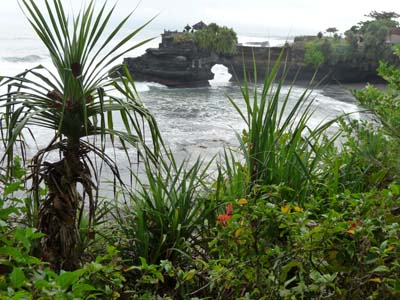
The seashore
Pura Tanah Lot
23/07/2009
The road went along the coast without access to the beaches; there as elsewhere in Southeast Asia bivouacs were not easy to find. I obtained the authorization to bivouac on the huge carpark of the temple.
Denpasar
The Lp mentioned the Tourist Office of Denpasar at Ubung Bus Terminal, alas it did not exist; local policemen located it at Renon without knowing its address. I traversed the Bypass up to the island of Serangan and stationed my truck on Rajah Serangan opposite Makro. Then I went to bicycle looking for the TO which I found about 12:00 closing times, an employee, very courteous, gave me information that I wished. Then I moved towards the Museum Negeri Propinsi Bali where I also arrived at closing time 12:30; employees let to me visit it on my own way. Collections are exhibited in four specialized pavilions of which most remarkable are prehistoric tools, textiles, paintings and masks.
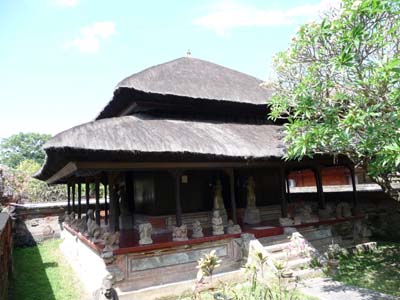
Pavilion
Museum Negeri Propinsi Bali
Denpasar
24/07/2009
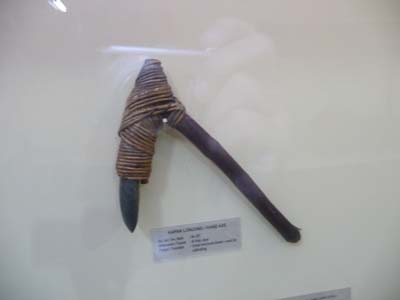
Prehistoric tool
Museum Negeri Propinsi Bali
Denpasar
24/07/2009
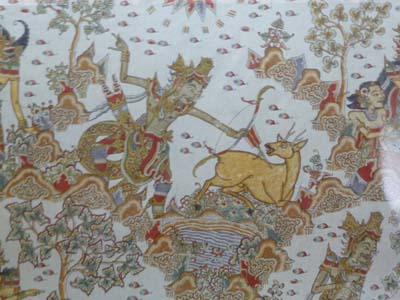
Painting, Ramayan
Museum Negeri Propinsi Bali
Denpasar
24/07/2009
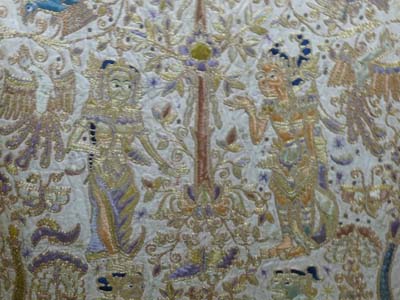
Gold-threaded cloth
Museum Negeri Propinsi Bali
Denpasar
24/07/2009
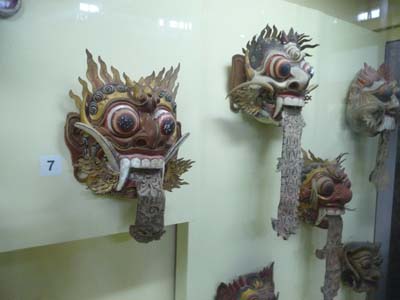
Masks
Museum Negeri Propinsi Bali
Denpasar
24/07/2009
Next Pura Jagatnatha, very recent construction, is a place of prayer with inevitable Brahmans.
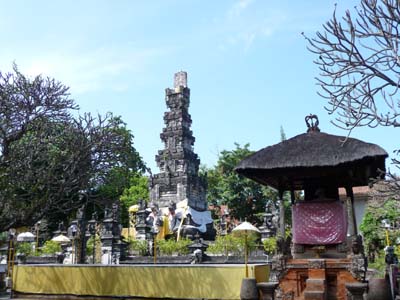
Pura Jagatnatha
Denpasar
24/07/2009
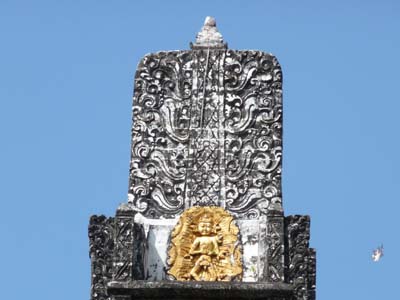
Pura Jagatnatha
Denpasar
24/07/2009
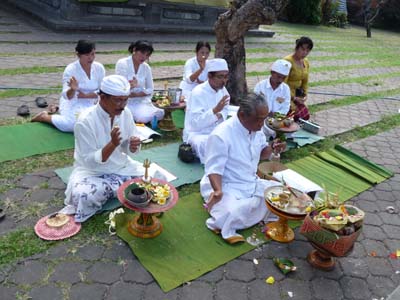
Brahmans
Pura Jagatnatha
Denpasar
24/07/2009
Denpasar is a city with very narrow streets on single direction and with insane traffic of vehicles and motorbikes. It is very difficult to be directed. Separately the two visited monuments it is not of any interest. I cycled back to me truck in the late afternoon after having did shopping at Makro. I bivouacked along Rajah Serangan.
Pura Luhur Ulu Watu
Saturdays 25/07 I headed to Pura Luhur Ulu Watu by the Bypass up to an airport then by Raya Uluwatu up to the temple. The latter is narrow and, lined by trees and vehicles in parking on the two sides making a problematic traffic, the parking on alternate sides is either unknown or nor respected.
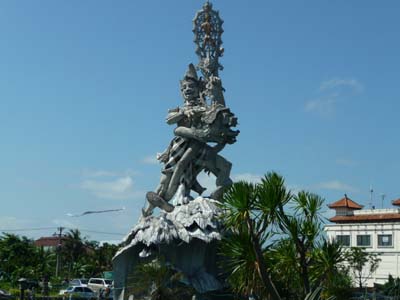
Dewa Ruci Statue
Denpasar
25/07/2009
The temple is at the top of a cliff overlooking the sea, the site is stunning and the temple is less. Monkeys pullulate, they steal glasses and hats etc Two hours of road outward journey and return for one hour of strolling on the site.
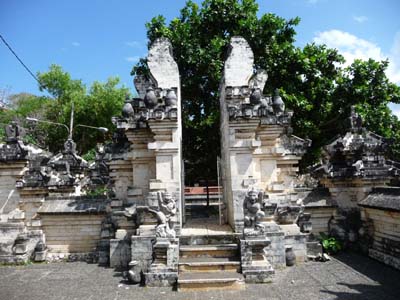
Gate
Pura luhur Ulu Watu
25/07/2009
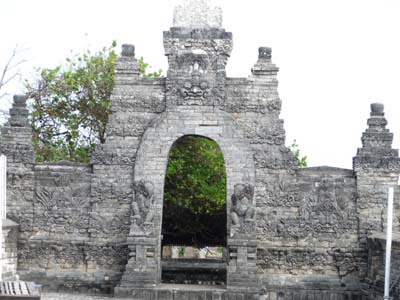
Pura Luhur Ulu Watu
25/07/2009
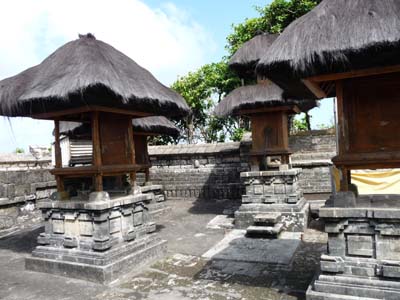
Pura luhur Ulu Watu
25/07/2009
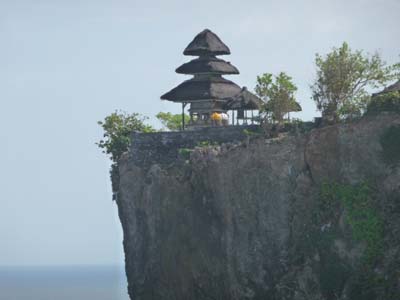
Pura Luhur Ulu Watu
25/07/2009
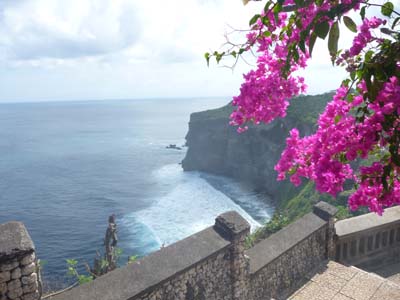
Pura luhur Ulu Watu
25/07/2009
I had lunch on the spot. No possibility of bivouac, I turned over on Raya Serangan which is a dam leading to the eponym island; the bivouac is a driving spot for conducting apprentices; it did not have nobody there.
Danau Bratan
I left Denpasar and the edge of sea to central mountains and the edge of the lake Bratan -Danau Bratan- at approximately 1260 meters of GPS altitude dominated by Gunung Catur at 2096 meters high. On the move the crossed villages did not have anything tourist, it was the habitat of the working population far from the pleasures for Western tourists. Pura Ulun Danu Bratan was built in the 17th century at the edge of the lake; it is dedicated to the goddess of water Dewi Danu. Architecture is traditional, a tower with 11 thatched roofs. The site gathers several pertaining to worship buildings accessible to alone Brahmans.
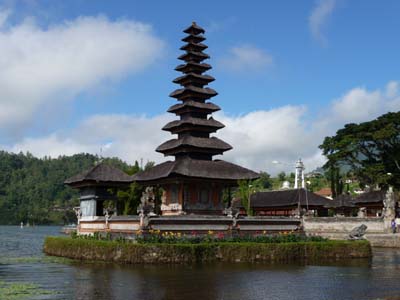
Pura Ulun Danu Bratan
27/07/2009
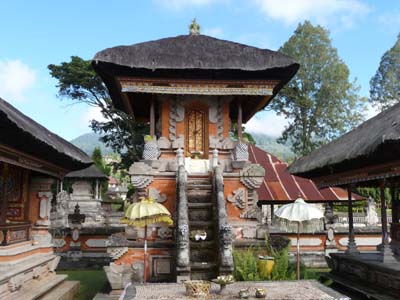
Pura Ulun Danu Bratan
27/07/2009
After a long walk at the edge of the lake I visited Bali Botanical Gardens attached to the National Botanical Garden at Bogor. Its surface is 154 hectares on the slopes of Gunung Pohen. It is organized with English and the tropical lawns are magnificently maintained. The pavilion dedicated to orchids does not exhibit only wild varieties from Indonesia. In a greenhouse behind netting I saw other varieties. Two immense demoniac statues keep the park.
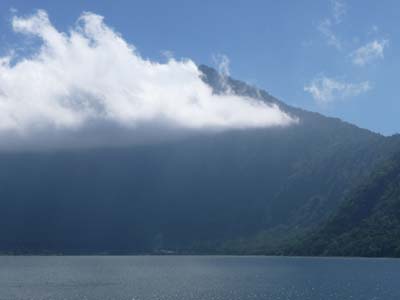
Danau Bratan lake
27/07/2009
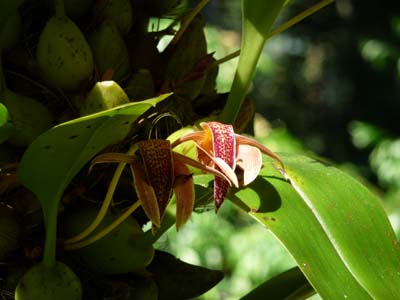
Orchid
Bali Botanical Gardens
27/07/2009
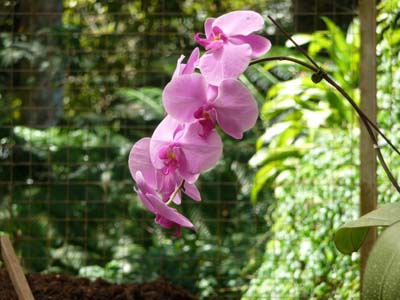
Orchid
Bali Botanical Gardens
27/07/2009
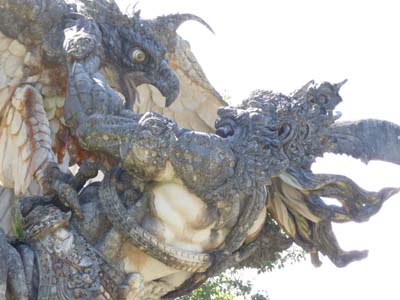
Sculpture
Bali Botanical Gardens
27/07/2009
It was one moment of Alpine quietude before approaching the tourist paramount town of Ubud. I bivouaqued on the parking of the temple.
Ubud
Left at 06:00 I arrived around 08:40 at Ubud. Informed by the T.O at Denpasar that there was no carpark, I extremely opportunely found a small platform in front of a private clinic in Peliatan. Information taken by local people who observed me park my truck, there was no problem to remain two days there. At once I override my bicycle to go in search of the city. Streets are very, very narrow and with single direction. I had prevention against Ubud fearing excesses of a tourist city; alas reality exceeded my apprehensions, succession of tout shops and seducer restaurants, intense traffic of vehicles and motorbikes rented by tourists, consequently pollution in all kind. I stopped initially at the Tourist Office to take a citymap and to buy a ticket for a performance of Legong, the most graceful Balinese dance. The city has many temples; to visit them it is madatory to have the covered legs, for example with a sarong, and museums centred on Balinese painting.
Balinese temples of Hindu religion have nothing to do with their Indian counterparts; they are the expression of the ancestral Balinese culture. The entry is a much worked monumental gate giving on a vast space occupied by open pavilions some to carry out rites and others to receive musicians and dancers. A statue of the deity of the temple is present in front of gate vaults with covered thatch roofs. The whole is of red, black and gold colour. I met craftsmen working to carry out hats of dancers.
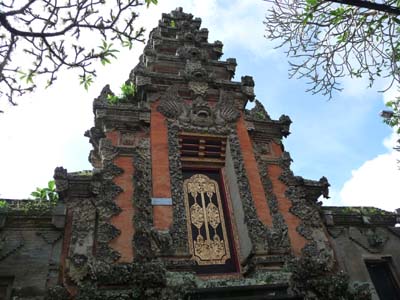
Gate's Pura Marajan Agung
Ubud
28/07/2009
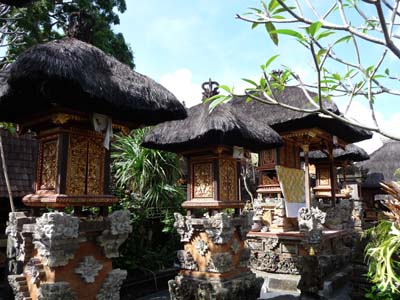
Pura Desa Ubud
Ubud
28/07/2009
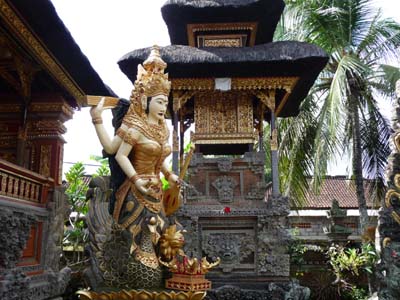
Dewi Saraswati
Ubud
28/07/2009
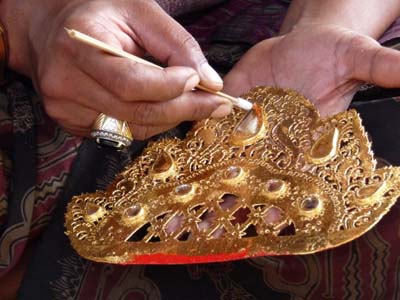
Handicraft
Ubud
28/07/2009
City and rich trader museums expose Balinese painting in all its states, traditional with scenes of Hindu mythology, Mahabharata, Ramayana, figurative, scenes of everyday life at the market and in the rice paddies, and modern, under Western influence.
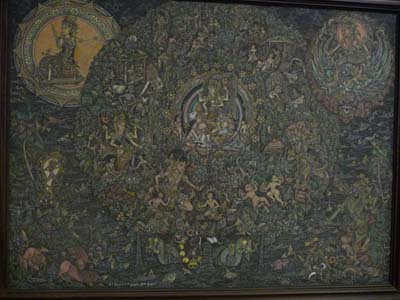
Classical painting
Wheel of Life
Ubud
28/07/2009
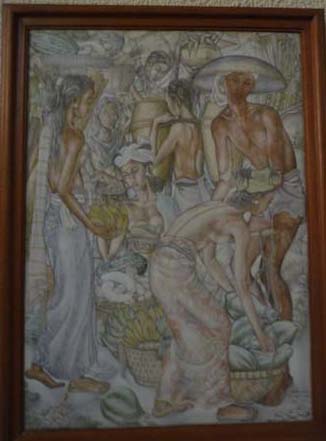
Live painting
at the market
Ubud
28/07/2009
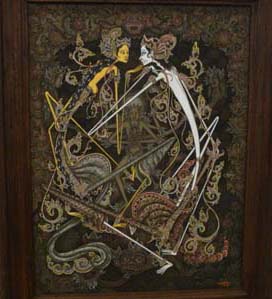
Modern painting
Ubud
28/07/2009
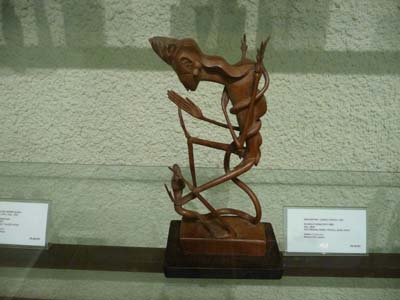
Sculpture
Ubud
28/07/2009
As its practice Lonely Planet handles the panegyric with excess, reality is sometimes less attractive.
Legong, dance
In evening I attended a performance of dance in six acts telling a Balinese folklore story. These dances were carried out at the court of the kings. The dancers are dressed with brocade and carry a very elaborate make-up. Movements of the various parts of their body, head, arms, hands, fingers, legs and feet take part in the expression of the story. They are accompanied by an orchestra of gamelan which supports their action. I spent a pleasant moment.

Welcome dance
Ubud
27/07/2009
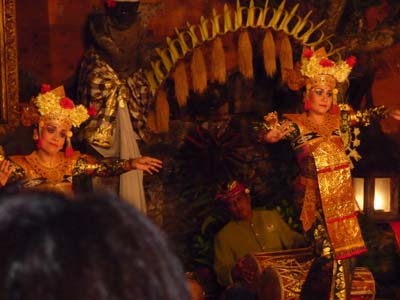
Legong Kraton dance
Ubud
27/07/2009
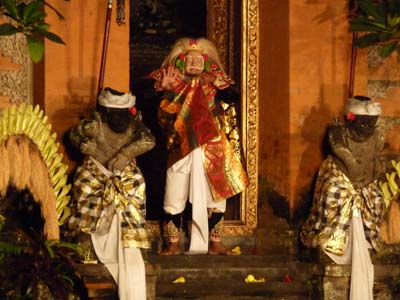
Topeng Tua Mask dance
Ubud
27/07/2009
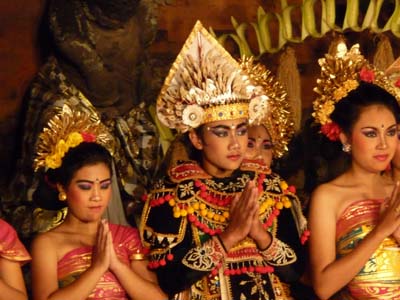
Final
Ubud
27/07/2009
Tampak Siring
Although two days were planed in Ubud I left the following day towards Gunung Batur. On the move I visited two sites close to Tampak Siring. In a narrow valley Gunung Kawi is a strange site of sculptures excavated from cliff and pavilions of Balinese tradition dating back to the 11th century. Little information is known; the site could be a reminiscence of the Indian sites like Ellorâ and Ajanta, but without their splendour.
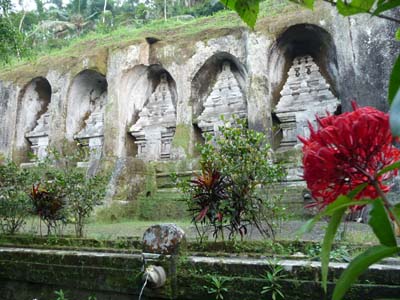
Gunung Kawi
Tampak Siring
28/07/2009
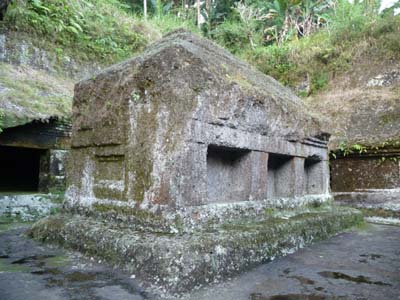
Gunung Kawi
Tampak Siring
28/07/2009
At the exit of the city the sacred springs of Tirta Empul are much venerated, devotees come to prayer by taking a bath. I attended the ceremony of the presentation of offerings, with the rites carried out by a Brahman accompanied by a monotonous chant.
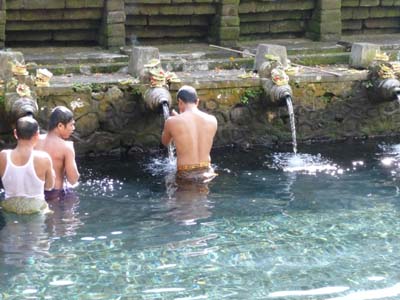
Tirta Empul
Tampak Siring
28/07/2009
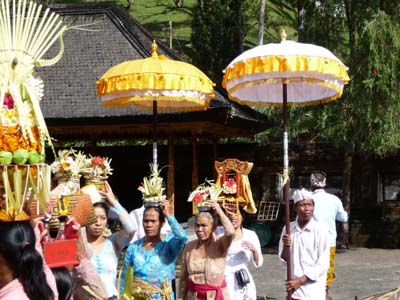
Tirta Empul
Tampak Siring
28/07/2009
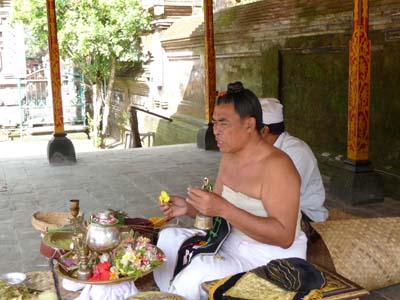
Tirta Empul
Tampak Siring
28/07/2009
Gunung Batur
I took again the road peacefully towards Gunung Batur where I arrived at lunchtime to visit Pura Ulun Danu Batur.
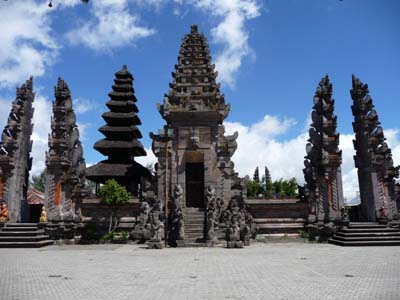
Pura Ulun Danu Batur
Gunung Batur
28/07/2009
In the early afternoon I headed down in the caldera with my truck to bivouac at the edge of the lake on volcanic rocks at 1073 meters of altitude GPS.
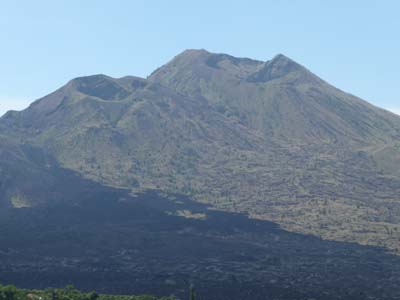
Volcanoes
Gunung Batur
28/07/2009
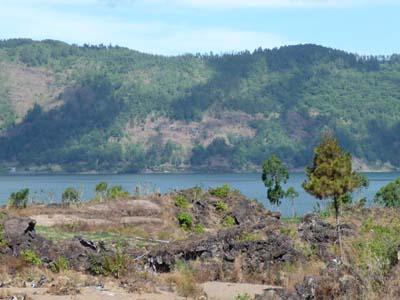
Danau Batur, bivouac
Gunung Batur
28/07/2009
Bangli
The 29/07 on the way towards Pura Besakih I visited two temples in Bangli. Pura Kehen, reduction of Pura Beaskil, shows a classical architecture, a much worked monumental gate giving on a courtyard where candi bentar, split gate, shows in prospect a meru, temple with eleven-thatched roofs.
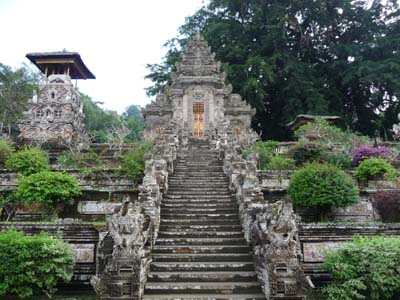
Monumental gate
Pura Kehen
Bangli
29/07/2009
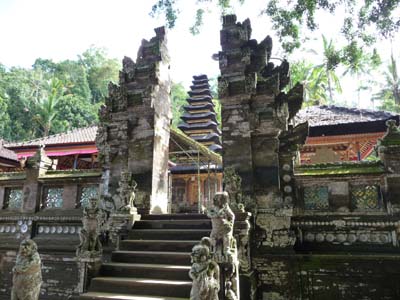
Meru,
11 thatchered roofs
Pura Kehen
Bangli
29/07/2009
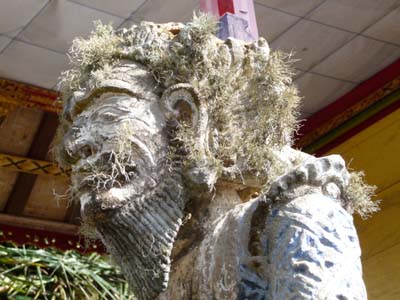
Mossy statue
Pura Kehen
Bangli
29/07/2009
At the exit of the city Pura Dalem, temple of the dead, expose on the exterior wall some very evocative panels of adulterous-men's afflicted torments.
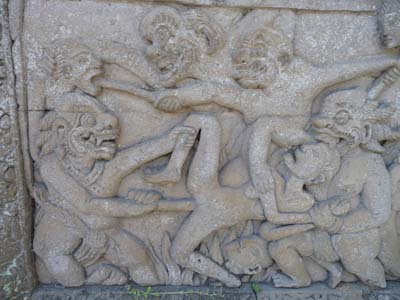
Pura Dalem Penunggekan
Bangli
29/07/2009
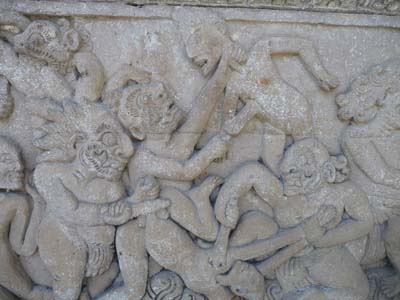
Pura Dalem Pununggekan
Bangli
29/07/2009
Pura Besakih
On the slopes of the Mt Agung Pura Besakih is the most venerated in Bali; alas visitors, no devotees, are not allowed to enter the meru, main temple. The meru with the top of the MT Agung in background is superb.
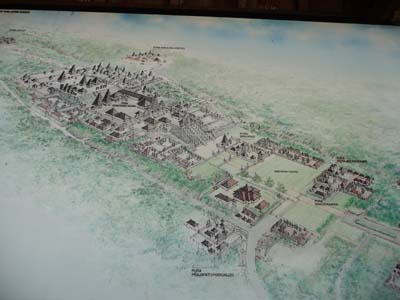
Panoramic view
Pura Besakih
29/07/2009
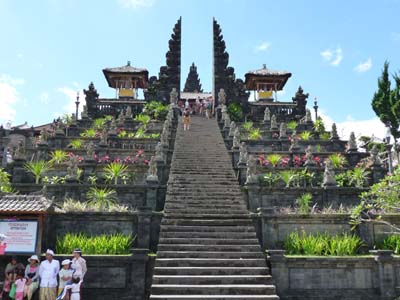
Candi Bentar
Pura Besakih
29/07/2009
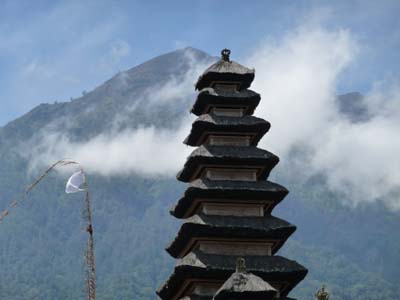
Meru, 11 thatchered roofs
Pura Besakih
29/07/2009
The vast carpark being deserted I bivouacked on the spot.
Semarapura
The 30/07 I again went down from the mountain and I stopped in Semarapura ex Klungkung which were the theatre of a martyr of the population and of the king at the time of the terrible battle with hand-weapons on April 28 1908 which opposed them to the Dutch army equipped with rifles. Suicidal battle, puputan, there was no survivor and the royal palace was razed. This building it remains only a monumental gate.
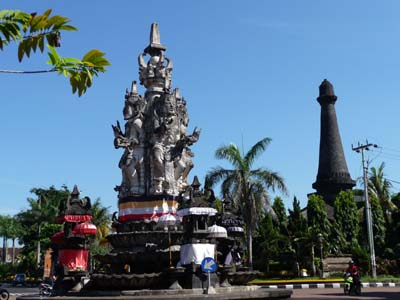
Kanda Pat Sari Statue,
Monumen Puputan
Semarapura
30/07/2009
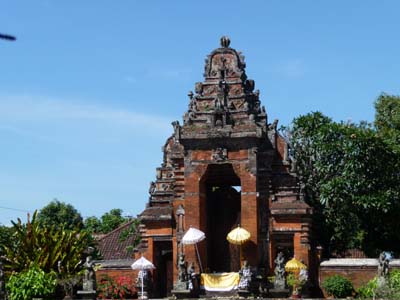
Gate of Palace
Semarapura
30/07/2009
In the enclosure of the palace, Bale Kambang, Floating Pavilion, have a covered ceiling with painting in the tradition of Klungkung as well as Kertha Gasa, Hall of Justice.
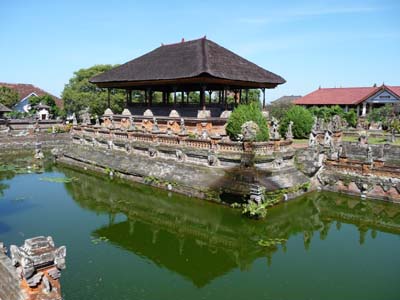
Bale Kambang
Semarapura
30/07/2009
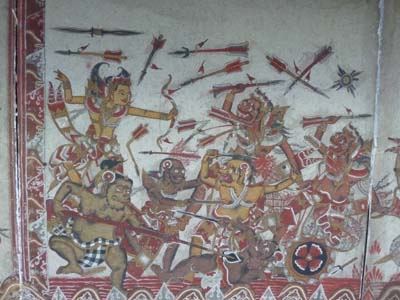
Painting
Semarapura
30/07/2009
Further on the museum Semarajaya exhibits photos of the royal family in 1908 and various objects.
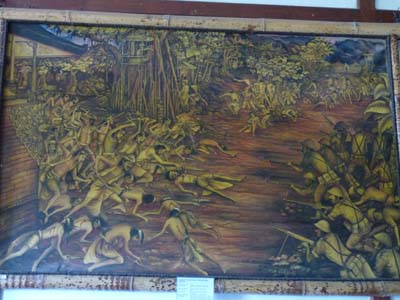
Puputan
Semarapura
30/07/2009
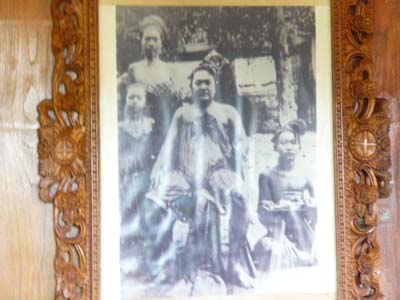
Royal family
Semarapura
30/07/2009
On the move towards Padangbai I visited my ultimate temple in Bali, Goa Lawah, at 9 kilometres away from Semarapura. There was a ceremony of the offerings, the Brahman was a woman. I bivouacked on the carpark vis-à-vis the sea.
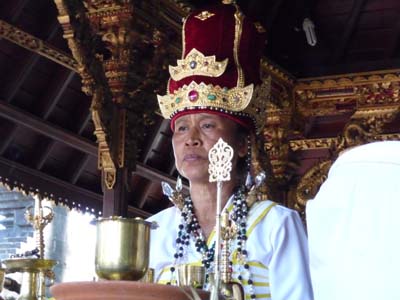
Brahman
Pura Goa Lawah
30/07/2009
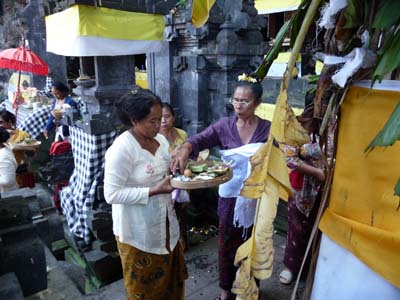
Offering ceremony
Pura Goa Lawah
30/07/2009
Padangbai
The 31/07 I decided to stay in Padangbai to update my website with pages of my trip in Bali. I loaded on a ferry to Lombok on the 01/08/2009.
Final report of my trip in Bali
The island of Bali has three facets, cultural, sporting and economic.
The first two aspects
are the consequence of the development of tourism since 1970, slowed down by
terrorism in 2002 and again in rise since 2005. These two aspects are much
localized, cultural in Ubud and worshipper in temples, sporting in the south
of Denpasar in Sanur, Nusa Dua and Kuta where hotels and resorts follow one
another along the beaches. Not having any taste for sunbathing I did not take
that to pass. I did not linger in Ubud although I took much pleasure
while attending a performance of traditional dance. I traversed the
countryside and I climbed mountainous slopes to visit the most famous temples
and to see the ceremony of offering presentation. Weather being often
covered with morning rains I did not climb Gunung Batur.
Population, 3.5
million inhabitants, is accessible, attentive and helpful. Policemen very
present helped me in cities to locate sights to be visited and to park my
truck by greeting me with a rise thumb. I was seldom controlled; before
everything I presented the Travelling Permit that the policemen did not
know but that they read conscientiously.
Balineses are good workers in rice
paddies, on roads and in tourism industry, hotel trade, pseudo objects of art.
Vendor’s harassment at sights is rather good child.
Roads in Bali, except
by-pass, are very narrow –the width of the roadway is lower than 5 meters–
and lined with trees at very close to the roadway and with very low branches
making problematic the crossing of vehicles. The maximum speed of my truck
was 35 kilometres per hour, however distances are short.
Bivouacs were not easy to find; I used mainly carpark of temples.
