|
|
 |
India,
Ladakh |
|
This travel followed
the journey in Tibet in 1990 which showed the necessity to test the
fitness of the narrator to hike in order to visit the Buddhist
monasteries located in high altitude. It was a six-day trek
for a 21-day stay.
It was made in 1993, from
July 30 to August 21. After a 10 hours Lufthansa flight , the arrival in
Delhi was on time. The way, by bus, from Delhi to Leh took two days
on a dirt road by getting over passes up to +5.000 m and a night under
the tent at +4,900.
Ladakh is not any more an
independent Himalayan kingdom like Nepal or Bhutan. It
is part of the Jammu and Cachemire State of the Indian Union. It is
located in the Indus valley limited to the north by the Ladakh
range and to the south by the Zanskar range. The north and west borders
are disputed. The capital Leh, 3,500 m, is a few kilometres away from
Indus river.
This journey proposed
to discover this desert area between 2,500 and 5,000 meters high,
but there are very beautiful oases. The settlement by Tibetans of Bon
PO religion started towards 500 of our era. The introduction of the
monarchy was effective towards 900 with the development of Buddhism and the
construction of monasteries.
The first day was devoted
to the visit of the city of Leh reported further. It was an
acclimatation day too. The transfer to Lamayuru was made by jeep.
The report in six stages will be
accompanied by six topics by briefly developing an aspect of this still
theocratic civilization. General comments
are given by the presentation of the Indian subcontinent,
India. |
|
|
|
|
Lamayuru, Tingsmogang |
|
|
|
 |
|
Lamayuru |
 |
|
Tingsmogang |
| |
Buddhism:
Buddhism appeared in the 5th century BC in reaction to the formalism
of the Brahmanism of the Aryans. It is the awakening of the
suffering and the dissatisfaction of life.
Suffering finds its origin in the ignorance of the impermanency of beings
and things, self-centredness and real
existence of the ego.
Buddhism wants to free man from his suffering by showing him the
way which leads to an inalterable happiness. Two ways are
proposed to followers, the Lesser Vehicle and the Greater Vehicle.
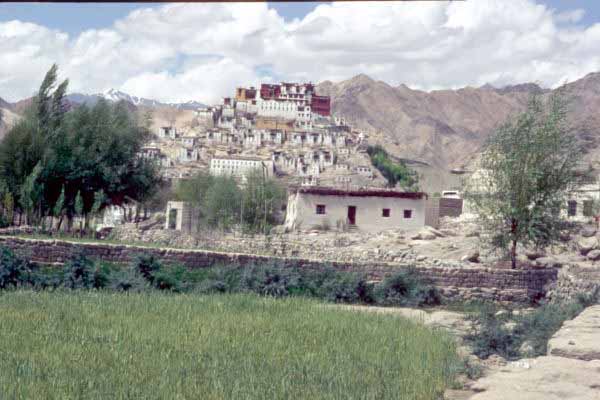
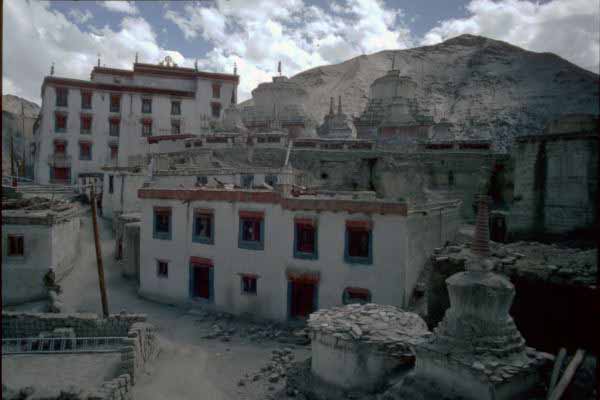
Lamayuru is established on a rock peak at 3,800 m high in a fairy-like
landscape. Built between 11th and 16th centuries the rooms
are variously interesting. Singge Lhakhang, of the 11th century,
presents a sculpture of Vairocana and frescos of dancing skeletons.
Tingsmogang is a large village in the north of the road to Leh.
A royal Citadel of the 15th century, it was the seat of Delek Namgyal.
Two temples are built on a hill, one white devoted to Maitreya
presents its 8 m high sculpture, the other red devoted to Chenrezi
presents Avalokiteshvara with 11 heads. |
|
|
|
|
|
The trek followed mule trails without big difficulties.
The Tingsmogang valley is the richest of Ladakh, fields staged in
pieces surrounded by channels planted with tall trees, fruit trees.
Getting over the pass offered a superb sight on the village. Two
passes +3,900 m high were crossed to go to Likir. |
|
|
|
|
Likir, Alchi |
|
|
|
|
The Buddist Monastery:
The monastery, Gonpa in ladakhi, is set around an interior
court sometimes bordered with a gallery. It has rooms on
several floors. The most important are:
Lhakhang shelters the Divinity. All the rooms of Lhakhang are
devoted to a deity.
Dukhang is used as refectory by the monks.
Chokhang is used as the Rinpoche room, he is the superior of
the sect concerned.
Gonkhang shelters the terrible Divinities.
The monastic rule and the hierarchy are codified in a very rigorous
way.
Rizong,
nested in an imposing landscape, is reached after an idyllic walk
along a torrent and by winding between the cells of monks on hillside.
A room presents all the Buddha life in the form of didactic frescos.
Likir, in a
superb landscape, is one of the most important monasteries of Ladakh
to which the monasteries of Alchi and of Karsha in Zanskar are
affiliated. The rooms are worthy of a thorough visit. Zimchung presents a unique
collection of Thangka in Ladakh.
Alchi, on the left
bank of Indus river, is the most beautiful monastery of Ladakh, of 11th
and 12e centuries. It is composed of five major buildings whose
Sum-tseg is the most interesting beyond question. |
|
 |
|
Rizong |
 |
|
Likir |
|
|
|
|
|
|
This six-day trek made possible to discover exceptional monasteries
in great landscapes. Apart from the visit of the monasteries the way
can be made in three stages. the way from Alchi to Leh was made by jeep.
|
|
|
|
|
Leh |
|
|
|
 |
|
The king's palace |
 |
|
Gonkhang |
|
|
The Buddist
Iconographic:
All Lhakhang are preceded by a narthex covered by a repetitive
iconography.
Lokapala are the four guards of the cardinal point,
Mitsering is the old man character of long life,
The wheel of life symbolizes the reincarnation rule with in the
center a pig, a cock and a snake, for ignorance, wish, hate.
The eight symbols of good omen defined by Buddhism,
The tree surrounded with animals symbolizes solidarity.
Leh is set
around its bazaar dominated by the Palace and the Gonkhang monastery.
The city is located on one of the possible Silk roads
towards the south by getting over the Karakorum pass, +5,575 m.
The King's palace,
built about 1600, dominates the city by its imposing mass. In ruins it
seems to have to be restored in the future years.
Gonkhang, located
on a hill overhangs the palace as well as the city. Its access is either by
the road or by a winding way on hillside. The viewpoint at sunset is exceptional. |
|
|
|
|
|
The visit of the monasteries of Shey, Tikse, Hemis and Stok required
one day starting from Leh by local bus to do lot of mileage
skirting Indus river. It is a race against the clock regarding to the
distance and to the tourist frequentation of these sites.
|
|
|
|
|
Hemis, Tikse |
|
|
|
|
Buddhist Art:
Tibeto-lamaïst art of the fresco was set by Menla Todrup
in the 15th century. No freedom is left on the initiative of the
painter, it does not have an artistic expression.
Thangka are paintings on a piece of paper stuck on a
textile media. They are hung in Lhanhang and in the chapels of private houses.
The mandala is the representation of a deity by a symbolic diagram
on a circular base. It is used as visual aids to the
meditation in the Tantric Buddhism practice.
Sculpture is fixed by the rules as strict as painting, hieratic
placing, code of the colours and of the gestures.
The dances are of two kinds. The gar is the ceremonial dance
of the ground blessing . The chams is the ritual dance to
overcome the enemies of the Buddha doctrines.
Shey
is a complex of a palace and a gonpa. This site was
the capital of Ladakh in the 15th century. The palace is in ruin and
the gonpa shelters a Buddha statue 8 m high.
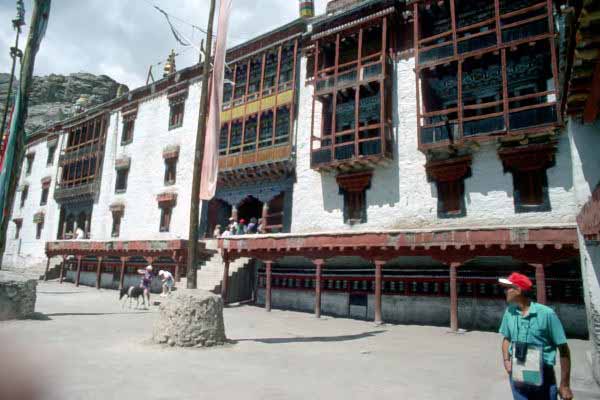
Hemis is the
largest monastery of Ladakh, founded in 1602. The entry by the
interior court offers a superb sight of the majestic front on two
floors. At left a small sheltered courtyard presents a group of
painted slates. The monastery took several hours to visit the richness
of its collections. The kitchen is worthy of interest.
Tikse, built on hillside
in the 15th century, is especially famous for its
situation, for the view offered from its roofs and for its integration
in the landscape.
Stok is the
residence of the royal court since its exile. A stately palace on a
headland, transformed into a museum it exhibits a very beautiful
collection of Thangka and Perak. |
|
|
|
|
|
|
|
A journey by local bus to make these visits near Leh by
descending Indus river then by going to another perpendicular valley.
|
|
|
|
|
Spituk, Phyang |
|
|
|
 |
|
Spituk |
 |
|
Phyang |
|
|
Ladakh population:
The population has a very low growth rate which causes demographic
stability. The climatic roughness, the hardness of the life in high
altitude, tantric buddhist civilization, give a unitary vision of this
population without caste in spite of the partitioning imposed by the
distances between agricultural valleys.
Clothing depends on the climate, heavy dress of dark red wool which
goes down to the ankles, large pointed shoes, cocked hats or
peraks for women.
The social organization is unique in the world. The heritage goes to the
elder son who gets married, the other brothers can
become monks, settle abroad or remain on the farm without founding
separated homes, they marry the wife of the elder brother, it is polyandry.
The goal is the preservation of the family land property,
a consequence of the scarcity of arable land.
Spituk,
dominating all the Indus valley , was built in the 11th
century then extended in the 15th. The most original building is
the gonkhang sheltering two enormous statues of black Mahakala. We
attended the evening prayer, it was a fascinating moment.
Phyang, a great
artistic place of Ladakh, was founded in 1530. It is composed
of three rooms. The strangest is the gonkhang with a large black
Mahakal. |
|
|
|
|
|
Three-hours rafting down the Indus river was the occasion to
see exceptional landscapes from the river.
The return to New Delhi was by plane on scheduled flight of domestic
lines on time after a meticulous inspection of
the luggage and the prohibition of the cameras in cabin or without pile,
under risk of confiscation. |
|
|
|
|
Agra, Taj Mahal |
|
|
|
|
Great Moghols:
The Moghol Empire was created by Babur Shah about 1526,
descendant of Tamerlan by his father and Gengis Khan by his
mother. Crown prince of Ferghana, he was excluded from the succession
from childhood. Afterwards many war vicissitudes he turned against the
sultanate of Delhi with success to create his Kingdom.
The dynasty of Great Moghols reigned until the colonization of India
in the 19th century. It left in the north India some prestigious
monumental constructions.
Taj Mahal is
a white marble mausoleum built on the order of Shah Jahan for
his preferred wife, Mumtaz Mahal, dead prematurely. It is
the monumental expression of an inconsolable love. It was built from
1632 to 1648 in a group of admirable gardens, whose architects are unknown.
The visit is recommended at the end of the day or better in the moonlight.
Two monumental gates must be crossed to discover at the
end of the triumphal alley of a basin, the mausoleum standing on a
terrace. Of Persian style it is visible from the Red Fort where Shah
Jahan stayed. He could see Taj Mahal where his beloved wife lay. |
|
 |
|
Taj Mahal |
|
|
|
|
|
|
The discovery of Ladakh was a revelation by the beauty of the
monasteries, by the kindness of Ladakh-Pa as well as by the fitness of the
narrator to go trekking. The future will confirm this, 14 treks including
six climbs above +6,000 m high.
|
|
|
|
|
The return to France was made after one night of transit in New Delhi, in
flight Lufthansa via Frankfurt with a departure in the middle of night
and arrival in Paris in the middle of the morning the next day.
|
|
|
|
| Neuilly, le 2003/07/05 |
|

|
|
|
|
|