|
|
 |
India,
Zanskar |
|
It was the large crossing
of Zanskar: From the green slopes of Manali, by passing through Zanskar
to Lamayuru. It was a beautiful trek that required stamina but without much
difficulty. Its duration was 21-day of walk for a 30-days stay.
It was made in 1994, from
August 04 to September 02. After a KLM flight via Amsterdam, the arrival
at Delhi was on time. The way, by bus, from Delhi to Dasha took two days
and one night in Manali.
Zanskar was a Himalayan kingdom
vassal of Ladakh. It is part of the Jammu and
Cachemire State of the Indian Union. It is located in the Zanskar valley,
a tributary of Indus. It is really an out-of-the way valley. The easiest
access is in the west by coming from Srinagar via Kargil to Padum
by a very difficult road but with superb landscapes. From the east on foot
was the goal of this trek. In winter from Leh by going in the bed of the
frozen Zanskar river, it will be the objective
of a trek in 2002. The historical capital Zangla, 3,600 m high, is at
the bord of Zanskar and can be reached by jeep via Padum.
This trek proposed to discover this
medieval area in two stages. The first part went from Darsha to Padum,
the second from Padum to Lamayuru, then Leh and return to New Delhi.
The report in six
tables is accompanied by six topics concerning the trek. The cultural comments
were given by the report of the previous trek,
Ladakh. General comments are given by the presentation of the Indian subcontinent,
India. |
|
|
|
|
Darsha, Shinkun-La |
|
|
|
 |
|
One torrent |
 |
|
Second torrent |
|
|
The support team:
The group of twelve trekkers was accompanied by a French guide of the selected
tour operator. The local crew starting from Darsha was composed
of four cooks, four muleteers and 25 mules
to carry the group luggage and food for the duration of
the trek.
Manali, a village 1,826m high, is a crossing point for hikers towards Zanskar,
Lahaul or Spiti. Many agencies place their logistics at
the disposal of potential trekkers. It is also a vacation
resort famous for its mild climate, for the beauty of its
orchards and for its panoramas on the Himalayas.
Darsha, +3,400 m high, was the starting point of the trek after one night on the
site and the meeting of the local crew in the morning. Three camps
were necessary to reach the foot of Shinkun-La and the crossing of one
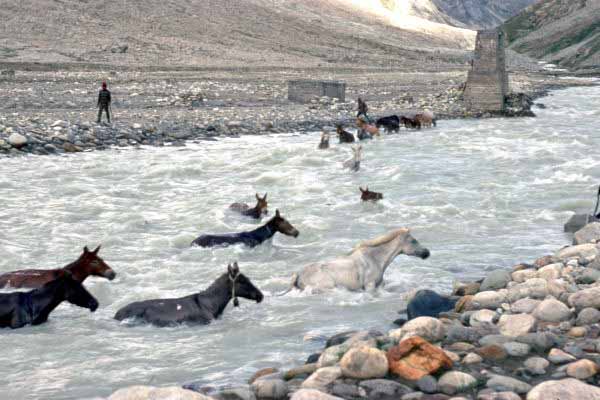
torrent using a pulley bridge for the men and the luggage, the mules
got across in the water.
Shinkun-la, +5,090 m high, the climb was not very difficult. On the
other hand the crossing of a second torrent,
grown bigger at the end of the day by the snow melt, was dangerous and required
roping upt. Three groups of four people were thus made up. |
|
|
|
|
|
The trek was a matter of race and rhythm. A couple of
experienced trekkers said it is necessary to walk twice with one's heart.
First not to get out of breath, it is crippling in
altitude and second to admire fauna and flora. Thus we
could look at the marmots much bigger than in the Alps, at the splendid flowers and
at the fields covered by edelweiss that cannot seen in Europe.
Here nature is pollution-free.
|
|
|
|
|
Phuktal |
|
|
|
|
The collective material:
The collective material, except food and kitchen tools, was composed
of tents for two people, foam mattresses, a mess tent for the meals
and the evenings, a toilet tent and a pharmacy for the sores and problems
related to altitude.
For some treks in countries where supplying is difficult of supply, a
complement of food could be brought from France, reducing of as much the
weight admitted for personal luggage. Moreover for a trekking
peak, it is necessary to add the climb material.
Purne, two
days were taken to reach this village which is the base camp to visit
the Phuktal monastery in one day outward journey and return.
Phuktal is one of
the most spectacular sites of Zanskar dominating at 3,990
m high the Tsarap valley. It is offered to the sight at the curve of the way,
nestling at the cave entrance which gathers the monastic
buildings. It was built in 11th or earlier in the 15th century.
Lhakhang is the most interesting room for its frescos. Dukhang
contains a collection of old Tangka. Gonkhang shows statues of Deites
of the Bhuddist Pantheon. |
|
 |
|
The trail |
 |
|
Phuktal |
|
|
|
|
|
|
The trek progressed at an average altitude of 4,000 m with an
alternance of ups and downs. The temperature was good between 20
and 28° Centigrade. Walking on the mountainside on a ground of rotted rocks
could be sometimes dangerous. The use of two walking sticks ensures a better stability.
|
|
|
|
|
Karsha |
|
|
|
 |
|
A bridge |
 |
|
The mosque of Padum |
 |
|
Karsha |
|
|
The personal material:
Any experienced trekker knows the composition of his bag. It is minimum,
weight is the number one enemy . It was divided into two bags.
A travel bag, carried on the back of mule, of yak or by porters contains
one's belongings, the sleeping bag, a complementary mattress and
daytime snacks. Its capacity is approximately
80 to 100 litres for a maximum weight ranging between 18 and 20 kilos according to
the weight of the collective material. The other, a rucksack, contains a
change of clothes and the food for one day, personal
pharmacy and the photographic material. Its capacity is approximately 35
to 45 litres for a weight according to the endurance of the trekker.
The chart of serious tour operators provides a list of recommended equipment.
Personally the day before of the departure I made my bags
by equipping myself from head to foot to forget nothing, then by weighing
myself with them to check their respective weight.
Padum, three days
were necessary to reach this town then Karsha, a campsite. On
the way we visited the monasteries of Mune and Bardan.
Bardan on a rock peak looks like a fort controlling the valley. The entry
was made through a dark corridor. Dukhang has paintings
dating from the foundation of the monastery, which represent the five
Dhyani Buddha.
The town of Padum did not have any interest, except to note
the progress of Kashmiri Moslems and the recent construction of a
mosque.
Karsha, built in
the 15th century with buildings dating from 11th century, dominates the Zanskar valley
with its imposing mass on the mountainside. Like many monasteries
the way which leads to Lhakhang zigzags between the houses of the monks.
The temple of Avalokitesvara is the oldest in Zanskar with paintings of
Manjusri and Vajrapani. |
|
|
|
|
|
The first part of the trek ended by the arrival in the Zanskar valley.
It was characterized by the alternance of the dryness of the mountains
and by the greenery of the valleys. Many torrents were crossed requiring to put
on sandals rather than tongs. The bed of the torrents is very unequal
and dangerous, it can be at the origin of accident for the sensitive feet.
The height of water varies from ankles to semi-thighs, even to waist.
The way from Padum to Karsha is long and painful.
|
|
|
|
|
Lingshed |
|
|
|
|
The photographic material:
It depends on the interest of the traveller. I have
two cameras. One is a reflex camera with three zooms with
constant opening covering the field from 20 to 200 millimetres. The
other is a compact of 35 mm for a featherweight carried up to
the climbs. The equipment in films corresponds to a film per day of
journey. They are slides of 64 ASA and two of
200 ASA for the compact one.
Parfi-La, 3,900
m high, its climb was made painful by the heat, 34°C and by the lack
of water, no possible supplying, no source. For the next treks, it will be
necessary to have two water bottles, used alternatively to let the
pills of water purification act.
Hanuma-La,
4,700 m high, the climb was long without difficulty by a pleasant
temperature of 19°C. The pass was very windy and the sight on
the monastery was superb.
Four days of walk are taken to reach Lingshed.
Lingshed,
3,800 m high, built on hillside in the 15th century. |
|
 |
|
The trail |
 |
|
Lingshed |
|
|
|
|
|
|
The way towards the Lingsed monastery was made without major
problem. The following days were more difficult. The average water
consumption was four to five litres per day.
A storm of a rare violence was met at the time of the passage of the
Sengge-La pass in unprotected area with fall of enormous hail. We
were curled up under our rain capes with our rucksacks on our heads to
protect us.
|
|
|
|
|
Lamayuru |
|
|
|
 |
|
Sengge-La |
 |
|
Lamayuru |
|
|
Physical
preparation:
The physical preparation is not really specific to trekking. It is
the application of the proverb, "mens sana in corpore
sano". Personally I jog, every day, without competitive spirit from
six to twelve kilometres. The rest is the matter of mind, see infra.
Sengge-La,
5,000 m, the climb of the pass was not very difficult. The
continuation by the climb of Bumiktse-La, 4,200 m, made it possible
to have after the descent a splendid sight on the village of
Photoksar located on the other bank at the foot of an enormous mountain.
Sirsi-La,
4,800 m, less high than the preceding pass, the last third was
very stiff. The camp was installed in Wanla.
Prinkiti-La,
3,726 m, the not very difficult climb was made by a narrow gorge
in a lunar landscape which offers, at the top, a splendid
sight on the Lamayuru monastery.
Lamayuru,
a very important Ladakh monastery was presented to the previous
trek. |
|
|
|
|
|
The arrival at the Lamayuru monastery required the crossing of a
small green valley and the crossing of a torrent. The vehicles for the
return to Leh awaited us there. On this way we made a stop at the
Alchi monastery visited the previous year. For me, it is the
site synthesizing best Tantric Bhuddism building of this Himalayas area.
|
|
|
|
|
Leh |
|
|
|
|
Psyche:
Psyche, the mind, makes up for much in the success of a journey
in high mountain a fortiori at the time of a climb.
Some tour operators offer training courses prior to the
trekking which include meetings of initiation to sophrology and
psychological preparation.
The degradation of psyche can intervene following sores like the
turista or foot blisters. We could not too much point out
the precept given by the handbook distributed to the soldiers in the
old days: "Feet are the object of all our care".
Leh, the return
to the capital of Ladakh was the occasion to be immersed in this
typical atmosphere of Ladahk-Pa, Zanskar-Pa coming to supply
themselves in the bazaar. We stayed two days visiting again the
monasteries of the Indus valley. |
|
 |
|
Leh |
|
|
|
|
|
|
The discovery of Zanskar confirmed the impression of my previous trek
in Ladahk, an area with very diversified and very contrasted
landscapes, a civilization very rich in symbiosis with the roughness of
the life, a hospitality of the Zanskar-Pa which equals only that
of the people who lives in harsh, poor conditions in the mountains.
The six winter months are spent completely out from the rest of the
world. We will understand this reality when I go to
Chadar in January 2002.
|
|
|
|
|
The return
to France was made, after one night of transit in New Delhi, by KLM
flight via Amsterdam with a departure in the middle of night and arrival
in Paris in the middle of the morning the next day.
|
|
|
|
| Neuilly, le 2003/07/05 |
|
|
|
|
|
|