|
|
 |
India,
Chadar |
|
In 1990 when I read
the book "Two winters in Zanskar" by O. Föllmi I could not
think, even imagine going to Chadar on day. Chadar (or Tchadar)
is the name of the frozen Zanskar river. A Chadar-Pa ("that of Chadar")
is a person who does this journey, outward and back. It is the winter way of
communication between the Zanskar valley and the Indus valley. It is used
by any Zanskar-Pa who goes to Leh for his business. It is also the only way
to carry the saw log which cannot be carried through the passes, even in summer.
The children use it to go to boarding schools in Leh.
Chadar was visited in 2002,
from January 26 to February 20. After a Air France flight, the arrival
at Delhi was on time. The short night was spent sleeping on the floor of the domestic
airport on standby to take the Jet Airways flight to Leh. This flight
enabled us to admire the Himalayas in winter seen from the sky.
The presentation of
Zanskar was made at the time of the report of the "
Large crossing of Zanskar " The road follows the frozen Zanskar river
to its junction with the Indus at Nimo in deep and narrow gorges where
the sun always does not penetrate.
This trek proposed to discover the life on the
frozen river, in this six months per annum isolated area and in two monasteries.
The way is reversed compared to Zanskar-Pa, we took it from Leh to Karsha and
returned by the same way.
The report in six
tables is accompanied by six topics concerning the trek and life
in winter in Zanskar valley. General comments
are given by the presentation of the Indian subcontinent,
India. |
|
|
|
|
The frozen river |
|
|
|
 |
|
Lama Angchup |
 |
|
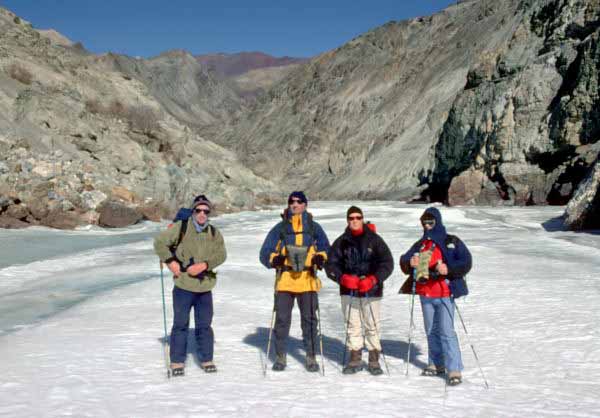
The trekkers |
 |
|
On the river |
|
|
The support team:
The group of four trekkers was accompanied by a French guide of the
selected tour operator. From Chiling, the local crew is composed of
a guide, a Lama of the Karsha monastery, and seven Zanskar-Pa as
porters of the group luggage, of food for the duration of
the trek and pharmacy.
Chiling, village 3,550m high, was the starting point
of the trek after a three-hour transfer by bus. This village produces
the brass and copper utensils sold at the market of Leh. We will find there,
on eighteen days later, the bus for the return to Leh.
After
a snack close to the three Chortens, we went down on the river to take
our first steps on the ice. This first initiation walk was
short, four hours. This three-day phase was marked by a blocking of
the group progression due to the thawing river that meant no walking on the ice,
Levitation was not possible in spite of our guide, Lama of Karsha monastery.
The following day, in the early morning to benefit from
the freezing of the night, we were able to cross the passage of
the day before. However, freezing was not sufficient, it was
necessary to take off shoes to walk in partially frozen water.
The effect on the group was biting!
I fell into the water with my camera which was covered with a
fine layer of ice. Indeed under water there was a second layer of
ice.
|
|
|
|
|
|
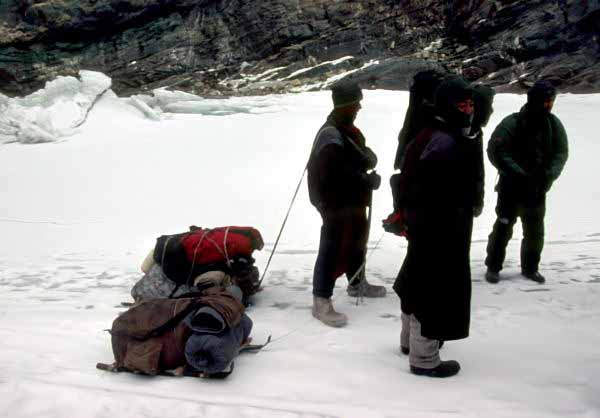
Walking on the river was cut by pauses, every two hours, to eat and
drink something hot. A walk day duration depended on
the localization of the cave chosen by the Lama for the night and
of the hazards met, it varied from 4 to 8 hours of walk.
After a three-day walk on the river we left it to go to
the Lingshed monastery. The progress was made by going
up a splendid canyon to the village of Skiupatta, 4,000 m
high, completely isolated in winter. The continuation by the Skiupatta
pass, 4,400 m high, in snowfields and by a foggy day enabled us to
reach the monastery.
|
|
|
|
|
Lingshed |
|
|
|
|
The collective
material:
The collective material was reduced to its minimum, it did not have anything,
except food, kitchen utensils, a pharmacy.
The nights passed in caves, more precisely under a kind of hood, or
under the stars. The night temperature was on average of -20°C
close to the campfire.
Lingshed,
+3,800 m high, built on the hillside in the 15th century. The monks of the
monastery welcomed us with tea salted with yak butter. We met young monks
chanting psalms read on paper strips. The temperature was sepulchral,
but very fortunately the classroom giving on the due south valley was heated by the sun.
About 1,000 inhabitants live
isolated in autarky all the winter in this pretty valley. The night was spent
in a very beautiful farm, well heated, which enabled me to finish the drying
of the camera which started again without problem. |
|
 |
|
A cave |
 |
|
Lingshed |
|
|
|
|
|
|
The return on the river was made by a small steep sided valley passing
through pretty canyons. The junction with the Zanskar river was a
climb on slipping rocks, because the junction, insufficiently frozen,
did not support the weight of the trekkers and the porters.
Traffic on the river _it was not Paris on a day of strike of public
transport_ made it possible to appreciate the utility of this
communication road between the two valleys. The meetings on the river
were mostly Zanskar-Pa carrying goods to sell at the Leh market.
We saw rafters of frames towed on the river.
Meeting Zanskar-Pa was always an exceptional moment of exchange of information,
in particular on the state of the river, punctuated by Djulé, Djulé !
|
|
|
|
|
The Zanskar valley |
|
|
|
 |
|
On the slope |
 |
|
Pidmo |
 |
|
Tongde |
|
|
Individual material:
It was adapted to the specific conditions of this trek beyond norms.
Canadian Boots with overbots equipped with small tungsten crampons, clothing system
of three layers, gloves and hat for low temperatures, sleeping bag for extreme
temperatures and a pair of slippers for the bivouac evening during the drying of the boots.
I never was cold. On the other hand, one should not
hesitate to cover oneself at the time of the passages in the shade. The
amplitude of diurnal temperatures is very important between sunny parts, of 0°C with +5°C and the parts
in the shade, of -5°C with -10°C.
Pidmo,
a village 3,500 m high, was reached after two days and a half of walk
on the river, we left the gorges. From there we were in the Zanskar valley,
we progressed on the mainland and slept in splendid farms.
Zangla, the capital 3,500 m high, was at the junction of a river with
Zanskar. A very beautiful ruin of the royal fortress of the 15th century is
visible on a rock peak.
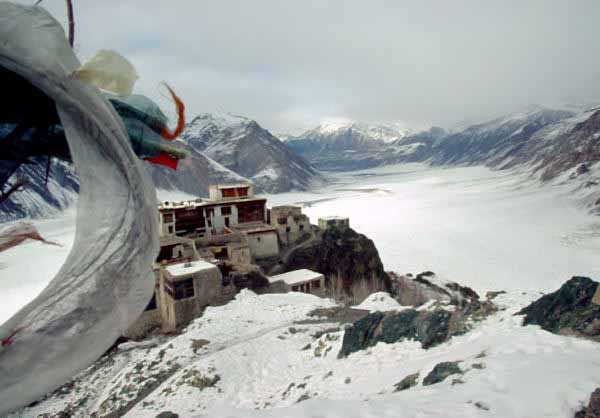
Tongde, a village and monastery 3,500 m high. The monastery is perched
on a hill dominating the plain of Padum. It is said to have been built by
the Tibetan Master Marpa in the 11th century, paintings
testify.
|
|
|
|
|
|
The sight of the plain of Padum covered with snow from the
monastery of Tongde was sumptuous. It was possible to see the Karsha monastery
on mountainside of the other side of the valley.
Three-day of walk in the Zanskar valley were necessary to reach the
Karsha monastery. Tiredness was felt in the group, a rest in the
monastery will be the occasion to recover one's health for the return.
|
|
|
|
|
Karsha |
|
|
|
|
Monastic life:
The Karsha monastery was the occasion to get exposed to monastic
life in winter and to share the meal of the monks, rice, vegetables,
salted tea mixed with tsampa.
We stayed two nights in the house of the Lama who was our guide. The
rooms were built in the house belonging to the family of
the Lama. Let us recall that the Tibetan society is polyandric, the elder
son gets married, the other brothers settle abroad, become monks, or remain
on the farm and marry the wife of their elder brother. The family provides
for maintenance of its members in the monastery.
Karsha, built
in the 15th century with buildings of the 11th, dominates the Zanskar valley
with its imposing mass on mountainside.
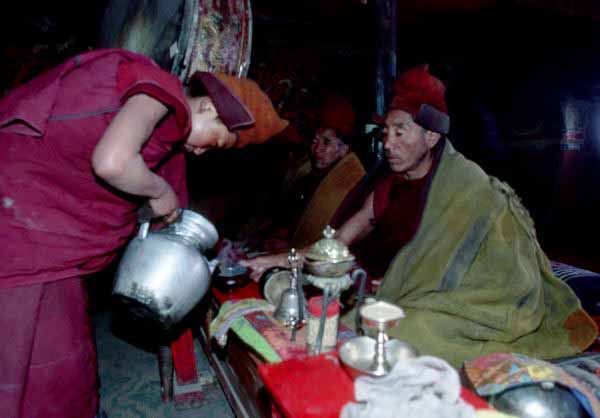
During our stay we attended several meetings of the monks in prayer
under their heavy greatcoat of red wool regularly drinking bowls of
salted tea with yak butter mixed with roasted barley flour,
Tsampa.
In the cell of the Lama our guide we attended a concert of Tibetan horns and
conches. The Lama is served by a young monk who carries out domestic tasks.
We were invited the day before of our departure by a cousin we listened to
Tibetan songs interpreted by the girls of the house wearing splendid
Perak covered with turquoises. |
|
 |
|
Karsha |
 |
|
Karsha |
|
|
|
|
|
|
The part on the mainland of the return way, for me, was made on horseback,
led alternatively by the Lama and his cousin, Dolma.
I had strong bronchitis together with a drastic turista which did not leave me in Leh.
It took one day and a half to go from Karsha to Pischu then Pidmo
|
|
|
|
|
The Zanskar valley |
|
|
|
 |
|
Pishu |
 |
|
Pidmo |
|
|
The photographic material:>
I left with me usual material, a reflex camera with two zooms, covering with 20 to 70
mm, a compact one of 35 mm, with the usual equipment in films
The reflex camera fell into water with me und was covered by a fine layer
instantaneously from ice. Two days of drying at the campfire allowed
it to work again.
Pischu, 3,470
m high, the village is announced by a long wall of mani and
chortens. We spent the night in a house belonging to the nunnery of
the village. Nunneries are very rare with very few nuns.
Pidmo, 3,420 m high,
we remained at the village to drink a salted tea with butter
and to take again the bags left on leaving. Then we went down on the frozen river. |
|
|
|
|
|
The descent on the river was started in the sun when we left the
mainland of the Zanskar Valley to enter into the gorges. The return
trek took seven-day. It was the occasion to meet Zanskar-Pa
returning to the village.
The progress required, for the outward journey as well as for the return,
passages on the banks when the river was not frozen enough. These passages
had more or less dangerous climbing giving rise to some frights.
|
|
|
|
|
The frozen river |
|
|
|
|
Physical preparation, psyche:
It was the flattest trek which we made. The unevenness is between 300
and 400m on the trek from Chiling to the village of Karsha.
No specific physical preparation for this journey, but a mental preparation
for living an exceptional trial under conditions at least sometimes difficult.
Chiling,
the return to the starting point was reached with a feeling relief
physical tiredness as well as mental tiredness almost unbearable.
Indeed the return appeared long to us with gloomy weather
on most of the way except at the end after the junction with
the Markha valley.
One day of transition was programmed in Chiling as we waited for the
bus. It enabled us to look at the copper, brass utensils makers at work, to
take the last photographs of the frozen river and to go on a last walk in this
delightful place in the shade of large poplars and mountains covered
with snow under a radiant sun. |
|
 |
|
On the river |
 |
|
Chilling |
|
|
|
|
|
|
The discovery of Zanskar in winter is a personal experience as much as
an societal experience with the meeting of Tibetan civilization as we
had lived in 1990 at the time of the first journey in Tibet, following
in Alexandra David-Neel's footsteps .
This ultimate trek in Ladakh, Zanskar will leave the image of a medieval
society in agreement with itself although alive under very difficult material
conditions, compared with the Western way of life.
But for how long will it still support young Zankar-Pa? Already the
exodus towards the cities of India, as civil servants, towards the army
are ways out of the roughness of the living conditions in opposition
with life shown by the media. The films produced
by "Bollywood" are an incentive to settle abroad.
Zanskar-Pa getting warm in the sun against the wall of their houses, children
playing in the snow, landscapes of Ladakh, of
Zanskar under snow, the quiet vastness of the plain of Zanskar, the
gorges of the frozen Zanskar river under various lightings at various hours
of the day are as many images which are engraved forever in my memory.
One is not completely the same after Chadar.
|
|
|
|
|
The return to France was made, after one night of transit in New
Delhi, in an Air France flight with a departure in the middle of night and an arrival
in Paris in the middle of the morning the next day.
|
|
|
|
| Neuilly, le 2003/07/05 |
|
|
|
|
|
|