|
|
|
Pakistan |
 |
|
Pakistan was created on August 15, 1947 the day after the
independence of the Indian sub-continent. It was originally in two
parts, Western Pakistan, the current Pakistan and Eastern Pakistan,
the future
Bangladesh.
The
thousand-year-old history of the Subcontinent will not be recalled,
it was briefly described on the
India page. The historical part relates to the later phase after the
partition.
The name, Pakistan,
given to the nation resulting from independence is said to have two
origins. For the first, it may come from a letter abbreviation of the name of the provinces,
Punjab, Afgania, Kashmir, Indus-Sins, BaluchisTan.
For the second, it may mean "The country of the pure". |
|
|
|
|
|
History |
|
Geography |
|
|
|
|
As early as 1906, the Moslem
spheres created the Moslem League. In 1930, the idea of an
independent Moslem State was conceived by the poet sir Muhammad IQBAL.
In the late thirties, Muhammad Ali JINNAH reorganized
the Moslem League in a mass party. He is regarded as the father founder of
Pakistan.
In 1946, the bloody clashes between Hindu and Moslem communities forced
the viceroy Lord Mountbatten to accept the Indian Subcontinent
partition. Independence was proclaimed on August 14, 1947.
It was followed by massive and deadly population transfers, 8
million Hindus and Sikhs were moved from Punjab to India and
conversely 6 million Moslems took refuge in Pakistan.
"Jammu and Kashmir" the Hindu Maharajah decision, whose
population was 85% Moslem to attach his area to India was
disputed by Pakistan and the war broke out.
On January 1, 1949 the division of Cashmere between the two belligerents
was made by UN on a precarious border called Cease-fire Line of Control. |
|
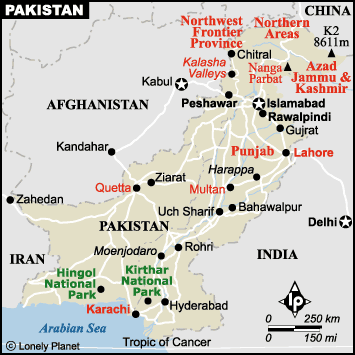
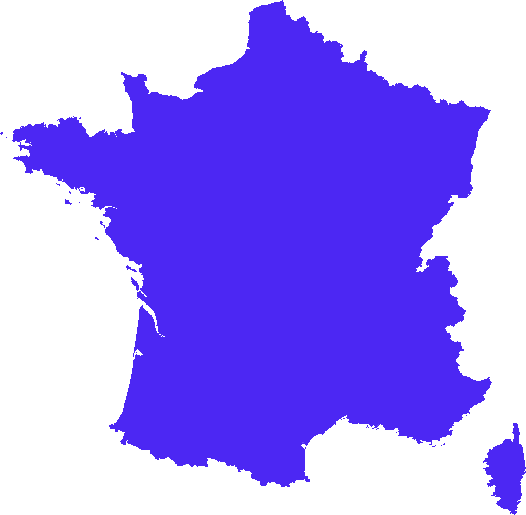
Pakistan whose surface is one and a half that of France, extends
from north in south on +1,800 Km. It can be presented in three
large areas maps.
The septentrional part, is made up of Himalayas, Karakorum and Hindukush
ranges which have four summits +8,000 m
high and 82 others +7,000m high.
The south-western part is formed by the Balutchistan plateau
which covers 44% of the territory. Its aridity less favourable to
farming and breeding has made of it a passage and traffic
area between Pakistan, Afghanistan and Iran.
The plains of Sind and Pendjab, Country to the Five Rivers,
constitute the basin of Indus and its four affluents. 3,200 km long,
Indus is the third longest Asia river. It is, like the Nile, the
Tiger and Euphrates at the origin of a great and brilliant
civilization, Harappa.
The Monsoon, mausim in Arabic, from June
to September is very light. Pakistan is a country with the
dry climate characterized by very contrasted altitudes and temperatures. |
|
|
|
|
The Pakistani landscape, like the geography, is very contrasted.
Deep, green and cultivated valleys are in the mountainous area. The Balutchistan
plateau is dry and arid. The alluvial Indus plain is the corn and rice
loft of Pakistan.
|
|
|
|
|
Economic facts |
|
Civilization facts |
|
|
|
|
Pakistan's
economy has endured two partitions, first from India then second from
Bangladesh. Moreover wars have catastrophic economic results.
Agriculture
provides the third of the gross national product. Productivity
remains low due to archaic means of production. The country is
self-sufficing in corn and rice.
The territory is not
very rich in mines. Electric power
is essentially of hydraulic and nuclear origin. There is also a little coal,
oil and gas.
Industry
contributes for the quarter of the gross national product. Progress
is slow due to the lack of capital, technology and qualified manpower.
The trade balance
shows strong deficit. Exports cover half of imports. The balance of
payments is balanced by the international assistance.
The Pakistani currency
is the rupee. |
|
The
official name is Islamic Republic of Pakistan whose capital is Islamabad,
a city created in 1961 in the Himalayas piedmonts a few kilometres
from Rawalpindi.
The population is approximately 150 million inhabitants. The
official language of Pakistan is Urdu, cousin of Hindi.
English is used by business and the administration.
Four ethnic groups form
the population. Punjabis, 64%, speak Punjabi. Sindhis, 12%, speak
Sindhi. Patchous speak Patchu, an Iranian language. Baloutches speak
Baloch.
The gross national
product is $282 billion the GNP is of $2.000 per capita.
Pakistan governed by
military regime seeks to affirm its identity by developing the reference to Koran,
the Charia is partially applied. The recent events do not support laicization.
The Pakistani are 97%
Moslems and 3% others. |
|
|
|
|
Pakistan attracts tourists either for treks in the Himalayas or for cultural
activities by visiting the archaeological centres or the monuments.
The North-West Frontier Province keeps apart from Islamic disturbances.
|
|
|
|
|
Information of the traveller |
|
Sights |
|
|
|
|
A six-month visa is
necessary to enter Pakistan.
The vastness of the
country, the diversity of the climates, the selected season are as many
parameters to be taken to define holiday conditions.
On the health plan it is
recommended to consult specialized websites, in France the website
of the Foreign Office. For trekkers in the Himalayas
no particular precaution is advised.
The traveller's
budget depends on his claims, Pakistan offers opportunities for
small budgets. |
|
Pakistan is also 4
provinces, speaking 5 vernacular languages and several local dialects.
Each area has its
personality, and its centres of interests. Several journeys will be
necessary to appreciate this cultural diversity.
The Karakorum Highway, KKH, from Rawalpindi to Kasha is a colourful
and exceptional landscape journey.
Sports
activities are possible in all Pakistan areas, treks, swimming, skiing.
Three
journeys were made from 1997 to 2001, three treks in the NWFP, North-West Frontier
Province. |
|
|
|
| Neuilly, le 2003/09/06 |
|
|
|
|
|
|