-- From the border of Cambodia to Angkor
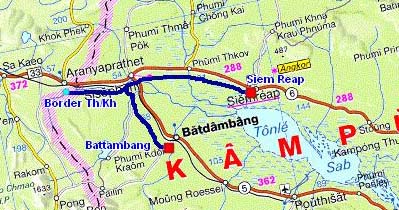
The road tracklog
From the border to Siem reap
from 12/01 to 14/01/2008
The border crossing on the 12/01 was described in the "Information" pages of both
countries, Thailand then
Cambodia.
The entry Cambodia was confusing so much the difference is large between the
both countries in the same geographical configuration. Road NH5 from Poipet to
Sisophon is a much degraded dirt track for the first thirty kilometres then it
became better. It is asphalted from Sisophon to Battambang. The landscape is
strewn with refuse and plastics bags. Villages are simple wooden houses on
piles.
In Battambang I found a bivouac along the esplanade of the river beside
Information Centre. Then I was going to stroll in the city. I changed money at
Western Union, open every day. Then I went to Internet, too slow. Finally I
took a collation on the pavement.
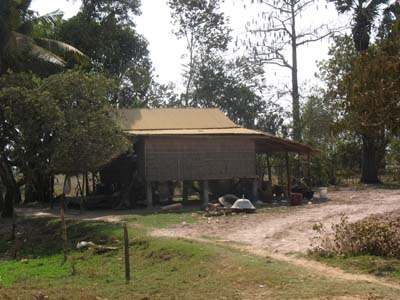
House on piles
the 14/01/2008
In this Sunday January 13 I visited the city by bicycle to discover old French houses. The most remarkable is the Governor’s residence prohibited to visitors. On the esplanade some houses preserved their original aspect. At the end of the afternoon a MAN truck came close to mine. It was Casper Jansen, a Dutch travelling alone. We exchanged information notably campsites.
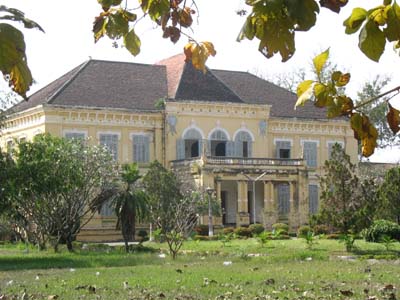
The Governor's residence
the 13/01/2008
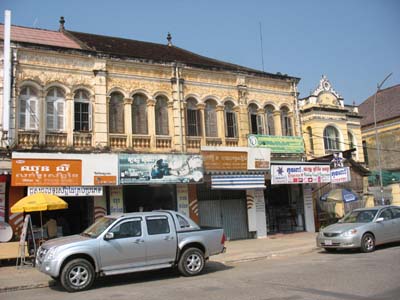
French houses
the 13/01/2008
After greetings and last information exchanged with Casper I left around 08:15 to arrive in Sisophon at 10:00 per 71 km on tarred road. Then the road became a dirt track as far as the entry Siem Reap where I arrived about 4:00 pm after 113 km, for a duration of 7:30 that is 24,5 km/h lunch pause included at a service area in Phnum Liep. The track was under work for a possible tarring in a few… times. The last kilometre before the entry the city is bordered with Top End hotels indicating that it is undoubtedly very tourist. Traffic was fluid. The bivouac was on a ground to be built between two houses by taking street Ph Sivatha on the left then the first street on the left. I took my marks in the city while cycling to the Information Centre which gave me a booklet then while strolling to find a supermarket and an Internet Café close to my bivouac.
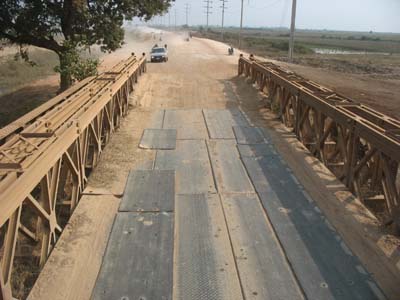
Bridge on road NH6
the 14/01/2008
The first day spent in Angkor was an amazement so much the site is imposing, gigantic monuments, disproportionate architecture and refined sculptures. The construction of these worship monuments in a city disappeared following various confusions from the invaders coming from the west and then from the east, given up by its sovereigns following the economic decline was spread out from year 800 to 1431 under the rule of ten main Kings. I cycled the small circuit from 6:30 am to 5:00 pm, is approximately about thirty kilometres from my bivouac downtown. It was impossible to avoid the horde of tourist groups except at lunchtime, because they went again to their hotels. This first contact left an mpression of incomplete, fortunately I remained several days. In this report it is no question of making an art book. There exist about it of very erudite in particular by the Ecole Française de l’Extrême-Orient, EFEO.
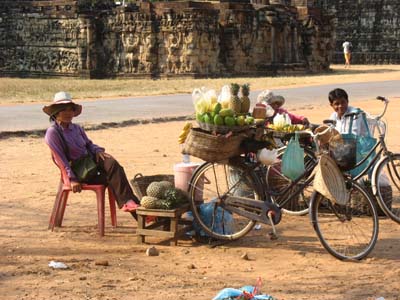
Fruit stall
the 15/01/2008
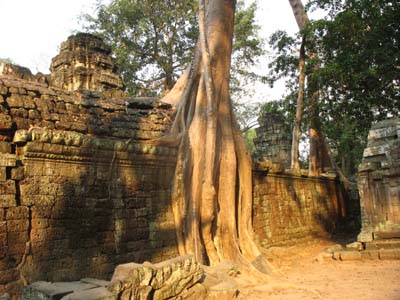
When nature came
the 15/01/2008
The following day I started in the night to Angkor Wat. When I arrived good places for taking photos were occupied by a crowd of tourists, it was the Parisian subway one day of strike. Alas this day there, the sun rose behind clouds, frustration of the tourist horde. This day was devoted to remake the petit circuit in opposite direction to supplement the visit of the first day. The architectural evolution appeared to me more clearly as well as the evolution of worship, temples devoted to Shiva then modified for Buddhism.
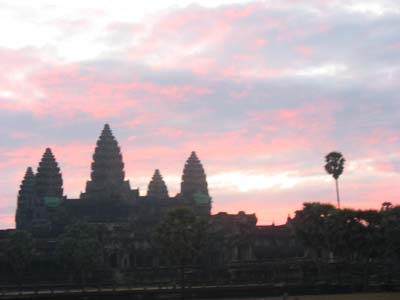
Sunrise
Angkor Wat
the 17/01/2008
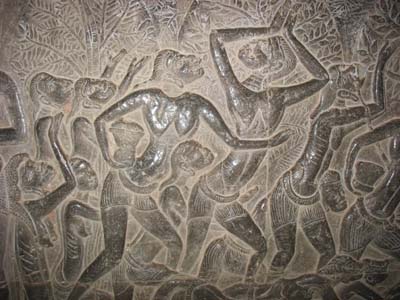
Bas relief, Dancers
Angkor Wat
the 17/01/2008
This day there I cycled the grand circuit of 27 km by revisiting at the sunrise the Bayon temple and its enormous faces of Avalokiteshvara. Then I was going to see on the avenue of the Victory the Buddha under Naga, called Jayabuddharmahânâtha. The grand circuit makes it possible to admire in particular Preah Khan built in the 12th century. It marks the evolution of Khmer architecture by the passage from the verticality of the temples mountain with the high central tower, representing the mythical Mont Meru centre universe to the horizontality of the temples with corridors. Let us note that the Khmer architects had not discovered the semicircular arch, their corridors are very narrow. At the same time on other side of the ground the Mayas had not discovered it too.
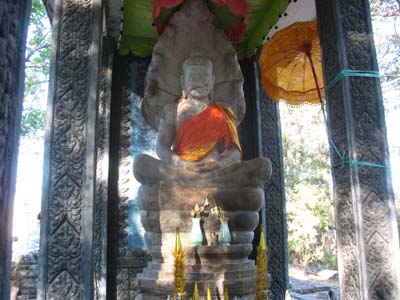
Bouddha under Naga
Vihear Prampil Lvèng
the 18/01/2008
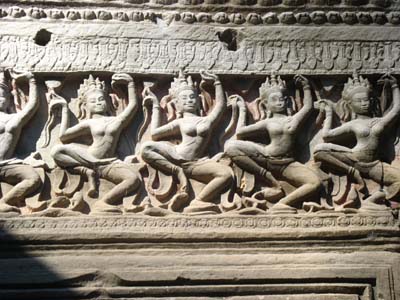
Bas relief,
Dancers
Preah Khan
the 18/01/2008
The 19/01 before cycling again the grand circuit I turned over once again to Angkor Wat at sunrise to take “The Photo”, que nenni I will never publish in GEO. Since my first visits the tourist groups most important were Chinese people before Japanese people then local people and finally Westerners. Some people of these groups were specialized in the tomfooleries in front of monuments. While going again in front of the Terrace of Elephants I stopped to take a photo of one of the towers, Prasat Suor Prat.
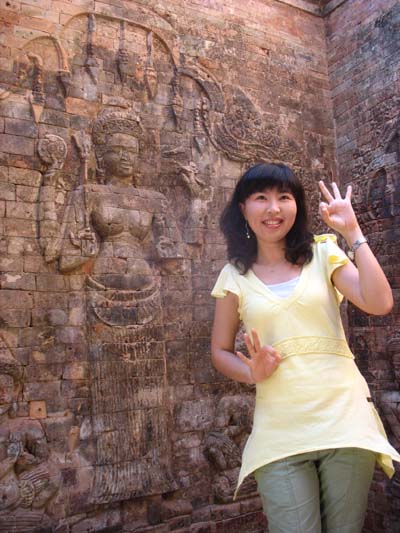
Chinese girl in front of Lakshmi
Prasat Kravan
the 19/01/2008
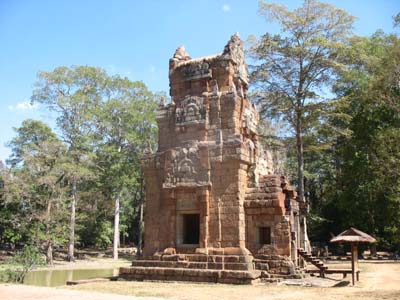
Prasat Suor Prat
Angkor Thom
the 19/01/2008
As I said at the time of the first visit, the site is imposing, its construction
is spread out from the 9th century to the 14th century, disproportionate, I
cycled more than 150 kilometres in four days, refined, sculptures attest
control of this art, cosmological vision of the universe sublimated by
architects, given up after the fall of the Angkorian empire but rediscovered
in 1860 by Henri Mouhot.
Let us recall that there as elsewhere share in the world monuments are to
worship only worthy to be built out of durable materials. Dwelling houses out
of wooden disappeared. Archaeologists estimate the population at several
hundreds of thousands of people occupied by public and military
administration, maintenance and animation of the temples, clerks, musicians,
dancers, finally farmers and slaves providing the muscular force for the
construction of the temples.
The decline then the fall of the Angkorian empire is there too common to the
other empires, ceaseless wars, construction of megalomaniac buildings
despoiling the people. The economy of the empire became bloodless. The close
countries became powerful, Siam and Viet-Nam. The Khmer kingdom was folded up
after the sack of Angkor on Phnom Penh which is always the capital. It occupies its ancestral territory
moreover it should be noticed that its population is to 99% Khmer unique fact
in the region.
Sunday 21 I prepared the trip to the northern Cambodia to visit the main sites, Prasat Preash Vihear, Koh Ker and Preah Khan.
The following week I visited remote Angkorian temples in the Northern area.
