Report of the end of trip into India
Thanks to:
-- Marie-Lou and Christian.
-- All met people on the move.
Incredible !ndia
India Tourism slogan of Government of India.
In prolegomena I would like to clarify some points throwing light on the remarks which follow. I practiced before packed tours during my occupation, see my website "Journeys". The trip round the world is an individual journey confronted with a daily reality of the visited country. As much to say immediately that lived of the two experiments only few common points have if they are the visited sites. Some judgments could appear negative to faultfinders. They come out from my everyday real-life and instantaneous observations. Even by doing the effort give up my behaviour of Westerner, the cultural difference implies sometimes excessive reactions.
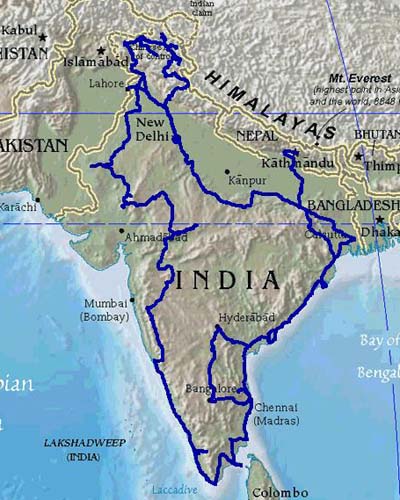
GPS tracklog of the trip in India
I Teams:
During the two stays in India, the team was composed
of my MAN truck and myself. I met a number of travellers in the camper van as
well as French and foreigners, German, Dutch, Austrian, Swiss, Spanish with who
I exchanged information.
II The journey:
A journey in India depends on several
factors: Entry and exit point in this country and especially centres of
interest. It is necessary to keep in mind that it is impossible to see all
sites and especially to understand India, it is essential to remain modest.
There are choices to make taking into account distances which are very large
and state of the road infrastructures, and also of the pressure of people as
well as climatic conditions. I wished to re-examine some sites of interest
visited at the time of my preceding trips and to see Orissa, Tamil Nadu and
Kerala. The accident in Munnar and the climatic conditions modified the
initial road plan.
2.1 the circuit:
The project presented, Presentation
thumb of the menu, was changed to stay at
the Man-Force garage in Ernakulam then to go to the Man-Force workshop in Puna.
Consequently I can not see again sites in Karnataka. Then I fled the heat in
Rajasthan by exiling me for a first stay in Ladakh before going in New Delhi
for a third stop at the Man-Force workshop in Gurgaon as a result of the
accident in Munnar.
Finally I went as envisaged to Pakistan for two-month stay in the Northern
provinces. Then back into India I went again to Ladakh to visit Nubra Valley,
Pangong Tso and Tso Moriri. At the stage in Manali, after Johann Pavia’s
advice, I decided to visit Spiti valley and Kinnaur valley to finish in Shimla.
On the road to New Delhi I stopped in Chandigarh, capital of Punjab and Haryana,
city designed by Corbusier. The stage in New Delhi was required by
the routine servicing of my truck according to recommendations of the
manufacturer. Moreover I had to choice the port of loading of my truck to
Malaysia. For this purpose for several weeks I had tried to obtain, by emails,
quotations from shipping agents in Chennai, Chittagong (Bangladesh) and
Kolkata. Interfreight Services PVT. LTD in Chennai quoted most
competitive by taking account of the way.
The journey represents more than 22,547 kilometres on a road network in
general degraded with a traffic not very dense except in the great cities,
with a left driven and a behaviour of the Indian drivers.
This distance was made in 254 days that is to say an average of 89 kilometres
a day.
2.2 The road network:
Without speaking about roads or rather about tracks about Ladakh, Spiti valley
and Kinnaur valley, the state of the road network in India is not at the
height of this great power and harm its economic effectiveness. Some big axes
are with tollgate even and especially when there is work in progress. I keep
in mind an organisational disorder. It is not rare to see structures in
neglected state for a long time as well as in the cities and in countryside
giving the impression of no completion. Moreover it seems to me that the works
in progress do not have any perennially have regard to the overload by axle of
the Indian trucks. Indian newspapers were made the echo of disorder by
stigmatizing no control of the government organization, NHAI, in charge of the
infrastructure road, understatement to speak about corruption. Indians
themselves, when they speak about the road networks, say with a ironic smile,
That is India.
At tollgate I discussed the price for my truck, to not tax it like a truck but
like a van, “Light Commercial Vehicle, LCV”. In 80% of the cases I had profit
of cause.
2.3 Indian drivers:
The behaviour of the Indian driver of private car is common to all Asian
countries. I take again my comment written for the Pakistan report.
One of the
most dangerous aspects is the systematic cutting in. That one is pedestrian,
cyclist or motorist when one precedes a vehicle which must turn on the left or
even on the right, the driver does not have patience behind, he overtakes and
makes a cutting in, without indicator of course.
The use of the indicator is specific of these countries. Driving on the left
lane, the indicator of right-hand side is used to announce to the vehicle
coming in opposite direction that one lets it going either that it overtakes
or that the roadway is with narrow lane or reduced by work.
The behaviour of truck drivers is altogether exemplary. They respect the
upstream vehicle priority.
As elsewhere in Asia, coach drivers do an immoderate use of the sound horn
with several tonalities.
2.4 The insurance of the vehicle:
I subscribed a one-year insurance in Kathmandu valid in Nepal, India, Sikkim,
Bangladesh and Bhutan.
2.5 Various facts:
The most outstanding fact was the accident in Munnar reported by the travelog.
Two other incidents enamelled my everyday life, on the one hand the recurring
problem of the valve of the brake air tank and the desiccato at the moment of
the truck starting and on the other hand a crack at the expand tank of the
hydraulic clutch actuator consequence of trepidations due to the bad condition
of the roads.
III Bivouacs:
To find a bivouac in India is not
an easy task. There is not infrastructure both for the camp-site and for the
parking of the motor homes. Apart from the beaches of the eastern and western
coast, the wild camp-site quickly becomes a martyrdom have regard to the crowd
of curious stationing close to the vehicle. I used the experiment of my
predecessors, J.C. Griffoin like Simone and Jean Moriot. Out their experiment,
a good source of information is of course Tourist Information Centre of the
visited State. The met travellers were seldom a source of information. Their
remarks were very often vague and sometimes my request remained unanswered. On
the other hand I gave them a copy of the table of my campsite-positions. On
the way I attended the areas of petrol pump, generally Indian Oil where I
supplied in diesel. I also practiced A1 Plaza of Reliance whose advantage is
to have a restaurant, showers and to be able to supply water. For that it is
necessary to note down the localization of A1 for the envisaged road from a
mural map in the petrol pump. But it is necessary to be ensured of their real
existence because some are in construction or disused!
The table of menu Campsite-position
gives waypoints of all my bivouacs as well
as mileage between each stage. I made it to be useful for travellers in camper
van. I do not have the claim to have found the best sites of bivouac. But it
is reassuring for a traveller of knowing that there is a possible bivouac near
the place where he is. I wish that this information have some utilities and
cause travellers to be made some in the same way. It would be interesting
besides that the association of the Camping-cars sur les Route de la Soie et
du Monde creates a database by country downloadable by members.
IV Supplies of food:
The hypermarkets are rare except in the big cities. It is necessary to be often
supplied in the small trade around the fruits and vegetables market or close
to the bus stand. Tins of tuna, corn flakes etc are difficult to find except
in Ladakh, for the trekking. In theory all the gravers have bread, toasts,
very often with the date of manufacture. The manufactured goods have the price
printed on packing.
In general I lunched or dined once per day at restaurant, at the corner of the
street in a dabha. I never had intestinal problems.
V Fluids:
There are several petrol suppliers in India. India Oil is the best represented where
I supplied myself. There are two categories of diesel, normal and premium,
XtraMile at Indian Oil. I always took this category except in Ladakh, Spiti
and Kinnaur valleys where only the normal category is available.
Except in Ladakh, in Spiti and Kinnaur valleys, the supply water did not pose
a problem. Sometimes it is necessary to ask local people to know where the
water pump is.
VI Money:
In India life is not expensive. The main post of expenditure, here like
elsewhere, is the diesel. Practical the Informations
page gives some costs as indication. I gave, with the current publication of
pages of this website, the evolution of the main expenditures, tolls of
roads/highways, cost of carparks, cost of visits, cost of the diesel litre. I
did not give the food cost because it is not representative. Inflation exists
one year on the other.
My bank HSBC is very well represented in India with ATM's.I already mentioned
that the advantage is the withdrawal without fee, which in fine represents a
considerable economy in fine. The withdrawal is limited to 12.000 INR per
transaction with the weekly limit of the held chart.
During the journey, the rate of average balanced exchange without commissions
was of 56.78 INR for one euro.
VII Guides:
I never took a guide to visit the sites. I had the Guide Bleu et Lonely Planet.
VIII Passport, visas, border crossings:
8.1 Visa to Pakistan:
A visa to enter India was taken in Katmandui the 29/11/2006. The cost of the
visa was 3050 NPR for six months and 300 NPR to send a fax for information to
France.
8.2 Border crossing from India to Pakistan:
The exit from Nepal and the entry India the 14/12/2006 did not support any
difficulty and lasted a minimum of time, see the
Travelog of the journey.
8.3 New passport:
During my trip in Pakistan I made renew my passport which did not have any
more virgin page for visas. I asked for a new biometric passport. For its
obtaining under four weeks it is necessary to produce a birth certificate of
less than three months. I received it the 17/07/2007.
8.4 Visa to India:
A visa to return into India was required the 16/07 and was obtained the 23/07.
The cost of the visa is 3300 PKR for six months.
8.5 Border crossing Pakistan/India:
The exit from Pakistan and the entry India the 04/07 was held as simply as on
arrival except Indian side where the six months deadline between two entries
of a vehicle posed problem to the customs officers,
Travelog of the journey
IX India:
To try to understand the reality of Pakistan and its
future I point out its remote and close origins briefly.
9.1 History:
It is common to the entire Indian subcontinent. I return the reader to the
§ 9.1 the report of the journey to Pakistan.
9.2 Facts:
With a population of a billion people, India became an economic power which it
is necessary to take into account. Signs are obvious:
-- Number of private cars is increasingly important getting doubtful traffic
in cities.
-- Tourism is in exponential growth in all tourist areas
-- Nuclear industry is present in the two sectors civil and military.
-- Space industry is emergent with the launching of rockets in space.
-- Power of IT industry is not any more to show.
-- Many other industrial sectors start to have an international size.
And more recently:
-- Purchase of European iron and steel industry, Arcelor and Corus by Mittal
Steel and Tata Steel,
-- Publication by Fortune magazine of the classification of great world
fortunes revealed three Indian families in the Top Ten. In its report the
newspaper Le Monde specified treacherously that there are in India 400 million
people who live with less than one dollar a day.
But also:
-- Corruption remains endemic in all the Indian sub-continent.
-- India the biggest democracy in the world is dominated by a system of
co-optation of the representatives as well on the level of the Union as on the
level of the States.
-- Infrastructure, roads, railroad and others are very late and damage the
economic effectiveness.
9.3 Hope reasons:
They emergent.
-- Revival of the political community
-- Power of the Indian diaspora abroad.
-- Awakening, in universities, of the disuse of the caste system
And especially
-- A very important emulation by the emergence of the Chinese economic power.
9.4 Mobile phone:
Mobile phone in international roaming does not work in Jammu & Kashmir and in Himachal Pradeh
close to sensitive borders.
9.5 Last news:
"Logan" car by Renault is produced in India by Mahindra.
X My appreciation:
To structure my talk I approach it with the five senses sight and taste for what I
liked, smell and hearing for what I disliked. Touch was never
consider.
10.1 I liked:
-- Visual landscape was partly exposed by the
tracklog with the current. Indian culture is dual, at the beginning with Védas,
it was a Hindu and Buddhist then Moslem with Arab, Persians and Timurids
invasions. Finally British Raj left a differentiated if not disputed mark.
Hindu and Buddhist art is of a complex approach have regard to their great
number of deities, to the symbolic system of the forms and gestural from the
epic novels bases of Indian culture, Mahabharata and Ramayana. Indo-Moslem art is
more easily accessible for non-figurative. However it is made conspicuous by
the miniatures, expression of the courtly love to the Eastern one. British Raj
left administrative monuments, railroad, language and democracy; certainly it
is not little, but no industrial, medical and educational infrastructure.
It is necessary to be conscious that there is no pure art awaited the
continuum of the history, contributions of permanent foreign artists called by
princes or prisoners at the time of the conquests. Specialists,
archaeologists, ethnologists and historians spread themselves in explanations
more and less studied and sometimes discussed. For example read in the French
Blue Guide by the way Red Fort in Agra, “… the harmonious beauty of this
building where combine decorative elements Rajputs and Indo-Moslems plated on
a majestic typically Indian structure.”
--Gustatory landscape is worth to
be told. When I visit a country I adapt me to the cultural and worship
differences, art of cooking is part of it. The food of the Indian is closely
related to the climate, to agricultural production like to practice religions.
More than 80% of Indians are vegetarian. I attended any kind of restaurants,
from upmarket to truck driver restaurant (dhaba). Even in restaurants of
international hotels food has only little thing to see with those been useful
in the Indian restaurants in France which adapted foods to the French taste.
Indian food varies between the north and the south, climatic and worship
cleavage like between the west and east, Punjab and Bengal. However basic food
is composed of rice in the south, bread (chapati) in the north and of lentils
(dhal) in all India. Of course the whole is seasoned with spices. In the south
the most widespread dish is the “Veg thali” rice served in a circular metal
dish or on a banana sheet accompanied by ten vegetables going from much spiced
to sweetened and ending with curd to extinguish fire. Rice is as you can eat.
On the littoral eastern and especially western in Kerala, the fish is
abundant. It is very often served in “Fish thali”. The meat is rare and
expensive. Chicken is the most widespread and in the Moslem areas mutton or
more often goat. The markets are well supplied out of vegetables and fruits of
excellent quality. The fruits of all kinds are abundant and succulent.
On the move, I liked to stop in the morning and in the afternoon to drink an
Indian milk tea accompanied very often by a “samosa” (fried pyramid pasty
filled with spiced vegetables).
Indians eat with the right hand without forks and spoons. Restaurants have a
corner with a wash-hand basin to rinse the hand after lunching! In dhabas it
is possible to have a spoon but fork and knife are unknown. See an Indian to
eat a veg-thali is a spectacle; he mixes rice with the various vegetables
which he nimbly put in his mouth.
10.2 I disliked:
--Olfactory landscape, “Odour of
India” is one of the major characteristics of this country. The fragrance is a
blend of the best and the worst. The best is quickly presented, number of
shops burns incense sticks to mask the worst. The worst is a compound of the
odour gave off by the refuses in decomposition which strew the landscape as
well as in cities and in countryside with the odour of the burning of this
rubbish as well as animal and human dejections.
Dustbin, public container and trucks buckets do not exist or little in the
great agglomerations. The population throws refuse in street. In the cities
they are removed. In the countryside they are generally burned.
Dejections as well as animal and human give off an odour which seizes tourist
at the turning of a monument, a street etc, in spite of the panels of recall,
“Open urination is forbidden, Fine 25 rs”. Indian male urinates anywhere. It
is not rare to see him at the edge of a road or in a street of an old district
making his needs either as Arabic or as European. When I stayed on the public
carpark in Mamallapuram, the back of my truck masking the view quickly became
a toilet, in particular for the women.
Toilets are rare, when they exist they are announced by the sign, “Toilet, Pay
and uses it”.
--Sound landscape of India is worth to be presented. It takes part in the
culture and the civilization of this country. Moreover it plunges its roots
into the Vedas.
As well as in cities and in countryside the first sound heard in India is the
horn of buses. It is strident with several tonalities. It is a pressing order
to line up a free lane. The horn of trucks has another tonality and is quite
as imperative. All commercial vehicles painted at the rear: “Sound Horn”. Of
course private cars are not in remainder. Motorbikes are not the least quiet.
Their driver permanently uses the horn of two short blows.
The excessive use of the horn arises from the non observance of traffic rules
in spite of many panels of recall: “Obey Traffic Rules”. Indeed no vehicle
uses the turn lights and drivers never consult the rear view mirrors when they
exist.
The vehicles of intervention, police, firemen, ambulances, etc emit sounds
quite different from those in France. Moreover in Europe the sounds of these
vehicles are specific of each country. The European Union did not try to
standardize them.
In Bangalore staying at the CWC I was to a hundred meters from the KR Puram
Railway Station. Trains, at the approach of the station and during the entire
crossing, ring a sound with a deep tonality. Indeed the railways are not
protected. Indian people cross them at any hour of the day and the night.
Traffic in cities very quickly becomes martyrdom. Sound pollution is the most
unbearable aggression.
One of the major aspects of India is the integration of arts. An artist is all
at the same time poet, painter, sculptor, musician and dancer. There is no
musical notation leaving the creativity of the artist free to express his
emotions. There are three types of music, the sacred music, Vedic, the
classical music, Raga, and the popular music, Carnatic.
It is not rare, at the turning of a temple to hear a sung artist being
accompanied himself with an harmonium. Sometimes temples use an over-boost
sound system emitting a shooting music for a Western ear.
XI The return trip to India:
The purpose of the return into India was to do a service of my truck and to
ship it to Malaysia. Beforehand I was to spend August in Ladakh and September
in Himachal Pradesh, not to brave monsoon in the northern India.
XII Relevance of this trip by camper:
The question must be put so many roads apart from
the beaten tracks were in very bad condition. Moreover a permanent aggression
of horns of trucks and buses was insupportable. On the way towards Chennai to
ship my truck, I did not support any more this pollution
accompanied by the loud speakers of villages diffusing songs for any Hindu celebrates.
India is the country of all pollution. The slogan of the Information Tourism
is relevant.
Of course I will travel again with my truck, however differently.