Report of the end of trip into Pakistan
Thanks to:
-- Christian and Marie-Lou.
-- My predecessors of the association of the Camping-cars on
the Road of Silk and of the World,
-- French people met in Tourist Campsite in Islamabad,
-- Mark and Walter, German travellers,
-- Pakistani who helped me on route.
The plan adopted for the Report of the trip into China is used as groundwork for reports of journey. Of course adaptations are made case-by-case. This report was written partly at the time of weeks waiting of the Indian visa lasted in Islamabad during which hot and wet weather alternated with torrential rains.
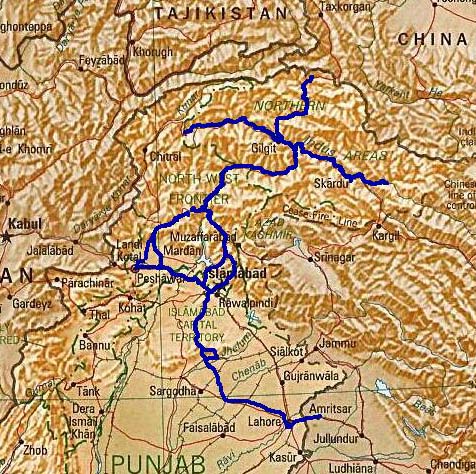
GPS tracklog of the trip in Pakistan
I Teams:
From Nepal, October 2006, I continued the journey
with my MAN truck. An individual trip and moreover lone has its advantages
and its disadvantages. It is not my matter to make an inventory of it. Some
aspects appeared in filigree in pages of the travelog.
For little that one is sociable, one is never lonely; met travellers of any
nationality and especially Pakistani come to meet me.
II The journey:
The majority of the camper-drivers are in transit in
Pakistan, coming from Iran and going to India or conversely, passing through
Islamabad looking for a visa to the following country. Rare are those who
visit the Northern provinces except those going to China by Khunjerab Pass.
Such was not my project. It is besides one of the limits of this report
because the Southern provinces were not visited.
2.1 The tour:
The original project was to re-examine the
mountainous provinces which were the theatre of three treks of which one with
the climb of
Mingli-Sar, 6,050 meters high, for my sixty years then to see
accessible valleys with my truck.
Reality was contingent several events, I fled the heat both in India and in
Pakistan, I awaited a new passport and spare parts, finally I needed a visa to
go again to India with the target of going to Southeast Asia.
The real tour passed through the valleys of Skardu and Gilgit River not
planed at the origin. Swat valley was partly visited by the south have
regard to prohibition to cross over Shangla Pass for my safety.
It represents nearly 4,400 kilometres on a road network in general degraded
with a not very dense traffic except in the great agglomerations with a left
driven and a Pakistani’s driver behaviour sometimes disconcerting.
I must say as of now that June, July and August is not and by far the most
favourable season to visit Pakistan.
2.2 The road network:
The Pakistani road network offers the best and the worst
given that the best was the exception and the worst the everyday.
-The best was the motorway M2 from Lahore to Islamabad; it is at the European
standards with parking areas comprising restaurants and shops. Of
course M2 is with toll, to see the tracklog page concerning my
mishap.
-The worst was the road from Besham to Shangla Pass, I put seven hours to do
34 kilometres indeed the spectacle was dramatic.
-Between them there is the Grand Trunk Road which is in general in good
condition and Karakoram Highway which has potholes and landslides.
Normally the Grand Trunk Road is with toll, but with a great smile and
sometimes with the argument of the foreign visitor, I did not pay at Toll
Gate.
I saw radar controls as well on M2 as on Grand Trunk Rd.
2.3 Pakistani drivers:
The behaviour of Pakistani driver of private car is
common to all Asian countries.
One of the most dangerous aspects is the systematic cutting in. That one is
pedestrian, cyclist or motorist when one precedes a vehicle which must turn on
the left or even on the right, the driver does not have patience behind, he
overtakes and makes a cutting in, without indicator of course.
The use of the indicator is specific of these countries. Driving on the left
lane, the indicator of right-hand side is used to announce to the vehicle
coming in opposite direction that one lets it going either that it overtakes
or that the roadway is with narrow lane or reduced by work.
The behaviour of truck drivers is altogether exemplary. They respect the
upstream vehicle priority.
As elsewhere in Asia, coach drivers do an immoderate use of the sound horn
with several tonalities.
2.4 The insurance of the vehicle:
I did not have insurance for my truck. It is necessary
to be extremely cautious.
2.5 Various facts:
At the time of this trip in the north, I noted that
there was rather less accident of trucks than in India, little trucks in the low
side of the road, little frontal crashes between trucks.
III Bivouacs:
Except in Swat valley, reality or psychosis of
police with respect to foreign tourists, there was not, during my trip,
problem of safety. When it was possible I practiced the wild campsite. However
it should be remembered that in mountain the flat grounds are extremely rare.
Being alone I sometimes bivouacked inclined. A good option is the use of the carparks
or lawns of the PTDC Motels. In general the manager is welcoming.
I recommend particularly that one in Gilgit where the people of Tourist Centre
are very eloquent and give reliable information on all the area. They know all
PTDC Motels and their possibility of carpark for truck. In general the cost
was 100 PKR per night. The total cost announced in the sheet of
practical Information takes account of nights in hotel in Peshawar and
Malam Jabba.
I did not practice the bivouac on the service areas except on M2, see
Campsite-position.
One of the great moments in looking for a bivouac was the rise to the
Polo
Ground in Karimabad. Very anxious of the possibility of doing it with my
truck, the population reassured me and helped me to go up.
IV Supplies of food:
Except in Islamabad and Lahore, there is not any
supermarket. Pakistan is the country of small shops even of graver at corner of
a street with dusty products. The supply in bread, toasts, did not put any
problem. It is necessary to look for Bakery. Local eggs, fruit and
vegetables are in quantity in all bazaars.
In general I lunched or dined once per day at restaurant, PTDC Motel or at
corner of a street. I never had intestinal problems.
V Fluids:
The Petrol State, PSO, is present on all the
territory. There are some Shell stations in the great agglomerations and on
Grand Trunk Road. I met two Total stations. The price of the diesel varied
little during my stay.
The water supply did not pose any problem. It is enough to manage it according
to the parking in PTDC Motels.
Be careful the manufacturers of chassis cabin for motor home are not present
in Pakistan except Mercedes and Volkswagen, there are some Sprinters. For
trucks, the market is held by Hino and Nissan. Bedford old trucks are
still in great number.
VI Money:
In Pakistan the life is not expensive. The main post
of expenditure, here like elsewhere, is diesel.
Practical Information page gives some costs as
indication.
I gave, with the current publication of pages of this website, the evolution
of the main expenditures, tolls of roads/highways, cost of carparks, cost of
visits, cost of the diesel litre. I did not give the food cost because it
is not representative. Inflation exists one year on the other.
My bank HSBC is present in Islamabad, Lahore and Karachi with ATM’s. I already
mentioned that the advantage is the withdrawal without fee, which represents a
considerable economy in fine. The withdrawal is limited to 20.000 PKR per
transaction with a weekly limit of the held card.
During of the journey, the rate of average balanced exchange without
commission
was 82,15 PKR for one euro.
VII Guides:
I took a guide to visit the Khyber Pass and Lahore. The
excursion to Khyber cost 2000 PKR for the car driver, the guide and the tip to an armed
guard and in addition 120 PKR for the Permit of the trip. With experiment, the
guide is not useful; he did not have many comments here to say. The Lonely
Planet guide book is largely sufficient.
In this part of Pakistan there are few paying visits except in Gandhara
area for archaeological sites.
VIII Passport, visas, border crossings:
8.1 Visa to Pakistan:
A visa to enter Pakistan was taken in Delhi the
25/05. Beforehand I went to the embassy of France to have a letter of
certification which I was well Guy BAZIN holder of the N°nnnn passport. The
cost of the visa is 1260 INR for three months.
8.2 Border crossing from India to Pakistan:
The exit from India and the entry Pakistan the 03/06
did not support any difficulty and lasted a minimum of time, see the
Travelog of the journey.
8.3 New passport:
My passport not having any free page for visas, I
asked for a new biometric passport. For its obtaining under four weeks it is
necessary to produce a birth certificate of less than three months. I received
it the 17/07.
8.4 Visa to India:
A visa to return into India was required the 16/07
and was obtained the 23/07. The cost of the visa is 3300 PKR for six months.
8.5 Border crossing Pakistan/India:
The exit from Pakistan and the entry India the 04/07
was held as simply as on arrival except Indian side,
Travelog of the journey.
IX Le Pakistan:
To try to understand the reality of Pakistan and its
future I point out its remote and close origins briefly.
9.1 History:
It is common to the entire Indian subcontinent.
-- Around 2500-1500 BC, the age known as of Indus developed along the eponym
river. The discovery of the cities of Harappa and Moenjodaro attested of a
very elaborate administrative organization and a population of approximately
five million. It declined for reasons if not unknown factors at least
discussed between specialists in various obedience.
-- Around 1500 BC, the beachcomber of the Aryan tribes come from Central
Europe
was established gradually in the area. Their sacred book, Veda, was written at
that time. It is at the origin of the Hinduism.
-- Around 500 BC, Darius, the Persian Great King, created satrapies in current
Punjad and Sindh.
-- Around 326 BC, Alexander the Great stopped his progression in Gandhara
before crossing over the Khyber Pass to return to Greece. Greek art influenced
the Buddhist statuary known under the name of the art of Gandhara.
-- Around 321 BC, the Maurya Empire controlled all the area by diffusing
Buddhism up to Tibet.
-- Around 711 AD, successive wave of Arab troops broke in the area by imposing
Islam.
-- Around 1020 AD, Mahmud of Ghazni then around 1191 Mohammed of Ghur,
Afghans, made several stiff up to future Delhi. The sultanate of Delhi was
creates in 1206 by Qutb-ud-DIN.
-- From 16th to the 17th century, Mughal come from the Central
Asia became the Rulers of all the north of the subcontinent. They developed a brilliant
culture influenced by Persian art.
-- From 17th century to August 13, 1947, the British dominated the entire
Indian subcontinent gradually. The English heritage is not negligible,
monuments, railway, the English language and parliamentary primarily in the
Indian Union.
-- In August 14, 1947, Pakistan was born in the pain. Migrations of Moslems
towards Pakistan, Hindus and Sikhs towards the Indian Union made several
million dead on both sides.
The name of Pakistan has two origins. It means “the Land of Pure” and it is
the acronym of Punjab, Afghania, Kashmir, Sindh and Balochistan.
-- In December 1971, Bangladesh was born.
9.2 Facts:
-- Pakistan is a mosaic of ethnos groups and
languages. The Urdu, national language, is the mother tongue of less than 10%
of the population. In the governmental authorities, English is the working
language.
-- The Tribal Areas, in the west from Peshawar along the Afghan border,
are an area of non Pakistani law. The system of castes, tribes and clans
remains the base of the social organization.
-- Islam is the only common point of the Pakistani, 96% of the population,
assertion to be moderated. The two main sects, Sunnites 77%, and Shiites 20%,
are under foreign influence, Saudi Arabia and Iran. Ismailis account for
hardly 3% of the population especially present in Hunza valley and Gilgit
valley. Currently the country is divided between moderate and orthodox
Moslems, without forgetting Taliban. Escalation between these various
factions is daily and made deaths in Islamabad recently.
-- Nearly 50% of the population is illiterate. Although Pakistan freed itself
from the charia, the majority of the population still observes its rules.
-- The population quadrupled since 1947 and would be 217 million in 2020. For
much of Pakistani the birth of a child is a Allah's gift. Family planning
is impassable. I had a discussion on this subject with both Ismailis met in
Dahimal which ignored the contraceptive means.
-- More than 60% of the population is rural. The Pakistani society is divided
into two classes, the rich who has nearly 80% of wealth and the poor.
Approximately 20 families have nearly 60% of wealth. The financial and
political families are closely overlapping. This social fracture is visible
especially in the megalopolis, Lahore.
-- Corruption remains endemic in the entire Indian subcontinent.
9.3 Hope reasons:
They exist but they are very thin.
-- Industrialization is in progress. But the insecurity of the country limits
foreign investments.
-- The middle class is being born in trade, handicraft industry and small
industries.
-- Emergence of a moderated Islam under the impulse of the government and of the
middle class.
-- The financial means given by the USA are considerable. It should be used
effectively.
-- Olivier Roy said in a recent interview : “… the structural alliance between
Pakistani army and Talibans was broken off,…”
-- The current government is strong with financial means. It had posted
creditable ambitions. Will it hold its promises?
X My appreciation:
10.1 I liked:
-- The hospitality of the Pakistani is not a vain word, it is real.
Admittedly it takes part of the Moslem culture and it is common to Islamic
countries. Moreover the begging is non-existent, fourth pillar of Islam, the
zakat, the dîme.
-- Landscapes of the northern provinces of Pakistan are dramatic. After my
three treks in the former
years I rediscovered them with pleasure knowing that walking is the best means
of approaching mountain and Alpine population. Sometimes I was frustrated to
more be able to walk with a rucksack. I more particularly recommend the valley
of Gilgit up to Shandur Pass. It would be necessary to plan a stay at the
festival of the meeting of the Polo teams of Chitral and Gilgit at the end of
the first week of July, which is contradictory with the following paragraph.
10.2 I disliked:
-- Muezzins of the mosques in Islamabad who blared out with over boost
loudspeakers, in particular at four O'clock am!
10.3 Season to visit Pakistan:
The summer months are not the most favourable to
visit Pakistan. The weather is hot and wet. It is necessary to go in
high altitude to find freshness, over 2,000 meters high.
XI Relevance of this trip by camper:
Considering the low level of development of
hotel trade in the hinterland of the Northern provinces, the journey by camper
is justified fully. Admittedly the roads always do not have a good surface
quality but finally a camper-driver must know to adapt to all situations.
XII The return journey to India:
The purpose of the return into India was to do the
service of my truck and to ship it to Malaysia. Beforehand I was to spend August
in mountains, in Ladakh, not to brave monsoon in the northern India.
